Buying Advice · 2026
Bidet Seats for Seniors and Limited Mobility: What Matters
By Ilane TallUpdated August 18, 2026Research-based
Best Bidet Seats is reader-supported. When you buy through our links we may earn a commission, at no extra cost to you. Commissions never change which products we recommend.
A bidet seat solves a genuinely practical problem for a lot of households, and one version of that problem comes up constantly in the reviews and product listings we read while covering this category: reaching, twisting and gripping to clean yourself gets harder as mobility changes — from arthritis, from a recent surgery, from a shoulder that no longer rotates the way it used to, or simply from the stiffness that comes with age. None of what follows is medical advice; that's a conversation for a doctor, occupational therapist, or physical therapist who knows the person involved. What we can do is lay out, in plain terms, which features of a bidet seat actually change day-to-day independence in the bathroom, and which ones are comfort extras that don't move the needle for this particular use case.
This guide focuses on six things that matter more for seniors and people with limited mobility than they do for the average shopper: why reduced reach makes a bidet seat worth considering at all, how a seat's added thickness changes the mechanics of standing back up, whether a remote or a side panel works better with a weak grip, what warm-air dryers actually deliver, how much clearance you need around the tank and lid if a grab bar or transfer bench is already in place, and what to check with a caregiver before you order anything.
One honest note up front: we compare published specifications, prices, and patterns across verified owner reviews — we don't run a physical testing lab, and we're not occupational therapists. Where a spec isn't published for a specific product, we say so instead of guessing at it.
The general case
Why reaching is the problem a bidet seat actually solves
Cleaning yourself with paper requires reaching behind or around the body, usually while twisting at the waist and supporting some weight on one arm — a combination that gets harder with a frozen shoulder, a healing hip, reduced trunk rotation, or general strength loss. A bidet seat replaces that motion with pressing a button or turning a lever that sits within a few inches of where your hand already rests. That's a mechanical simplification, not a medical treatment, and it's the reason caregivers and adult children researching a parent's bathroom bring up bidet seats so often when reach becomes a struggle — not because of any specific health claim, but because it removes a movement that gets progressively harder to do safely alone. If you're still weighing whether a bidet seat is worth it at all, our are bidet seats worth it guide covers the broader hygiene and cost case; this one stays focused on the reach and mobility angle specifically.
The mechanics
Seat thickness and effective height: what changes when you sit and stand
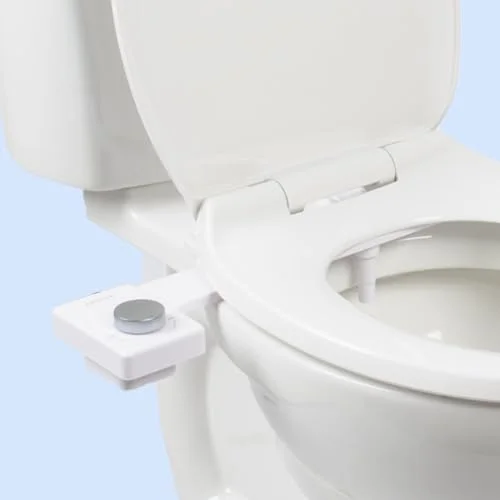
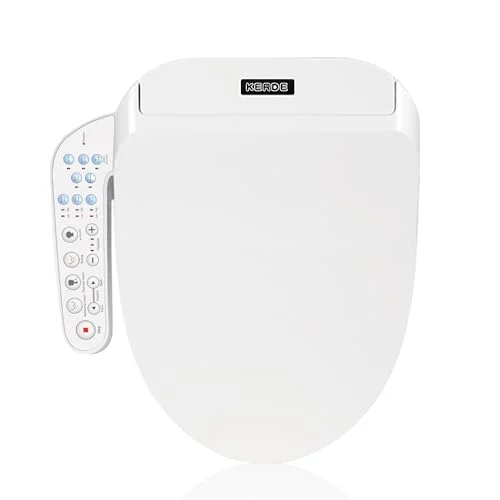
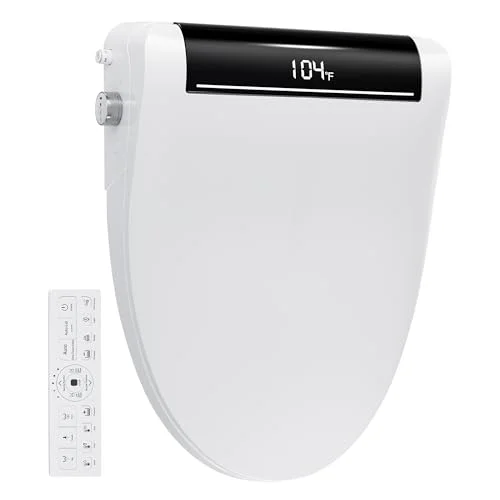
Every bidet product in this category adds some thickness under you, and how much matters more here than it does for the average buyer. A non-electric attachment, like the TUSHY Fresh Ultra-Slim Starter or the Bio Bidet SlimEdge, clamps between your existing seat and the bowl — a low-profile design is built specifically to keep that added layer thin, so the seat you sit on and stand up from stays close to what you're used to. An electric seat, like the KERDE or the ZingPOP, replaces the entire seat rather than clamping under it, and it has to house a pump, a heater and the nozzle mechanism somewhere — which means it's inherently a taller, deeper unit than a standard toilet seat.
Whether that added height helps or hurts depends entirely on the person. A slightly higher seat is often easier to rise from, which is exactly why raised toilet seats are sold as their own accessibility product — for some people, an electric seat's added bulk is a small bonus, not a drawback. For anyone already using a raised seat, a transfer bench, or a specific grab-bar height that was set up to match the current toilet, though, changing the seat height can throw off a routine that took real effort to get right. We don't have precise added-height figures published for the specific products in this guide, so the right move is to measure your current seat height with the lid up, ask the listing or seller for the seat's total height before ordering, and compare that number against whatever else in the bathroom — bar, bench, or step — depends on the current height staying put.
Grip and reach
Remote vs side panel when reach or grip is limited
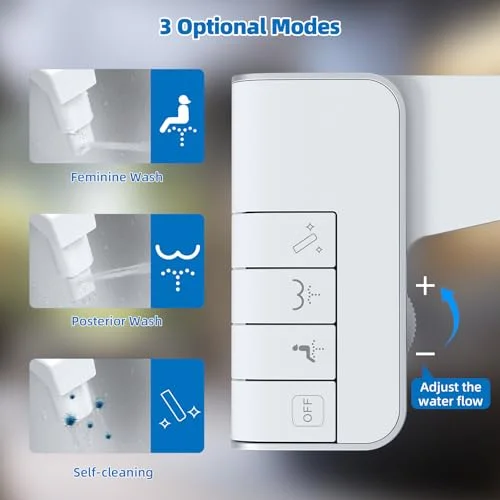
The products in this category use three distinct control styles, and they are not interchangeable if grip or fine motor control is the limiting factor. The simplest is a single dial or lever, the kind used by the non-electric attachments here: the Hibbent and Bio Bidet SlimEdge attachments both use an adjustable-pressure dial mounted beside the seat, and the TUSHY Classic 3.0 works the same way. One motion, one control, positioned where your hand naturally lands — no remote to aim, no menu to navigate, and nothing that needs batteries or pairing.
Electric seats step up in complexity, and the two here handle it differently. The KERDE is built around what its listing calls one-click intelligent operation — a single button drives the wash cycle instead of a sequence of settings, which asks less of fine motor control than a multi-button remote does. The ZingPOP goes further with voice control and an auto-opening lid, which is a genuinely different control model: you speak a command instead of finding and pressing a button at all. That matters for more than convenience — a wireless remote that slides off its wall mount and lands on the floor is a real, if minor, hazard for anyone who then has to bend down to retrieve it, which is precisely the motion a bidet seat is often bought to avoid in the first place. For a wider look at wireless-remote seats generally, our best bidet seats with a remote control guide covers the tradeoffs beyond this specific angle, and our electric vs non-electric comparison covers the outlet and running-cost side of going electric at all.
A genuine comfort feature
Warm-air dryers: what they actually do, and how long they take
Where a bidet seat includes one, an integrated air dryer blows warm air for roughly one to three minutes to replace patting dry with paper or a towel — and for anyone who struggles to reach down and dry off after the wash cycle, that's a second reach eliminated, which is often worth as much as the wash itself. The tradeoffs are real, though: a full cycle takes noticeably longer than wiping, the fan is audible on most models in this category, and the first few uses tend to leave you damp rather than fully dry until you learn the right distance and duration to hold still. None of the six products in this guide have a warm-air dryer confirmed on their published listing, so if that feature matters to you specifically, check the listing's feature list directly before buying — it varies model to model, even within the same brand's lineup. Our heated seats and warm water guide goes deeper on which comfort features across the category are worth paying for.
Around the toilet
Grab-bar and transfer clearance around the tank and lid
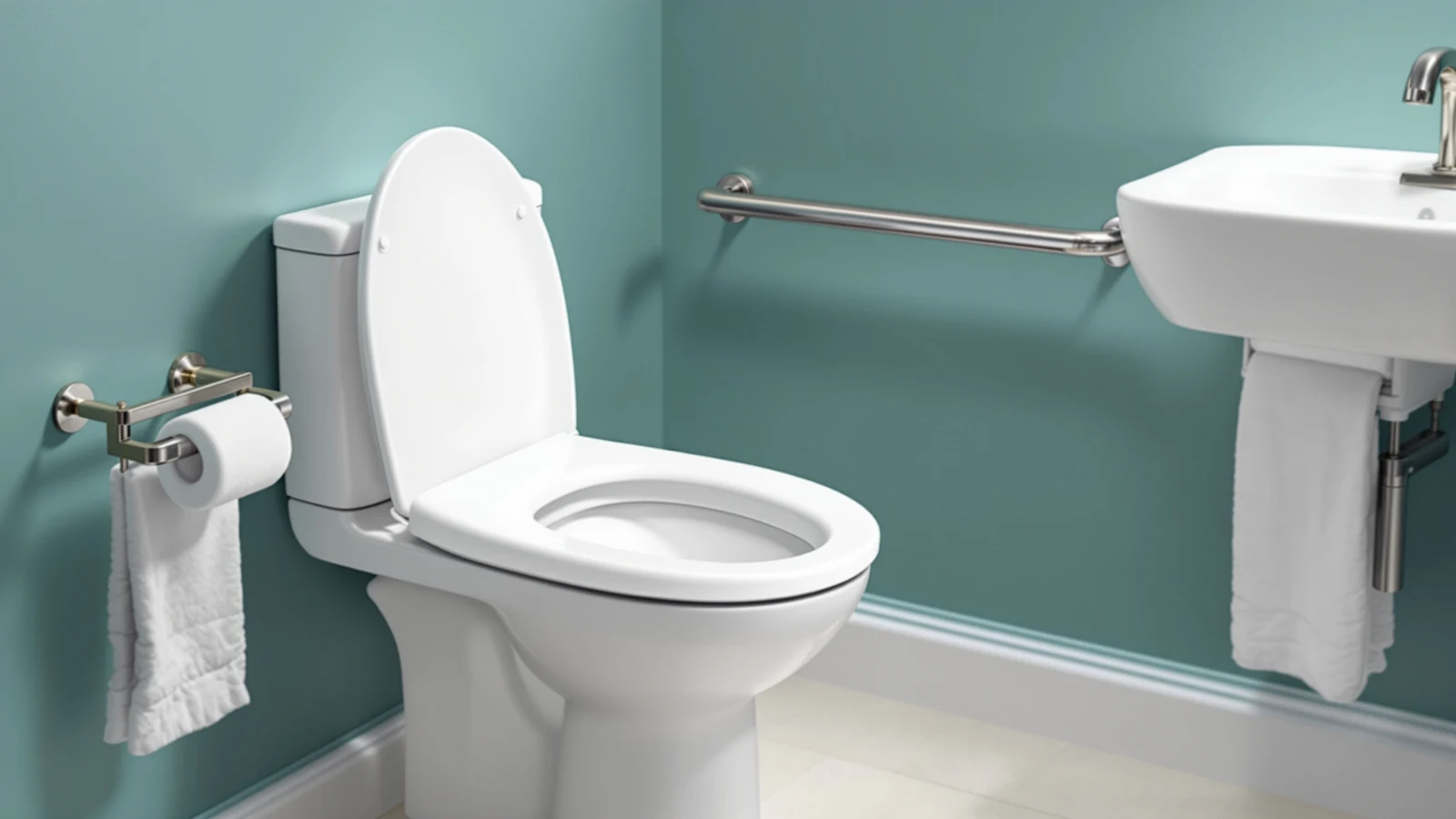
Non-electric attachments generally add very little hardware beside the bowl — just a small valve where the supply line splits, which rarely interferes with anything already mounted nearby. Electric seats are a different story: most carry a side control panel, and some route to a small internal tank, both of which add width or depth right where a grab bar or a transfer bench might already be positioned. Before buying an electric seat specifically, measure the clear space between your existing grab bar and the edge of the bowl, and compare that to the seat's published width where the manufacturer lists one — a seat that's a couple of inches wider than your old one can turn a bar that used to be perfectly placed into one that's now awkwardly close or too far to reach comfortably.
Two features in this lineup change the transfer itself rather than just the fit. An auto-opening lid, like the one on the ZingPOP, removes one physical step — lifting the lid — from a transfer that may already involve managing a bench, a bar, and your own balance at the same time. The fixed armrest on the KERDE can give you something to push against mid-transfer, which some owners will find genuinely useful — but it is not a substitute for a properly installed, code-compliant grab bar, and shouldn't be treated as one. If an outlet near the toilet is the thing standing between you and an electric seat, our do bidet seats need an electrical outlet guide lays out exactly what's required and what your non-electric alternatives look like.
Before you order
Installation help, and what to check with a caregiver first
Every product in this guide is a DIY install — a T-valve on the existing supply line, no plumber required, as our step-by-step installation guide walks through in full. But "DIY" assumes kneeling behind the toilet, gripping a wrench, and holding a seat steady while you bolt it down, none of which is a given for the person who will actually use the finished result. If the installation itself would be a barrier, it's worth having a caregiver, family member, or handyman handle the twenty-to-forty-minute swap rather than the end user, and there are a handful of things worth confirming with whoever is helping before you order anything at all:
- Bowl shape. Round and elongated bowls need different seats, and an ill-fitting seat leaves a gap that's uncomfortable and can rock. Our round vs elongated fit guide shows exactly where to measure.
- Outlet access. Electric seats need a GFCI outlet within cord's reach of the toilet — confirm one exists, or that adding one is realistic, before committing to an electric model.
- Existing equipment clearance. Measure the new seat's height and width against any grab bar, transfer bench, or raised seat already in place.
- Control style against hand strength. A single dial, a one-click button, and a voice command each ask something different of the person using it daily — match the control to the actual limitation, not the feature list.
- Who handles ongoing care. Self-cleaning nozzle cycles reduce upkeep but don't eliminate it; our cleaning and maintenance guide covers what still needs a hand periodically, and it's worth deciding upfront whether that's the end user or a caregiver.
None of this is a substitute for an occupational therapist's assessment if mobility needs are significant or changing — this guide is meant to narrow the shopping list, not replace that conversation. For most households, though, a quick measurement and an honest look at hand strength is enough to pick the right category before you spend anything.
The decision
So which one should you buy?
Start with a non-electric attachment if reach and bending are the main issue, there's no outlet nearby, or you'd rather test the concept for under $50 before spending more. The TUSHY Fresh Ultra-Slim Starter keeps added seat height to a minimum; the Hibbent is the lower-cost way to try the same idea.
Go electric with support features if grip strength, fine motor control, or the physical act of a transfer is the bigger obstacle. The KERDE's armrest and one-click operation, or the ZingPOP's voice control and auto-opening lid, both remove steps from the routine rather than just adding comfort.
Whichever direction you go, measure before you order, confirm the outlet situation if electric is on the table, and if a caregiver or family member will be doing the install or the ongoing cleaning, loop them into the decision before the seat arrives rather than after. For the broader hygiene, savings, and comfort case for bidet seats generally, our full worth-it breakdown is the place to start; for the attachment-vs-full-seat tradeoff specifically, see bidet seat vs bidet attachment.