Picks · 2026
The Best Bidet Seats With a Remote Control
By Ilane TallUpdated August 17, 2026Research-based
Best Bidet Seats is reader-supported. When you buy through our links we may earn a commission, at no extra cost to you. Commissions never change which products we recommend.
A side-panel bidet seat puts every control down at knee height, on the same side every time, in the dark, usually while you're mid-task. A remote-controlled one puts those same controls in your hand, on a wall cradle, or docked on the tank — wherever you decide they should live. That single change is the difference most owners notice first, and it's why remote models occupy the middle and upper end of almost every electric bidet lineup.
It isn't a universal upgrade, though. A remote adds a battery to manage, a piece of plastic that can slide behind the toilet, and — on some models — a genuine price premium over the identical seat with side buttons. This guide covers what a remote actually changes in daily use, which features tend to show up only on remote-controlled models, why a remote matters more than it sounds like for anyone with limited reach or grip strength, and six real remote-controlled seats ordered from cheapest to most expensive, with what each one's remote actually controls.
One honest note before we start: we don't run a fake testing lab, and we never pretend to. Everything here comes from published product listings, live pricing and manufacturer specifications — we compare and research rather than physically try every model ourselves.
The daily difference
Remote vs. side panel vs. app: the real ergonomics of each
All three control styles do the same underlying job — pick a wash mode, adjust pressure and temperature, start and stop the spray — but they put your hand in a completely different place to do it.
A side panel is mounted directly on the seat, usually on the right side at roughly knee height. It never needs batteries beyond the seat's own power, and it can't be misplaced, but you have to reach down and, in most bathrooms, look to find the right button. For someone standing or sitting comfortably with full mobility, that's a minor inconvenience. For anyone with limited reach, a bad back, or a bathroom where the toilet sits close to a wall on the panel side, it's a genuine daily friction point.
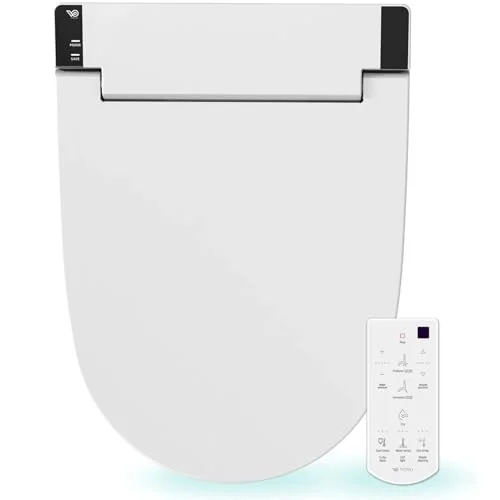
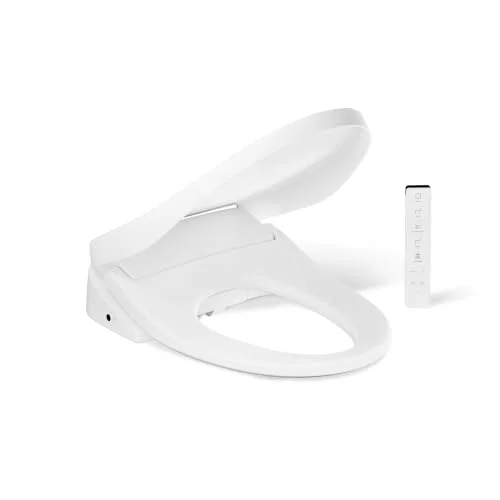
A wireless remote — the subject of this guide — moves those same buttons into a handheld unit, typically mounted on a wall cradle near the toilet or simply held. You get every setting without bending down, and because the remote isn't attached to the seat, you can position it wherever it's easiest to reach: a lower cradle for a wheelchair user, a higher one for anyone who prefers not to bend at all. The trade is that it runs on its own batteries, separate from the seat's power, and it can be set down somewhere other than its cradle.
An app, controlling the seat over Wi-Fi or Bluetooth from a phone, is the least common of the three and isn't a control method used by any of the seats in this guide — none of the six below are app-controlled. Where it does exist on higher-end seats elsewhere in the market, it trades the lost-remote problem for a different one: you need your phone unlocked and the right app open, which is often slower in practice than a physical remote sitting in a cradle at arm's length.
In practice, most owners who switch from a side panel to a remote describe the same adjustment period: a few days of setting the remote down in the wrong spot, then settling into leaving it in the wall cradle every time. After that, the appeal is less about any single feature and more about not having to think about where the buttons are.
Where it lives
Wall cradles, battery life and the remote-goes-missing problem
Every remote-controlled bidet seat in this category ships with a small wall-mount cradle — typically two screws or an adhesive pad — that holds the remote at a fixed spot near the toilet. It's not optional in practice: without it, the remote ends up on the tank lid, on the counter, or eventually on the floor. Mount the cradle at the height and side that suits whoever uses the bathroom most, not wherever the instructions show it by default; there's no rule that says it has to sit at standard side-panel height.
Battery life on these remotes is long by design, because the remote itself does almost nothing between presses — it's sending a low-power signal to a receiver on the seat, not running a heater or a pump. Depending on the model, that typically means somewhere from several months to well over a year on a set of standard AAA batteries before a swap is needed, and the remote usually gives some warning (a dim display or an unresponsive button) before it dies completely rather than failing without notice.
The realistic failure mode isn't a dead battery, though — it's a missing remote. Households with kids, guests, or simply more than one bathroom user report the same pattern: the remote travels. A cradle mounted somewhere visible and consistent solves most of this on its own. If a remote is lost or breaks, most manufacturers and third-party sellers offer replacement remotes for these seats separately, which is worth confirming on the specific listing before you buy — it's a cheaper fix than it sounds like, and far cheaper than assuming you'd need to replace the whole seat.
What you actually gain
Which features only appear on remote-controlled models
A remote isn't purely about comfort — on several of the seats in this guide, it's the only way to reach certain settings at all. A side panel has a limited number of physical buttons in a fixed space; a remote's buttons (or its layered menu, on models with an LED display) can expose more distinct functions in the same footprint.
- Multi-level pressure and position, adjusted without looking. Where a side panel often groups pressure into two or three physical buttons, a remote can offer the same range through a dial or button pad you operate by feel, since you're holding it rather than reaching for it.
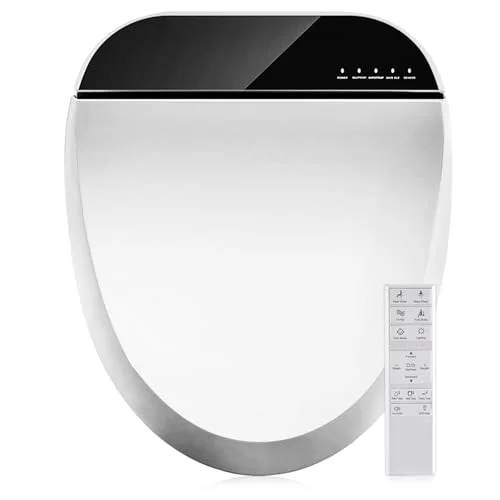
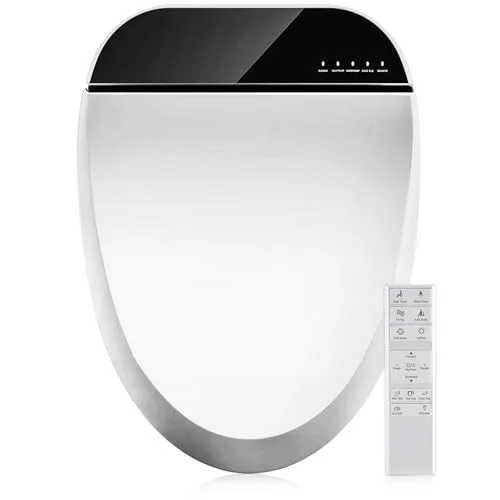
- Oscillating and pulsing wash modes. The XCQQ Elongated (~$169.99) lists oscillating cleansing as part of its remote-driven wash modes, alongside separate rear and feminine settings — the kind of mode-switching that's easiest to manage from a handheld unit rather than a bank of side buttons.
- An on-seat LED display paired with the remote. That same XCQQ model pairs its remote with an LED display on the unit itself, showing which mode and setting is active — useful feedback a plain side panel usually skips.
- A night light. Several remote-controlled seats, including the XCQQ, build in a night light as one of the settings the remote toggles — a small but genuinely useful feature for late-night use without flipping on the bathroom's main light.
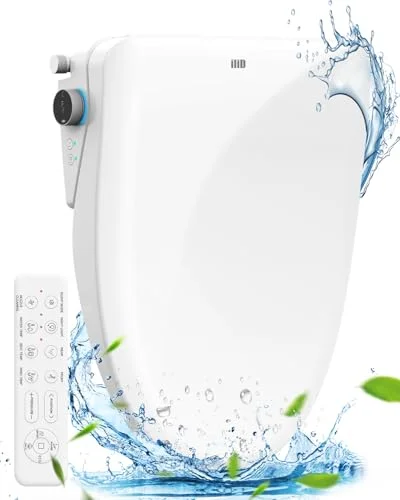
- Independent seat-heat and water-temperature control. Heated-seat models such as the Combier Heated (~$113.04) and the iliD (~$179.98) let you dial in seat warmth and water warmth as two separate settings from the remote, rather than a single combined "on" button.
None of this means a side-panel seat is missing functionality across the board — plenty of side-panel models offer multiple wash modes too. The pattern is narrower and more consistent than that: features that require several sequential adjustments (cycling through oscillation levels, toggling a night light, checking a status display) tend to land on remote models first, because a remote has more room, physically and functionally, to hold them.
Reach and grip
Accessibility: why a remote matters for limited reach or mobility
For anyone with reduced reach, grip strength, or the ability to twist and lean — arthritis, a recent surgery, a wheelchair, or simply an aging joint that doesn't love bending — a side panel bolted to the seat can be a genuine barrier, not just an inconvenience. It's positioned for an average standing or seated reach, on one fixed side, and it doesn't move to accommodate anyone else's needs.
A wireless remote removes that fixed geometry entirely. It can be mounted lower for a seated or wheelchair user, positioned on whichever side is easier to reach, or simply held in the lap rather than reached for at all. Large, clearly separated buttons — which most of these remotes use, since they're not constrained to the seat's side profile — are also easier to operate for anyone with limited fine motor control than a compact panel of closely spaced buttons.
This is a general accessibility observation, not medical guidance — what works best depends on the specific person and bathroom, and anyone shopping for a caregiving situation should confirm cradle height and button spacing against a listing's photos before buying. But as a category-level pattern, remote control is one of the more meaningful accessibility upgrades available in this product category, and it's a reasonable factor to weigh even for buyers without a current mobility concern, since needs can change over the years a bidet seat stays installed.
Before you order
What to check before you buy: mounting, batteries, replacement remotes
A remote-controlled seat installs exactly like any other electric bidet seat — the remote adds nothing to the plumbing side of the job. But it does add three things worth checking on the specific listing before you order, since they vary model to model and none of them are visible from the price alone.
- Bowl fit. Elongated and round bowls are not interchangeable, and a seat built for the wrong shape leaves a visible gap or won't seat correctly at all. Measure your bowl first — our round vs. elongated fit guide shows exactly where to put the tape measure. Where a listing gives an explicit size (the Combier Elongated and the KOHLER PureWash E835 are both specified as elongated here), trust that over the product name alone; where it doesn't, confirm against the listing photos and dimensions rather than guessing.
- Cradle mounting. Most remotes ship with a wall cradle that needs either two small screws or an adhesive strip. Decide where you want it — height and side — before installation day, since it's easier to place once than to relocate after the adhesive has set.
- Battery type and included batteries. Remotes typically run on standard AAA or similar batteries; check whether the listing includes a starter set or expects you to supply your own, so you're not left with a fully installed seat and a remote that won't power on.
- Replacement remote availability. Before buying, it's worth a quick check on the listing or manufacturer site for whether a replacement remote is sold separately. It usually is, and knowing that up front means a lost or broken remote is a small parts order, not a reason to replace the whole seat.
- An outlet nearby. Like any electric seat, these need a grounded outlet within reach of the power cord — independent of the remote, which runs on its own batteries. If your bathroom doesn't have one nearby, our outlet guide covers the options.
Installation itself follows the same steps as any electric seat: shut off the water, remove the old seat, mount the bracket, connect the supply line, and plug in — no plumber required. Our full bidet seat installation guide walks through it step by step, remote or not.
The decision
So which one should you buy?
If you want the cheapest way to try a remote, start with the Combier Elongated — it puts wash, dry and soft-close control in your hand for the price of many side-panel-only seats. If you want the widest set of remote-exclusive features without spending $200, the XCQQ Elongated is the strongest case for a remote on this list, bundling oscillating wash modes, a night light and an LED display into one seat. And if budget isn't the constraint and you'd rather buy the name you already trust for your other bathroom fixtures, the KOHLER PureWash E835 sits at the top of the range. Whichever you choose, mount the cradle somewhere deliberate on day one — that single habit is what determines whether you love the remote or lose it.