Best Bidet Seats
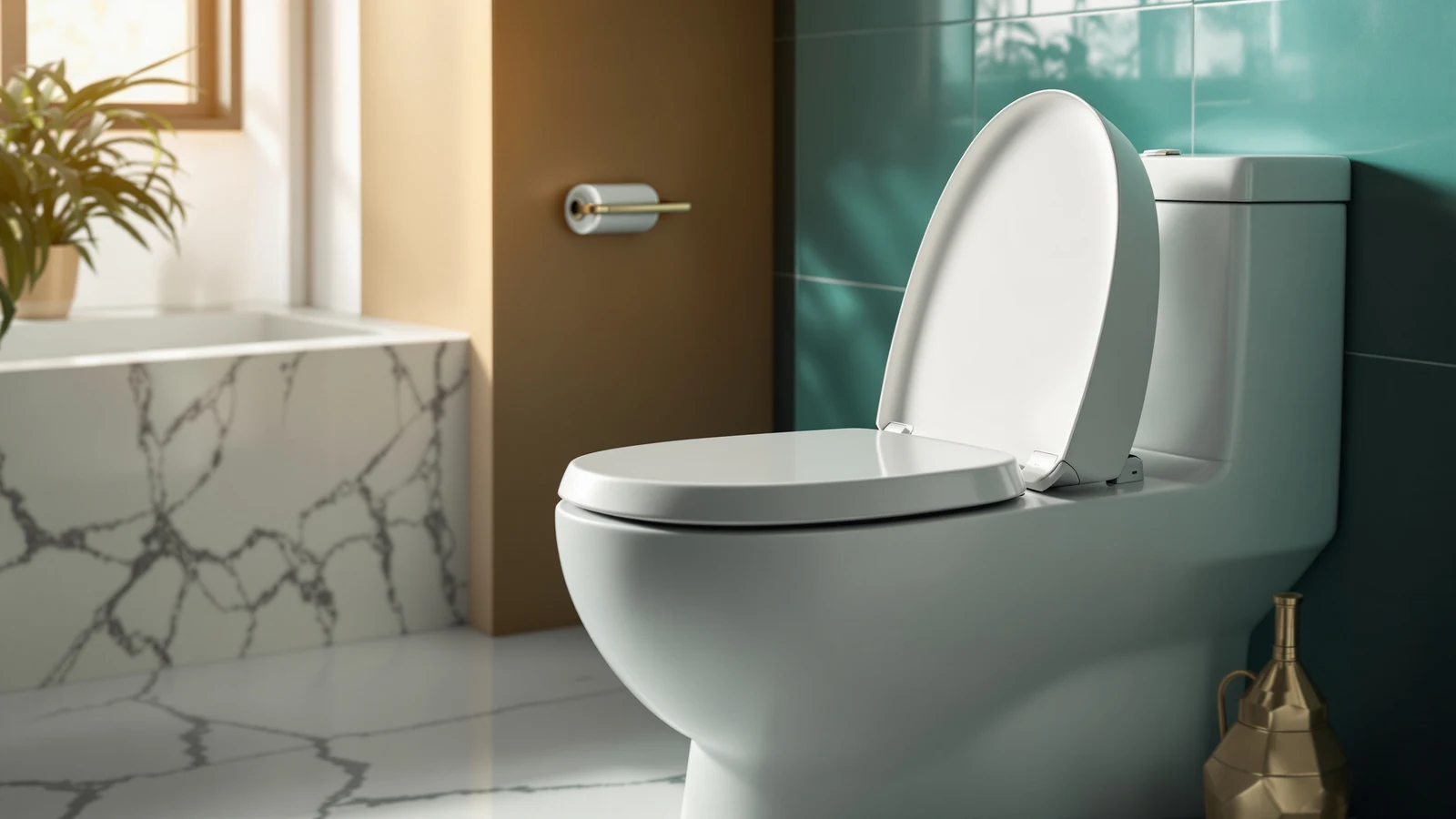
White luxury electric bidet toilet seat with a side control panel in an upscale bathroom
Buying Guide · 2026

The Best Luxury Bidet Seats

Best Bidet Seats is reader-supported. When you buy through our links we may earn a commission, at no extra cost to you. Commissions never change which products we recommend.

Somewhere around $250, the spec sheet for a bidet seat stops changing very much. Warm water, a heated seat, a remote or a side panel, a self-cleaning wand — by that price point most of the category has already checked those boxes. So what does the next $150, or $200, actually buy you? Not a longer feature list. A different set of engineering decisions: how the heater is built, what the valve inside is made of, how the lid is hinged, and whether the company behind it still answers the phone in year six.

This guide is about that upper tier — the seats priced from roughly $270 to $450 — and what separates the ones worth the premium from the ones that just added a nicer box. We compared published specifications, current pricing, and how each manufacturer talks about parts and support. One honest note up front: we don't run a testing lab, and we never pretend to. Everything below comes from what's published on the listing and what the manufacturer states about the product.

The premium, itemized

Where the extra $150 goes, part by part

Below $150, a bidet seat is usually a single-purpose device: a nozzle, a valve, maybe a heated seat pad. Above $250, you're paying for the pieces that turn "a bidet seat" into "an appliance," and they tend to arrive as a bundle rather than one at a time.

The most visible one is control input. A side panel mounted on the seat itself is the cheaper way to give a user adjustable pressure and position — you'll find one on the Kohler PureWash E590 in our picks below. A wireless remote is the step up from that: no reaching down beside the bowl, no leaning over to press a button. It shows up on the VOVO models here and, at the top of this list, on a Kohler priced specifically around that feature.

The second place the money goes is drying and finishing touches — a warm-air dryer, an LED nightlight in the bowl, and on some models a deodorizer that pulls odor through a small carbon filter before it leaves the bowl. None of these are load-bearing features; none of them are why anyone buys a bidet seat in the first place. But they're the difference between a seat that does the job and one that feels considered, and once you've used a warm-air dryer for a week, going back to reaching for toilet paper feels like a downgrade. If you're deciding whether that particular feature is worth paying for, our dedicated look at warm-air dryers walks through the trade-off in more detail.

The third, and least visible, is the lid and the wand mechanism — a quiet-close lid that lowers itself instead of slamming, and a self-cleaning wand that rinses itself before and after each use rather than leaving a plastic nozzle exposed between washes. These aren't glamorous line items on a spec sheet, but they're mechanical parts that get used dozens of times a day for years, and building them to not squeak, stick or slam is exactly the kind of unglamorous engineering that costs more to do well.

The single biggest cost driver

Instantaneous heating, and why it costs what it costs

If one component explains more of the price difference in this category than any other, it's the water heater — specifically, whether it's a reservoir or an instantaneous (tankless) design. A reservoir heater keeps a small tank of water warm at all times; it's the cheaper design to build, and it's why a lot of budget electric seats can hit a low price point at all. The trade-off is that the tank holds a limited amount of warm water — typically under a minute's worth — so a longer wash, or a second person using it right after the first, runs the water lukewarm and then cold. We cover exactly how long that window tends to last, and which situations drain it fastest, in how long the warm water lasts on a bidet seat.

An instantaneous heater heats water as it flows, on demand, so it doesn't run out the way a tank does. Building one costs more: it needs a heating element powerful enough to raise the water's temperature in the fraction of a second it has contact with it, tighter tolerances so it doesn't scald or run cold at the edges of its flow range, and more robust internal wiring to handle the higher, brief current draw. That's real engineering cost, not marketing — and it's a meaningful part of why the top of this category costs what it does rather than settling at a flat $150 for every model.

We want to be precise here rather than generous: none of the five listings in our picks below specify which heating architecture they use. That's a real gap in the published information, not a reason to guess. If continuous warm water through a long wash — or for a household of two or more people using the seat back-to-back — is the feature you care about most, read the current listing's specifications closely, or contact the seller, before you buy. Don't take a higher price as a stand-in for a spec that isn't stated.

What to actually look for

Build quality signals: valves, hinges, ceramic

A bidet seat is a small plumbing fixture wearing an appliance's clothing, and the parts that determine how long it lasts are mostly the parts you never see. Three are worth learning to look for on any listing, luxury tier or not.

The valve. Every bidet seat has a small valve core that opens and closes the water path to the nozzle, dozens of times a day, for years. Cheaper valves use plastic components that can wear, stick or crack — especially once mineral scale from hard water starts building up inside them, which is the same failure mode we detail in what hard water does to a bidet seat. Manufacturers that build for the higher end of this category tend to use metal or ceramic valve components specifically because they hold up better to that kind of repeated mechanical and mineral stress. Not every listing states its valve material, so where it isn't specified, treat it as an open question rather than an assumption in either direction.

The hinge. A quiet-close lid needs a hinge with a damping mechanism inside it — essentially a small, sealed shock absorber that slows the lid's fall instead of letting gravity do it. That mechanism is what fails first on a badly made quiet-close lid: the damping wears out and the lid starts slamming again, or worse, drops unevenly. It's a small, cheap-looking part that's disproportionately expensive to get right and keep right for years of daily use.

The wand and self-cleaning cycle. A self-cleaning wand rinses itself with a short burst of water immediately before and after each use, which matters because the nozzle is the one part of the seat that has to stay genuinely clean between washes. It's also one of the more failure-prone moving parts — it extends and retracts on a small motor and track — so a well-engineered version of it is a real quality signal, not a checkbox. We go into what "self-cleaning" actually does and doesn't guarantee in self-cleaning nozzles and hygiene features, explained.

None of this is stamped on the outside of the box, which is exactly why brand track record ends up mattering in this tier: a company that has built plumbing fixtures for decades has institutional experience with valves and water pressure that a seat-only startup hasn't had time to accumulate yet.
The part nobody asks about until it matters

Warranty and parts availability

Every electric bidet seat is, eventually, going to need a part: a remote that stops pairing, a wand seal that wears out, a heating element that weakens after years of daily cycles. What separates a $30 repair from a $300 replacement isn't the seat's original price — it's whether the company that made it still sells parts and answers support calls for it five or six years later.

This is where an established plumbing manufacturer has a structural advantage over a seat-only import brand. Kohler, for instance, has been building bathroom fixtures for well over a century and maintains customer support and parts channels as an ongoing part of its business — not something it has to reinvent for a single product line. That doesn't make every Kohler part cheap or every repair painless, but it does mean there's a company, and a phone number, still standing behind the product a warranty period after purchase.

Before buying anything in this tier, it's worth checking three things directly on the current listing or manufacturer site, because none of them are consistent across the category and none are things we'll guess at here: the length of the warranty (electric seats in this price range commonly range from one to a few years, but terms vary by model and change over time), whether the warranty covers parts, labor, or both, and whether the manufacturer sells replacement parts — wands, remotes, seals — directly, rather than requiring a full unit swap for a single failed component. A seat that costs $150 more but comes from a company with a real parts channel can be the cheaper seat over a five-year ownership window, even though it never looks that way on the price tag.

The picks

Five luxury-tier seats, and what each one is actually specified to do

Ordered by price. Every feature named below comes directly from the current listing — where a listing doesn't state a spec (heating type, warranty length, valve material), we say so rather than guess. All five are the elongated bowl shape; see our guide to elongated-toilet bidet seats if you need to double-check your own bowl shape before ordering.

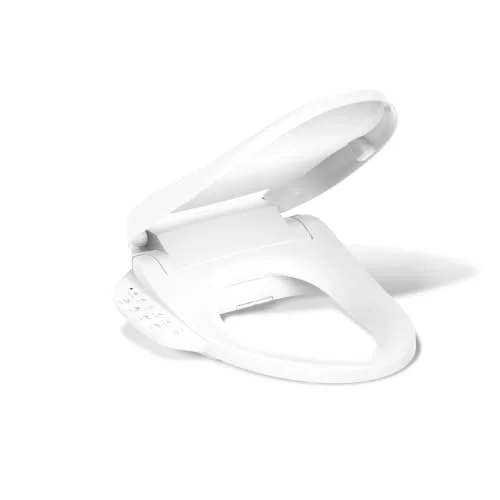
Kohler PureWash E580 elongated bidet toilet seat in white

Kohler PureWash E580

The entry point to the luxury tier

At $269.97, this is the least expensive seat that still clears the $250 line where this guide starts. Its listing centers on a quiet-close lid that prevents slamming, a self-cleaning wand, and adjustable water pressure with multiple cleansing options — the fundamentals done with Kohler's plumbing background behind them, without the side panel or remote extras of the models above it.

$269.97
ElongatedCheck price →
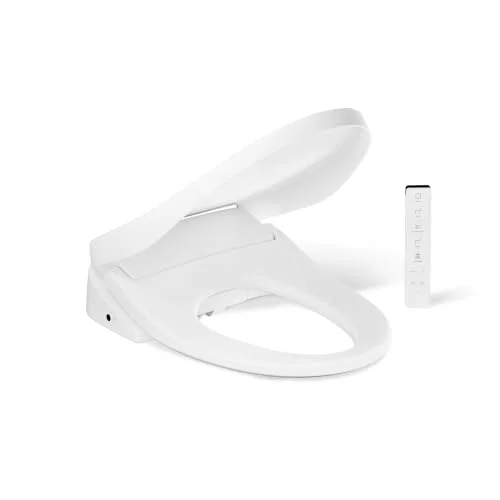
VOVO VB-6000SE elongated bidet toilet seat with warm water and heated seat

VOVO VB-6000SE

Warm water and a heated seat, made in Korea

At $299.00, the VB-6000SE's listing specifies warm water, a heated seat, an LED light, a warm-air dryer and a stainless steel nozzle — the fuller comfort bundle that starts to appear once you're spending north of $270. VOVO builds exclusively bidet seats and manufactures this one in Korea, a market where the category has been mainstream for decades.

$299.00
ElongatedCheck price →
Kohler PureWash E590 elongated heated bidet toilet seat with side panel

Kohler PureWash E590

Side-panel control and the fullest published feature list here

At $359.13, the E590's listing is the most fully specified of the five: heated, warm water, a warm-air dryer, a quiet-close lid, a self-cleaning wand, adjustable water pressure, a nightlight, and control from a side panel rather than a remote. Kohler also lists it as an easy installation. Whether the side panel or a wireless remote suits you better is mostly a matter of preference — a panel is fixed and can't be misplaced; a remote means not reaching down beside the bowl.

$359.13
Elongated · side panelCheck price →
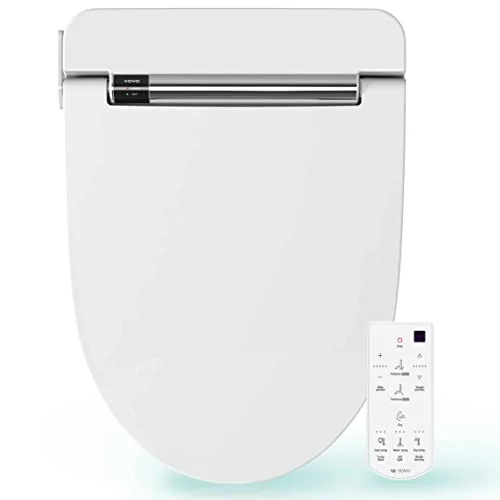
VOVO VB-4000SE elongated bidet toilet seat with deodorizer

VOVO VB-4000SE

Adds a deodorizer to the VOVO comfort bundle

At $399.00, the VB-4000SE carries the same core bundle as its sibling above — warm water, heated seat, LED light, warm-air dryer, stainless steel nozzle, made in Korea — plus a deodorizer, which is the one feature that separates it on the listing. If odor control specifically is what's pushing your budget upward, that's the model where VOVO has put the money.

$399.00
Elongated · deodorizerCheck price →
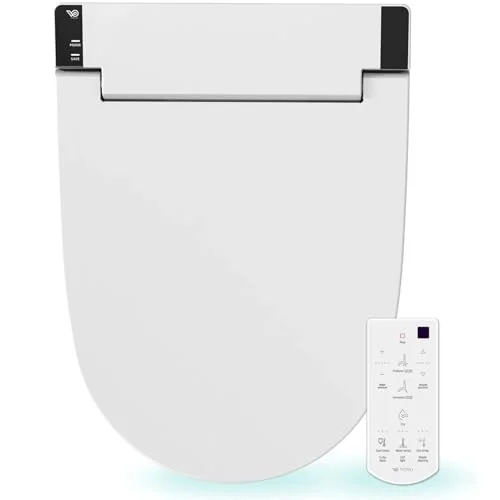
Kohler PureWash E835 elongated electric bidet toilet seat with remote, white

Kohler PureWash E835

The most expensive seat here, and the most narrowly specified

At $399.00, the E835 is priced $180 above the E580 from the same manufacturer, but its own listing names fewer features up front than the cheaper models here: elongated fit, electric operation, and a wireless remote. That's not evidence it does less — Kohler may simply be leading with the remote rather than itemizing every function on the title — but it does mean we won't credit it with warm water, a heated seat or a dryer unless the listing states them. Read the current listing closely before assuming the higher price implies a longer feature list.

$399.00
Elongated · remoteCheck price →
The honest limit

Where more money stops buying more

Lay these five listings side by side and a pattern shows up that's easy to miss when you're comparing one seat at a time: the feature count doesn't rise in a straight line with the price. The $359.13 Kohler PureWash E590 lists more named features than the $399.00 Kohler PureWash E835 that costs $90 more. That's not proof the more expensive seat is worse — it may simply be specified differently, built around a different set of priorities like the remote, or documented less thoroughly on that particular listing. But it is proof that price, on its own, isn't a reliable stand-in for capability once you're above roughly $270. Past that point, you're often paying for one or two specific things — a remote instead of a panel, a deodorizer, a brand's parts and support infrastructure — rather than a longer list of buttons.

That's the practical ceiling worth knowing before you shop: the gap between a $270 seat and a $450 seat in this category is rarely a gap in what the seat can physically do for you day to day. It's a gap in specific comfort features, in how the company backs the product over time, and in build details — valves, hinges, wand mechanisms — that don't show up on a spec sheet at all. If your budget tops out around $300, you are very likely getting the comfort features that matter most to daily use. Spending up to $450 is a bet on refinement and support, not on a fundamentally different product. And running cost doesn't scale with sticker price either — our breakdown of what a bidet seat actually costs to run shows that the electricity and water behind any of these five seats amounts to a few dollars a month, regardless of which one you buy.

The practical advice, then, is to buy for the specific feature you actually want — a remote, a deodorizer, a side panel you can't misplace — rather than assuming the top of the price range is automatically the top of the category. In a market where the spec sheet stops growing past $250, the best luxury bidet seat for you is whichever one names the exact feature you're paying extra for.

FAQ

Luxury bidet seats: common questions

Is a $450 bidet seat really better than a $270 one?

Not in a straight line. Above roughly $250–$270, the core comfort features — warm water, a heated seat, self-cleaning — are already common across the category. What the extra money tends to buy is one or two specific additions, like a wireless remote instead of a side panel or a deodorizer, plus the manufacturer's track record on parts and support. Buy for the specific feature you want, not for the highest number on the price tag.

What's the single biggest cost driver in a luxury bidet seat?

The water heater. A reservoir (tank) heater is cheaper to build but holds a limited amount of warm water before it runs lukewarm; an instantaneous heater warms water on demand and doesn't run out, but costs more to engineer and build. Not every listing states which type it uses, so check the current listing's specifications if this is your top priority.

Does a higher price mean better build quality, like ceramic valves?

Often, but not automatically, and not every listing specifies its internal materials. The parts that matter most for longevity — the valve core, the lid's damping hinge, the wand's self-cleaning mechanism — are rarely itemized on a product page. A manufacturer with a long history building plumbing fixtures has more institutional experience with those parts, which is a reasonable proxy when the spec sheet itself is silent.

Why does warranty and parts availability matter more at this price?

Because a $270–$450 seat is expensive enough that replacing the whole unit over a single failed wand or remote is a real loss. A manufacturer that still sells replacement parts and answers support calls years after purchase can turn what would be a full replacement into a small repair. Check the current warranty length and what it covers directly on the listing or manufacturer site before buying, since terms vary and change over time.

Keep reading

Go deeper before you buy