Self-Cleaning Nozzles and Bidet Hygiene Features, Explained
By Ilane TallUpdated August 23, 2026Research-based
Best Bidet Seats is reader-supported. When you buy through our links we may earn a commission, at no extra cost to you. Commissions never change which products we recommend.
Open any electric bidet seat listing and the hygiene claims start stacking up fast: self-cleaning nozzle, stainless steel wand, antimicrobial materials, sometimes UV, sometimes "electrolyzed water." Read enough of these and you start to wonder which of these words describe something the seat actually does, and which are there because they sound clinical and reassuring next to a product you're about to install inches from your body.
The honest answer is: some of it is real engineering with a measurable effect, and some of it is marketing language stretched well past what it can support. Both categories can be true about the same product at the same time — a seat can have a genuinely useful pre- and post-use rinse cycle and an antimicrobial-plastic claim that does almost nothing for the surfaces you actually touch. This guide separates the two, feature by feature, using what manufacturers actually state in their own listings rather than the vaguer language that ends up in ad copy.
One honest note up front: we don't run a testing lab and we haven't swabbed these nozzles under a microscope. Nobody selling you a bidet seat has published that data either, as far as we've found. What follows is a comparison of published specifications, manufacturer claims, and what's publicly known about how each mechanism and material actually behaves — not a lab verdict, and we say so plainly wherever the evidence runs out.
The short answer
What's real, and what's mostly a marketing word
Does something measurable
Automatic pre/post rinse, and the nozzle material
A nozzle that rinses itself before and after every use, and retracts out of the bowl environment between uses, is a mechanical behavior you can verify by watching it happen. Stainless steel over plastic is a real, checkable material difference in how the wand resists staining, scratching, and bacterial buildup over years of use.
Mostly a marketing word
"Sterilizes," "antimicrobial," unexplained UV or electrolysis
A brief rinse is not sterilization, and a listing that says "antimicrobial" or "UV self-cleaning" without stating an exposure time, a standard it meets, or what the process actually kills is asking you to take the claim on faith. Treat words like these as a feature to research, not a fact to bank on.
The mechanics
What "self-cleaning" actually means in practice
Strip away the marketing and a self-cleaning nozzle is almost always the same basic idea: the wand runs a short burst of water over itself immediately before it extends to wash you, and another burst immediately after it retracts. The bidet water pressure and nozzle guide covers how that same water path handles pressure and spray pattern; this is the hygiene half of the same plumbing.
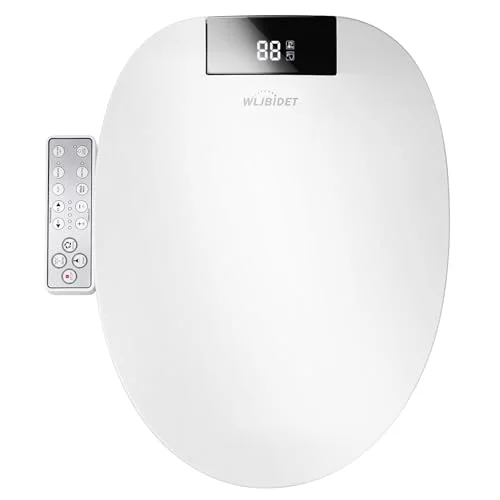
The WLJBIDET O7L-1V is a clean example of how manufacturers describe this in their own words: its listing states the self-cleaning nozzle "activates automatically before and after each use," which is exactly the pre-rinse-then-post-rinse pattern the category is built around. It's a mechanical step, not a chemical one — the nozzle isn't being disinfected, it's being rinsed with the same water supply that feeds the wash itself.
The third piece, retraction, is a design detail rather than a chemical one. Between uses, the nozzle withdraws into a housing under the seat rather than sitting exposed inside the bowl. That matters because it limits how much time the nozzle spends anywhere near the bowl environment when it isn't actively spraying — a simple positional choice that reduces exposure, independent of whatever rinse cycle runs alongside it.
Put the three together — pre-rinse, post-rinse, retract — and you get a nozzle that starts each use relatively clean and doesn't sit exposed between uses. That's a genuinely useful baseline. It is not the same claim as "sanitized" or "sterilized," and reputable listings generally don't use those words for a plain water rinse, for good reason: a few seconds of unheated water flow removes residue, it doesn't kill pathogens.
What it's made of
Stainless steel vs. plastic: why the nozzle material matters
Four of the five bidet seats we cover in this guide advertise a stainless steel nozzle; one doesn't state the material at all — worth noticing, not assuming.
01
Surface porosity
Polished stainless steel is far less porous than injection-molded plastic. Fewer microscopic pits and seams means less surface area for residue and biofilm to cling to between rinse cycles.
02
Scratch resistance
Plastic nozzles scuff and scratch with routine contact and cleaning wipes; every scratch is a new pit that a plain water rinse is less able to flush clean. Steel holds its smooth finish far longer.
03
Staining and discoloration
Hard water and mineral buildup discolor plastic visibly over months; steel resists staining and is easier to see clean or dirty at a glance, which matters when the whole point is trusting what you can't fully inspect.
04
What the listings actually say
Combier, IYTATA, KERDE and the iliD seat all describe a stainless steel nozzle in their own feature text. The WLJBIDET O7L-1V's listing doesn't specify a material — if that distinction matters to you, confirm it on the current listing before buying.
The label science
UV and electrolyzed-water claims: what manufacturers state, and where the claim stops
Beyond a plain water rinse, some electric bidet seats in the broader market advertise more elaborate wand-cleaning steps — a UV light cycle, or water that's been electrolyzed (sometimes marketed as "ionized" or "EWATER") into a mildly acidic or alkaline solution believed to have some antimicrobial effect. Neither of the five seats in this comparison advertises either feature, but they show up often enough in the category that they're worth understanding before you shop further afield.
Here's the honest limit of both claims. UV light can reduce microbial load on a surface it directly illuminates, but the effect depends entirely on wavelength, intensity, and — critically — exposure time, none of which most consumer listings publish. A UV LED that runs for a fraction of a second as a wand passes by is not doing the same work as a UV sterilization unit designed and tested to a published standard. Electrolyzed water claims have a similar shape: the underlying chemistry is real and used in some commercial sanitizing contexts, but a consumer bidet seat's implementation, concentration, and contact time are almost never disclosed, which makes the practical, at-home effect impossible to verify from a listing alone.
None of that means the features are fake. It means they're unverified from where we sit, and a manufacturer that wants your trust on this specific point should publish the numbers — exposure time, standard met, third-party test — rather than the word alone. Until a listing does that, our advice is to treat "UV self-cleaning" and "electrolyzed water" as a mechanical bonus on top of the base rinse cycle, not as a reason by itself to pay a premium.
The coating question
Antimicrobial plastic is a coating, not a substitute for cleaning
What the additive actually does
Slows growth on the plastic itself
An antimicrobial additive is typically built into the plastic resin (often a silver-ion compound) so it's present for the material's lifetime rather than a surface spray that wears off. Its job is narrow: it inhibits the growth of bacteria and mold on that specific plastic part, mainly limiting odor-causing growth and material degradation over years of use.
What it doesn't do
Rinse away anything already on the surface
An antimicrobial coating doesn't clean. It doesn't remove residue, mineral deposits, or waste that's already there — it only makes the plastic a slightly less hospitable place for new growth to establish. A seat with antimicrobial plastic still needs the same weekly wipe-down as one without it; the additive is a slow, passive property, not an active cleaning step.
None of the five seats we cover here list an antimicrobial-plastic claim in their published feature text, so we're not attributing it to any of them — this section exists because the claim is common enough elsewhere in the category that it's worth knowing what it means before you see it on a listing.
What actually helps
The features that actually reduce your cleaning workload
Set aside the words that sound clinical and look instead at what changes the physical amount of cleaning you do. Three things on this list genuinely move the needle:
Automatic pre/post rinse. Every wash starts and ends with the nozzle rinsing itself, which means you're not relying on remembering to clean it manually after each use — the seats from Combier, IYTATA, KERDE, iliD and WLJBIDET all include this as standard.
Warm-air drying. A built-in dryer, offered on all five seats here, cuts toilet paper use — less paper going into the bowl means fewer clogs and less debris around the seat and hinge area to wipe up later.
Oscillating or moving spray patterns. The IYTATA and KERDE seats both describe an oscillating or front-to-back moving wash. A spray that covers more area per use tends to leave less for you to deal with afterward compared with a single fixed stream.
A guard or housing over the retracted nozzle. Keeping the nozzle tucked out of the main bowl area between uses is a simple physical barrier against splash-back and residue reaching it in the first place.
None of these replace cleaning. What they do is reduce how often the nozzle itself needs your direct attention, which is a meaningfully different — and more honest — claim than "self-sanitizing."
At a glance
The hygiene features on five electric bidet seats
What each manufacturer's own listing states about the nozzle. Prices move on Amazon — confirm the live price before buying.
Three ways to buy on hygiene features specifically
Combier Electric Bidet Toilet Seat
Lowest price with a stated stainless nozzle
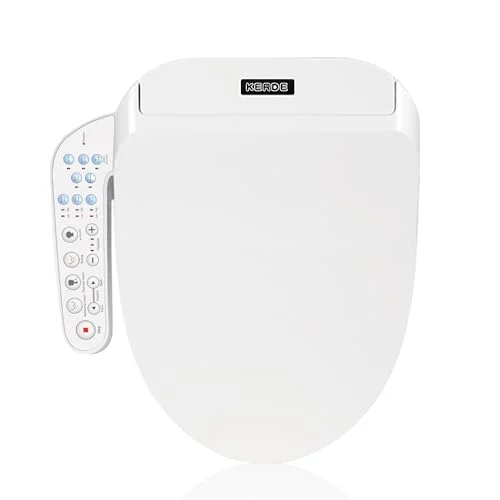
Combier's listing specifically calls out stainless steel self-cleaning nozzles with dual front and back wash, at the lowest price of the five here. It's elongated, sized 15" x 20" per the listing — measure your bowl before ordering, as our round bowl bidet seats guide explains, elongated-specific seats don't fit round bowls.
Oscillating spray, so the wand covers more and sits still less
Its listing pairs a stainless steel, self-cleaning nozzle with an oscillating spray function — the wand moves through the wash rather than holding one fixed position, which is a small but real difference in how thoroughly a single pass cleans. It also adds instant, temperature-controlled warm water and a warm-air dryer.
The most explicit pre/post-rinse language of the five
Its listing spells out the mechanism plainly — the self-cleaning nozzle "activates automatically before and after each use" — which is the clearest manufacturer statement of the pre-rinse/post-rinse pattern this whole guide is built around. Elongated fit per the listing; nozzle material isn't specified, so don't assume steel here without checking the current listing yourself.
Every hygiene feature in this article operates on the nozzle. None of them touch the seat, the lid, the hinge area, the control panel, or the outside of the bowl — the surfaces you and everyone else in the household actually put hands on. Those still need the same weekly attention any bathroom fixture needs: a wipe-down with a non-abrasive cleaner on the seat and lid, attention to the hinge gap where residue and hair collect on any seat, and a cloth (not a scouring pad, which will scratch even stainless steel) over the nozzle housing itself. Our how to clean and maintain a bidet seat guide walks through the specific steps and the cleaners to avoid, including which chemicals can degrade seals and gaskets over time.
It's also worth running the manual self-clean cycle most electric seats include as a button or remote function — separate from the automatic pre/post rinse — every week or two, particularly if the household is large or anyone is prone to UTIs, where nozzle hygiene matters more than average. If you ever notice reduced pressure or an odd spray pattern, that's usually mineral buildup or a partial clog rather than a hygiene failure on its own, and it's covered alongside the other common fixes in our installation problems and fixes guide.
The bigger picture: a self-cleaning nozzle, stainless steel construction, and a dryer that cuts down on paper are all genuine reductions in how much manual cleaning a bidet seat demands compared with, say, a standard toilet with no bidet function at all. But "reduces" isn't "eliminates." Budget five minutes a week for the seat itself, same as you would for any other bathroom fixture that gets daily use — and if you're weighing the electricity behind the warm water and heated seat that make these features possible, our what does a bidet seat cost to run guide has the honest numbers.
FAQ
Self-cleaning nozzles: common questions
Does a self-cleaning nozzle mean I never have to clean the seat?
No. A self-cleaning nozzle rinses the wand itself before and after each use, but it doesn't touch the seat, lid, hinge area or control panel — those still need a weekly wipe-down like any bathroom fixture. Think of it as reducing how often the nozzle specifically needs your attention, not eliminating cleaning altogether.
Is a stainless steel nozzle really better than plastic?
Mechanically, yes. Stainless steel is less porous, more scratch-resistant, and resists staining better than injection-molded plastic, which means less surface area for residue to cling to over years of use. Four of the five seats in this comparison — Combier, IYTATA, KERDE and the iliD seat — state a stainless steel nozzle in their own listings; the WLJBIDET O7L-1V's listing doesn't specify the material.
What does a "UV self-cleaning" or "electrolyzed water" claim actually sterilize?
It depends entirely on exposure time, intensity, and concentration — details most consumer bidet-seat listings don't publish. The underlying chemistry and physics can have a real antimicrobial effect in controlled, disclosed conditions, but an unverified claim on a product listing isn't the same as a published, tested standard. None of the five seats in this guide make either claim.
Do antimicrobial-coated nozzles need less cleaning?
Not meaningfully. An antimicrobial additive slows the growth of bacteria and mold on the plastic itself over the material's lifetime, but it doesn't rinse away or remove anything already on the surface. A seat with antimicrobial plastic still needs the same routine cleaning as one without it.