The Best Bidet Attachments (No Electricity Needed)
By Ilane TallUpdated September 3, 2026Research-based
Best Bidet Seats is reader-supported. When you buy through our links we may earn a commission, at no extra cost to you. Commissions never change which products we recommend.
Not every bathroom has an outlet within reach of the toilet, and not everyone wants one there even if it did. That's the entire reason non-electric bidet attachments exist: no heater, no remote, no circuit board, and nothing to plug in. You unbolt your existing seat, sandwich a thin attachment plate under it, and you have a working bidet in under half an hour — for a fraction of what an electric seat costs.
The catch, and it's a real one, is temperature. A non-electric attachment sprays whatever comes out of your cold supply line, full stop, with one narrow exception we'll get to. Everything else about the category — how the nozzles work, which parts wear out first, how hard the install actually is, and which of the five real, current attachments we compared are worth your money — is what this guide covers. We compared published specs, listed prices and the details manufacturers put on their own product pages; our full electric vs. non-electric comparison goes deeper on the two categories side by side if you're still deciding which aisle you belong in.
One honest note before we start: we don't run a fake testing lab, and we never pretend to. We don't own every attachment on this page, and we're not going to invent a story about a bathroom that doesn't exist. What follows is built from manufacturer specifications, current Amazon pricing, and the mechanics of how these things are actually built — with every claim tied to a real listing, not a guess.
The short answer
If you just want the pick
Buy this one
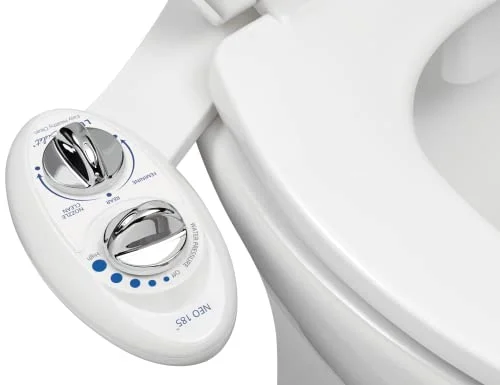
LUXE Bidet NEO 185
A dual-nozzle attachment — a stronger rear wash and a separate, softer front wash — behind a guard gate, with metal-ceramic valve cores and braided steel hoses in place of the plastic most budget units use. It's $49.99 and installs under your existing seat in about twenty minutes.
Unless you want warm water
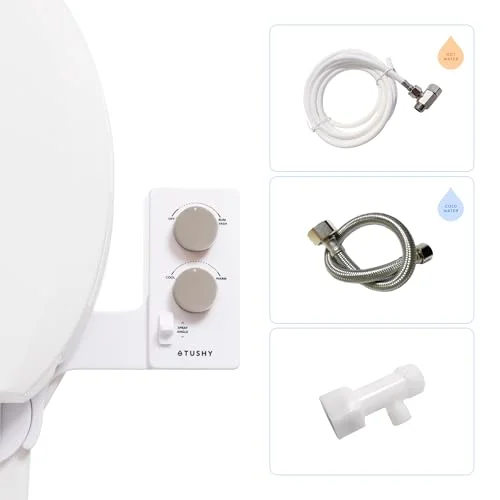
TUSHY Spa 3.0
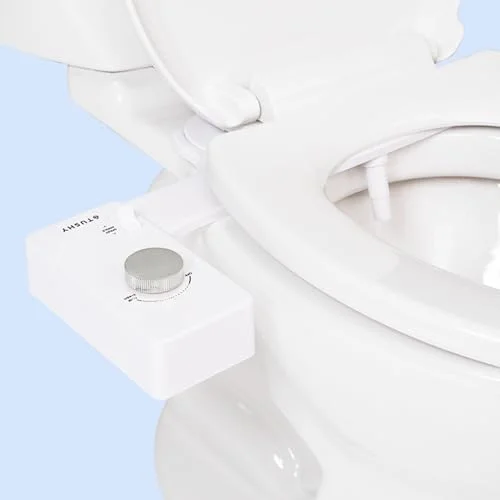
The one attachment on this page that isn't stuck with cold tap water. It runs a second hose to your sink's hot supply and mixes temperature at a dial — genuinely warm, with no outlet and nothing electrical. It's $149.00 and has to sit near a sink to work.
The mechanics
What an attachment is, and why it needs no power
Strip a non-electric bidet attachment down to its parts and there isn't much there: a thin plate that sits between your toilet bowl and your existing seat, a small valve that taps into the water line already feeding your toilet tank, a length of hose, and a nozzle that extends when you turn a dial or press a lever. That's the whole mechanism. There's no pump, because your home's own water pressure does the work of pushing water through the nozzle. There's no heater, because nothing here warms the water — it arrives exactly as cold or as mild as your cold supply line runs. And there's no circuit board, remote or battery, because nothing in the system needs electricity to operate.
That absence is precisely why these things are cheap. The Hibbent Bidet Attachment runs $38.99 — you're paying for a well-machined valve and a couple of nozzles, not a small appliance. Compare that to an electric seat, where the water heater, seat heater, pump and control electronics are most of what you're paying for, and the gap in price starts to make complete sense rather than feeling like a trick. If you want the full breakdown of what that price gap buys you on the electric side, our electric vs. non-electric guide lays it out feature by feature, and this piece on the outlet question covers exactly what electric models require that attachments simply don't.
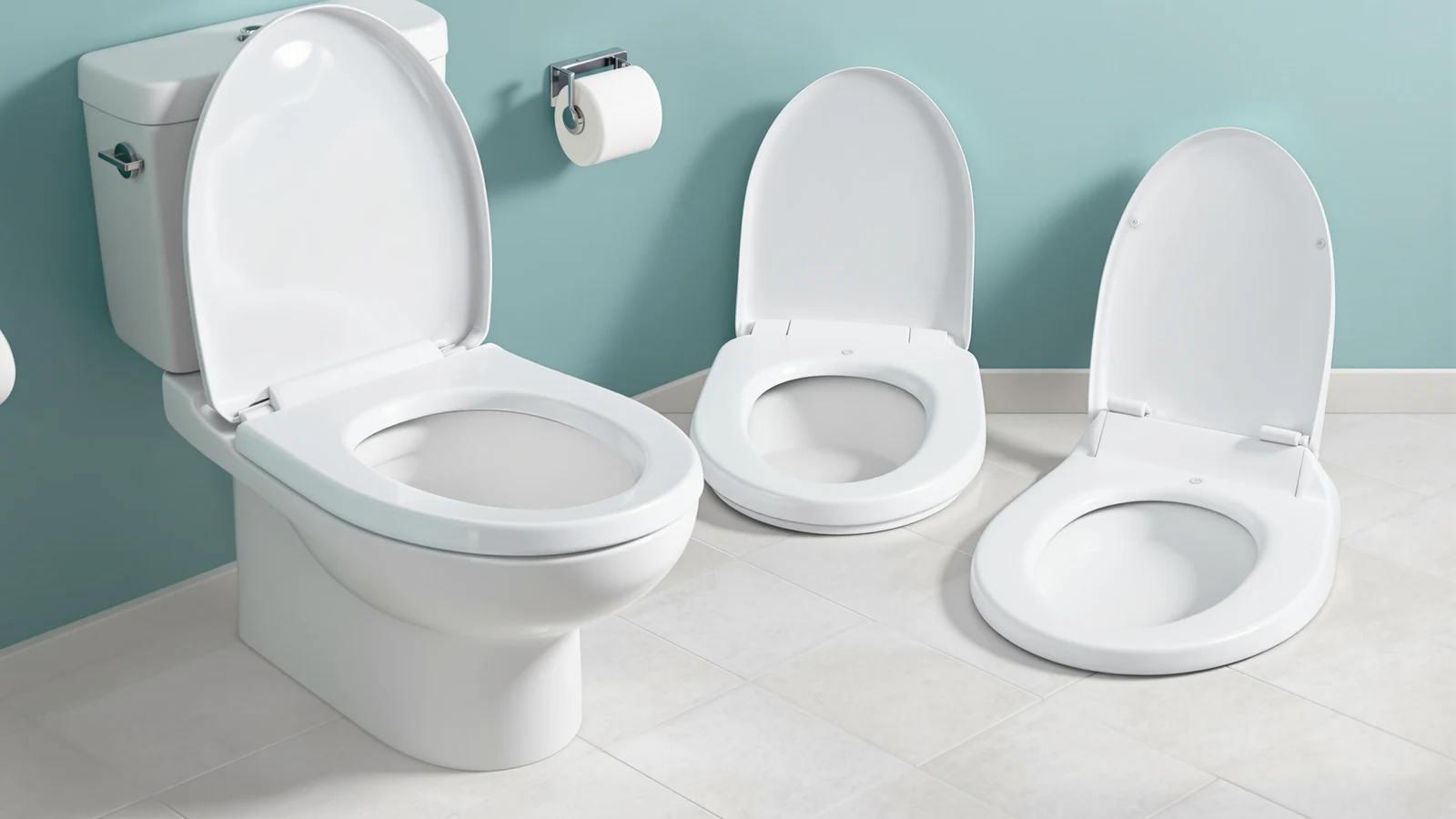
It's worth being precise about the two shapes these non-electric products come in, because listings use the words loosely. An attachment — every product in this guide — is a slim unit that clamps between your existing toilet seat and the bowl, using your current seat's hinge bolts to hold everything in place. A non-electric seat replaces the seat entirely, sprayer built in, which looks tidier but means buying a whole new seat rather than adding a thin layer to the one you have. If you're weighing the two shapes against each other rather than electric versus non-electric, our bidet seat vs. bidet attachment comparison covers that fork specifically.
The honest trade-off
Cold water: the objection, and the two ways around it
Here's the part every non-electric listing undersells: the spray is exactly as cold as your tap's cold line, because that's the only line these attachments connect to. In a warm climate, or in summer anywhere, that's simply cool and unremarkable. In a cold climate in January, supply lines can run into the low 40s Fahrenheit, and the first second of a winter wash is genuinely bracing — reviewers across the category describe it in almost identical terms. This isn't a defect specific to any one of the five products here; it's a property of how non-electric attachments work, full stop.
There are two real ways around it, not one.
Buy the attachment that mixes in warm water. The TUSHY Spa 3.0 is the exception on this page — instead of a single cold-water line, it runs a second hose to your sink's hot supply and blends the two at a temperature dial, cool through to genuinely warm. No outlet, no cord, nothing electrical to fail — just a second plumbing connection. The trade-off is that it has to be installed within hose-reach of a sink, which isn't every bathroom layout, and at $149.00 it's the most expensive attachment in this guide.
Manage the exposure instead of eliminating it. If a warm-water attachment isn't practical in your bathroom, an adjustable pressure dial — the Hibbent has one — lets you keep the wash brief and gentle rather than a sustained blast, which is where most of the discomfort reports concentrate. It's also worth knowing that tolerance genuinely shifts: people who stick with a cold-water attachment through the first week or two commonly report they stop noticing it, especially outside the coldest months.
What we won't do is pretend a $30–$50 cold-water attachment secretly delivers warm water, or that the discomfort is smaller than owners report it to be. If warm water is non-negotiable for you and a second sink hose isn't workable, that's the specific point where this category stops being the right answer — more on that at the end of this guide.
Under the hood
Dual nozzles, pressure dials, and the parts that break first
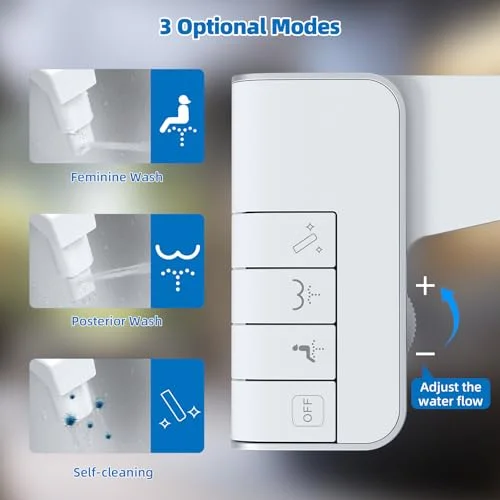
The single spec that separates a merely functional attachment from a good one is whether it has one nozzle or two. A single-nozzle unit does one job. A dual-nozzle design — like the Hibbent, which lists a separate frontal wash and rear wash, or the LUXE NEO 185, with its dedicated rear and feminine-wash nozzles — gives you a stronger spray for one job and a gentler, differently angled one for the other, rather than compromising on a single setting for both. Both of those attachments also list an adjustable water pressure control, which matters more than it sounds: the ability to turn intensity down to a trickle is what makes a cold-water attachment tolerable for a first-time user, and turn it up when you actually want it.
Nozzles on every attachment in this category retract behind a small guard gate between uses, and the better units — the Hibbent explicitly lists a self-cleaning water sprayer — rinse the nozzle itself as it extends and retracts, so it isn't sitting exposed between washes. That self-rinse is a small detail that matters more than it seems: a nozzle that never gets cleaned is the single biggest hygiene complaint the category attracts, and it's a solved problem on any attachment that includes it.
As for what actually fails: these are mechanically simple products, so the failure points are mechanically simple too. The valve core — the part you turn to start and stop the spray — is what wears fastest, typically going stiff or developing a slow drip after a few years of daily use. A washer inside it can flatten and seep. And on the cheapest attachments, a plastic T-adapter (the small fitting that splits your existing supply line) can crack if it's over-tightened during install, which is the single most common leak complaint in this entire product category — not long-term wear, but a slightly overzealous first install. It's exactly why a detail like the NEO 185's metal-ceramic valve cores and braided steel hoses, in place of the all-plastic hardware on cheaper units, is worth paying attention to rather than dismissing as marketing language: it's the part of the product most likely to need replacing. If something does go wrong after install, our installation problems and fixes guide covers the leak, pressure and fit issues that come up most, and our water pressure and nozzle guide goes deeper on nozzle types and pressure settings specifically.
Getting it on
Fitting one to a seat you already own, in ten minutes
The install path for every attachment in this guide is the same, and it doesn't involve a plumber. Shut off the water at the small supply valve behind your toilet, flush to clear the tank, and unbolt your current seat — usually two plastic wing nuts under the bowl's rim. Lay the attachment's thin mounting plate across those same bolt holes, then bolt your existing seat back down on top of it, sandwiching the attachment between the seat and the bowl. Connect the attachment's own hose to a small T-valve threaded onto your toilet's existing supply line, turn the water back on, and check every connection for drips before you consider it done.
Most owners report the whole process takes somewhere between ten and twenty minutes once the water is off, and the only tool most installs actually require is a flathead screwdriver for the old seat's bolts — nothing gets cut, soldered, or routed through a wall. The one step worth doing carefully rather than quickly is tightening the T-valve: hand-tight plus a modest quarter-turn with a wrench is normally enough, and over-tightening it is the most common cause of the plastic-fitting cracks mentioned above. A wrap of plumber's tape on the threads before you connect it solves the overwhelming majority of slow-drip complaints reported for this entire category. For a fuller step-by-step with the exact order of operations, see our complete installation guide; if you hit a snag once the water's back on, our troubleshooting guide is built around the specific problems that come up most.
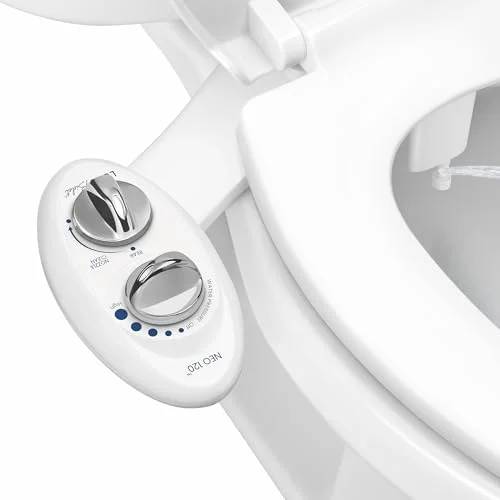
Fit is worth a quick check before you order, too. None of the attachments in this guide publish a bowl-shape spec, which means the honest answer is: check the listing yourself for your exact model before buying, rather than assume. What we can tell you from the manufacturer's own numbers is footprint — the LUXE NEO 120 lists dimensions of 17 x 10 x 3 inches, noticeably larger than the NEO 185's listed 13.5 x 7 x 3 inches — worth a tape measure first if your toilet sits close to a wall or a low cabinet, or if you have a small bathroom to begin with. Our guide to bidet seats for small bathrooms covers clearance in more detail if that's a live concern.
At a glance
How the five compare
Ordered by our recommendation. Prices move on Amazon — confirm the live price before buying.
Two dedicated nozzles — a stronger rear wash and a separate, softer feminine wash — sitting behind a guard gate, with metal-ceramic valve cores and braided steel hoses where cheaper attachments use plain plastic. Its listed footprint of 13.5 x 7 x 3 inches is the smallest of the five, which helps in a tight bathroom. It installs under your existing seat in about twenty minutes and does the job for less than a dinner out.
The only warm water you can get with no electricity
Instead of a heater, it runs a second hose to your sink's hot supply and mixes temperature at the dial — cool through to genuinely warm, with no outlet, no cord and nothing electrical to fail. The one real requirement is that it has to be installed within hose-reach of a sink for the mix to work, and at $149.00 it costs roughly triple most of the cold-water attachments here.
Dual nozzles for a separate frontal and rear wash, an adjustable water pressure control so a first-timer can start gentle, and a self-cleaning sprayer that rinses the nozzle as it extends and retracts. At $38.99 it's the least expensive attachment we compared, and it doesn't cut the one corner — dual nozzles — that turns a bidet from a novelty into something you actually reach for.
LUXE's entry-point attachment, at a slightly higher price than the Hibbent but from the same brand behind the NEO 185's hardware upgrades. Its listed dimensions run 17 x 10 x 3 inches — a larger mounting plate than the NEO 185 — so it's worth a quick tape-measure check against your seat and any nearby wall or cabinet before you order.
For the design-conscious buyer who doesn't need warm water
A brushed nickel finish in place of the white plastic every other attachment here uses — a real material upgrade if the hardware sits somewhere visible. It's still a cold-water-only attachment at $124.00, which puts it only $34.05 below its warm-water sibling, the TUSHY Spa 3.0; if you're already spending TUSHY money, it's worth deciding upfront whether that gap is one you'd rather close.
The point at which an electric seat becomes the better buy
A non-electric attachment is the right call for a lot of bathrooms, but it isn't the right call forever, and it's worth being honest about where the line sits. If you find yourself reaching for the TUSHY Spa 3.0's dial every single wash just to make cold water tolerable, that's a signal you want warm water more than you want to avoid an outlet — and at that point, a heated electric seat with continuous warm water will simply do the job better than any dual-hose workaround, sink-adjacent or not. Our heated seats and warm water guide explains the difference between reservoir and instant heating if that's the direction you're leaning.
The other trigger is the household itself. A single person in a mild climate rarely outgrows a $30–$50 attachment. Multiple daily users, a genuinely cold climate, or a wish list that includes a heated seat, a wireless remote, or a warm-air dryer are all signs you've outgrown what plumbing alone can deliver — those features simply require power. And practically: if you already have, or are willing to add, a GFCI outlet within about three feet of the toilet, most of the reason to stay non-electric — avoiding an outlet — disappears. Our guide to the outlet requirement covers what's actually involved in adding one, including rough electrician costs, and our full electric vs. non-electric comparison walks through the complete decision, running costs and durability included, if you want the whole picture before you commit either way.
If you're genuinely undecided, there's a low-risk way to find out: buy the Hibbent or the NEO 185 now. If a month from now you're using it daily and only wishing the water were warmer, you have your answer — move the attachment to a guest bathroom and put that $270-plus toward an electric seat with real confidence, rather than guessing upfront.
FAQ
Non-electric bidet attachments: common questions
Do all non-electric bidet attachments spray cold water?
All but one of the current, real attachments we compared, yes — they connect only to your toilet's cold supply line, so the spray matches your tap's cold-water temperature exactly. The one exception here is the TUSHY Spa 3.0, which runs a second hose to your sink's hot line and mixes a genuinely warm spray at a dial, with no electricity involved at all.
Will an attachment fit the toilet seat I already have?
Almost always — these attachments are designed to sandwich between your existing seat and the bowl using the same bolt holes, so they aren't seat-specific the way a full replacement seat can be. None of the five products in this guide publish a bowl-shape spec, so if your toilet has an unusual bolt spacing or a skirted, French-curve design, check the listing's own fit notes before ordering rather than assuming.
What's the first thing that breaks on a bidet attachment?
Almost always the valve core — the part you turn to start and stop the spray — which can go stiff or start dripping after a few years of daily use, or a washer inside it that flattens and seeps. The single most common leak complaint across the category, though, isn't wear at all: it's a plastic T-adapter cracking from over-tightening during install. A wrap of plumber's tape and a modest quarter-turn, rather than force, avoids it in nearly every reported case.
When should I just buy an electric bidet seat instead?
When cold water stops being a minor annoyance and starts being the thing you dread — or when you have an outlet nearby and want a heated seat, a remote, or a warm-air dryer on top of warm water. At that point the comfort features an attachment simply can't deliver start to outweigh the price and simplicity advantage. Our electric vs. non-electric comparison runs the full cost and durability math for both sides.