Maintenance · 2026
What Hard Water Does to a Bidet Seat (and How to Stop It)
By Ilane TallUpdated September 2, 2026Research-based
Best Bidet Seats is reader-supported. When you buy through our links we may earn a commission, at no extra cost to you. Commissions never change which products we recommend.
A bidet seat's warm water, its spray pressure and its service life all depend on one thing most owners never think about: what's dissolved in the water running through it. If you're on well water or live somewhere the utility reports as "hard," your seat is quietly accumulating mineral scale on every wash — and by the time it's visible, it's already cost you pressure, temperature or both. This guide covers where that buildup actually starts, how to gauge your water's hardness without a test kit, what an inline filter does and doesn't stop, and how to descale a seat the way manufacturers recommend, rather than the vinegar-and-hope approach that shows up in forum threads.
One honest note before we start: we don't run a fake testing lab, and we haven't disassembled these specific seats to inspect their internals. What follows comes from published manufacturer maintenance guidance and the mineral chemistry of hard water and small-appliance heaters — the same chemistry that scales a kettle — plus the patterns that repeat across verified owner reviews once a seat's spray or warm water starts to fail. Where we can't verify a spec for a specific product, we say so and point you to the listing instead.
Where it actually starts
Where scale forms first, and why the nozzle is not it
Ask most owners which part of a bidet seat mineral scale attacks first, and they guess the nozzle — it's the part that touches water on its way out, and the part they can see if they look. It's almost never the first casualty. The nozzle retracts behind a guard gate and either self-rinses or gets manually rinsed after use; water doesn't sit on it between washes, and standing water is what scale needs. A surface that's wet for two seconds and dry for hours barely gives dissolved minerals time to precipitate out.
The parts that do sit full of water fail first: the inlet valve, where the T-valve splits your supply line and a small chamber sits static between uses, and — on any electric seat with a reservoir or hybrid heater — the heating chamber itself, designed to hold water at an elevated temperature around the clock. Heat is the accelerant: calcium and magnesium carbonate become less soluble as water gets warmer, the same reason a kettle scales faster than a cold-water pitcher left out for the same year. A bidet seat's heater is, chemically, a small kettle that never fully empties. Reservoir-style heaters — a tank of warm water kept ready at all times rather than heated on demand — are the more exposed design for exactly this reason: more standing warm water, more surface area, more time for minerals to bond to it.
The practical order of failure we'd expect, and that lines up with what shows up in owner complaints once you filter for hard-water regions: valve first (a slow drip or a spray that won't fully shut off), heater second (water that used to run warm now runs lukewarm, or takes longer to heat), nozzle last and rarest (reduced spray pressure from a partially blocked outlet). If your seat's symptom is "used to be hotter, now it's not," that's a heater-scale pattern, not a nozzle problem — and running the self-clean cycle more often won't fix it, because self-clean rinses the nozzle, not the tank.
Before you buy anything
Reading your water hardness without buying a kit
You don't need a test strip to get a useful first answer. Three free sources will tell you almost everything you need before deciding whether a filter and a descaling schedule are worth the effort:
- Your utility's annual water quality report (CCR). Every US public water utility publishes one, usually searchable as "[your city] water quality report" or on the utility's own site, and hardness is reported in grains per gallon (gpg) or parts per million (ppm, sometimes listed as mg/L calcium carbonate). Above roughly 7 gpg (about 120 ppm) is generally considered "hard"; above 10.5 gpg (180 ppm) is "very hard."
- The household evidence you already have. White crusting around faucet aerators and showerheads, a film on glassware straight out of the dishwasher, soap that won't fully lather, and a kettle or coffee maker that needs descaling more than once a year are all hard-water tells that apply directly to your bidet seat's heater and valve.
- Well water is the one case where a real test matters. Private wells aren't covered by a utility CCR, and hardness can vary block to block. A $10–$15 drop-count or strip test kit from a hardware store gives a usable number in under five minutes, which is worth doing once if you're on a well and skipping the filter question otherwise.
If your number comes back under about 7 gpg, the routine in this guide is still cheap insurance but not urgent — descale once a year and move on. Above 10.5 gpg, treat the filter and the 3-month descale interval below as the default, not the aggressive option.
The cheap first move
Inline filters: what they catch and what they do not
An inline filter sits on the supply line — either at the T-valve that feeds the seat or built into the seat's own fitting on models that include one — and it's worth separating what it actually does from what the marketing around it implies:
- What it catches: sediment, rust particles, and grit large enough to be trapped by the filter's mesh or cartridge, which is exactly what clogs a nozzle or scores a valve seal over time. A basic sediment filter (5–20 micron) handles this for $10–$20 and needs replacing every 3–6 months depending on your water.
- What it does not catch: dissolved calcium and magnesium ions. Hardness minerals are dissolved at the molecular level, not suspended as particles — they pass straight through a sediment filter the same way salt passes through a coffee filter. A sediment filter will extend the life of your valve seals and keep the nozzle from clogging with grit, but it will not stop scale from building inside the heater.
- What actually removes hardness: only ion-exchange (water softener) or reverse-osmosis systems change the mineral content of the water itself, and both are whole-fixture or whole-house investments, not something you screw onto a single bidet supply line. If you're not installing a softener for the whole bathroom, assume the hardness is getting to the seat regardless of which inline filter you buy, and plan on descaling on a schedule rather than expecting a filter to make it unnecessary.
The honest framing: buy the cheap sediment filter because it protects the valve and nozzle from grit and is worth $15, but don't skip descaling because you installed one. They solve two different problems, and only one of them is a filter's job. For more on why nozzle position and pressure matter beyond scale, see our bidet water pressure and nozzle guide.
The maintenance that matters
Descaling a seat without voiding the warranty
The instinct to reach for a harsh descaler or an appliance-cleaning tablet is understandable and, on a bidet seat, the wrong move. Manufacturers warn against strong acids (never anything stronger than diluted white vinegar), abrasive pads on the nozzle, and — critically — never submerging the control unit or letting descaling solution reach the electronics. Doing any of those three things is exactly the kind of misuse that voids an electric seat's warranty, separate from ordinary wear. Read the specific manual for your model before starting; the steps below are the general shape most manufacturers publish, not a replacement for it.
- Shut off the water supply at the T-valve, then run the seat's spray function briefly to relieve pressure in the line.
- Wipe the nozzle and guard gate with a soft cloth and a mild solution of white vinegar and water (roughly one part vinegar to three parts water) — never a scouring pad, which scratches the surface minerals cling to more easily next time.
- Run a diluted vinegar solution through the wash cycle only if your specific model's manual says the reservoir accepts it this way; on many seats this means running the spray function several times with the diluted mix in place of supply water via the included flush accessory, then following with several clean-water cycles to rinse it out completely. This is the step where skipping the manual is most likely to cause a problem — some heater designs should never have solution sit in them unflushed.
- Never let liquid near the side panel, remote dock or any exposed wiring. Keep a dry cloth in hand and work from the water side of the unit outward.
- Restore water, run one full clean-water cycle, and check for leaks at the valve before considering the job done.
Do this every 3–6 months in hard-water areas (above roughly 7 gpg) and roughly once a year otherwise. It takes fifteen minutes and it's the single highest-leverage maintenance task for warm water that stays warm and a valve that keeps sealing cleanly. For everything else that goes wrong in the first year — drips, crooked seating, low pressure — our installation problems and fixes guide covers the rest.
If you're shopping with this in mind
The picks that are easiest to service
Every electric bidet seat needs the same descaling routine above — hard water doesn't spare any brand. What varies is how much the design works with you: controls you can operate with wet or gloved hands mid-clean, and published documentation you can find before you buy. We haven't inspected these internally, so the notes below stick to what's published and how it maps to routine upkeep — not a claim that one is mechanically easier to open than another.
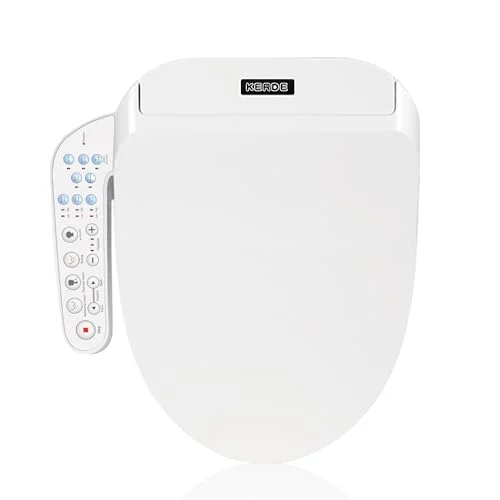
KERDE Electric Bidet Toilet Seat (Armrest)
One-click operation, easy to run a maintenance cycle without fumbling controls
This elongated seat's one-click intelligent operation means a wash-and-standby cycle — useful for flushing a descaling solution through evenly — is a single control rather than a multi-step panel sequence. It includes slow-close and a seat cushion designed to hold a constant temperature through winter; the armrest version adds a stable point of contact while you lean over the bowl during maintenance.
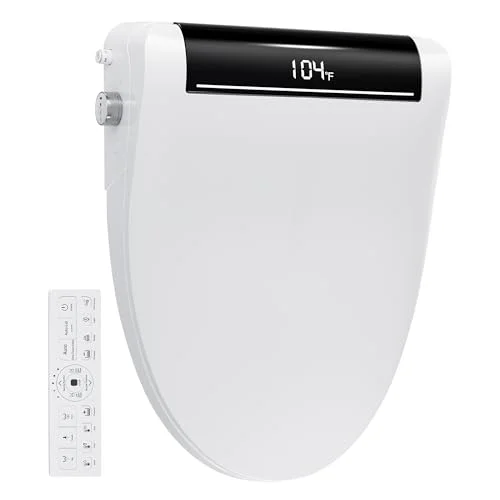
ZingPOP Bidet Toilet Seat
Voice control and auto-open mean fewer buttons to touch with wet hands
Voice control and auto-open are convenience features day to day, but they double as a practical maintenance perk: you can trigger a clean-water flush cycle without touching a side panel with hands that are mid-cleaning. It's elongated and heats water, which — per the guidance above — means its heating chamber is exactly the part that benefits most from the descaling schedule.
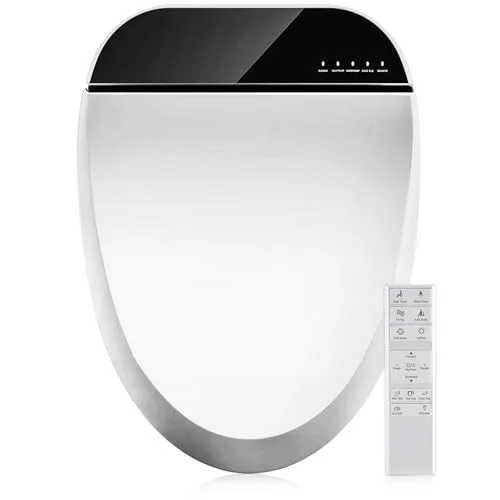
Combier Electric Bidet Toilet Seat (Elongated)
Elongated, 15" x 20" — a remote panel you're not reaching for mid-clean
Wash, dry and soft-close on a remote rather than a side panel means the control surface you'd otherwise wipe down with a damp cloth during descaling stays away from the water entirely. It's sized for elongated bowls at 15 by 20 inches, per the listing — confirm your own bowl measurement against that before ordering.
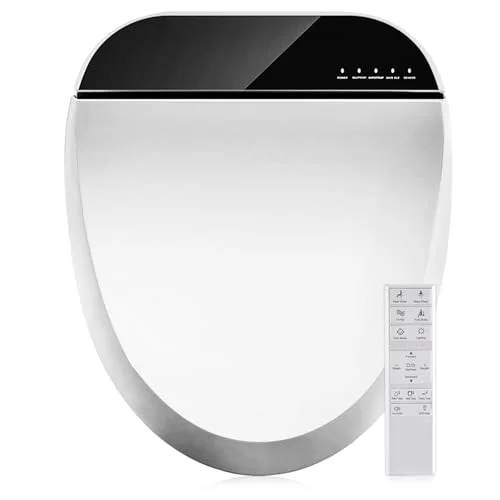
Combier Electric Heated Bidet Toilet Seat (Round)
The round-bowl option with the same remote-first control layout
The same wash/dry/soft-close remote design as its elongated sibling, built for round bowls, which makes it the pick if your toilet takes a round seat and you still want controls kept clear of the water and cleaning solution during a descale. As with any heated seat, its water heater is the component this whole guide is about protecting.
The end of the road
The failure that ends a seat, and how long you can delay it
Left untreated, hard water doesn't usually kill a bidet seat all at once — it kills it by degrees, and the degree that ends the seat's useful life is heater failure: scale insulates the heating element from the water it's meant to warm, the element works harder and runs hotter to compensate, and eventually it either can't reach target temperature or fails outright under the sustained load. By the time a seat "just stopped heating," the scale has usually been building for a year or more; the warm water going lukewarm months earlier was the warning that got ignored.
The valve tells a similar but less final story: a scaled valve seat develops a slow drip or won't fully shut off, which is a nuisance and a water-waster rather than a seat-ending failure, since valve components are the cheap, commonly-replaceable parts in the whole assembly. It's worth fixing promptly anyway — a valve that won't seal is also a valve under more strain, and strain plus scale is how a slow drip becomes a real leak.
How long can you delay the routine in this guide and get away with it? In moderately hard water, skipping descaling for a year or two before you notice reduced heat output is common — appliances are built with some margin. In very hard water above 10.5 gpg, owners in that range report noticeably reduced warm-water performance within the first year of neglect, and full heater failure inside two to three years isn't unusual for a device that should otherwise last 5–8. The gap between "the seat that's still going strong at year six" and "the seat that needed a new heating unit at year two" is, in a genuinely hard-water household, almost entirely explained by whether anyone ran the descaling routine. It costs fifteen minutes every few months. A failed heater costs a service call, a new unit, or a full replacement. For the full economics of keeping a seat running, our running cost guide breaks down electricity, water and parts together, and our self-cleaning nozzle guide covers the hygiene side of the same maintenance conversation.
FAQ
Hard water and bidet seats: common questions
Does hard water damage the nozzle first?
No — the nozzle is rinsed and dried between uses, so standing water rarely sits on it long enough to deposit scale. The inlet valve and, on electric seats, the heating chamber sit full of water continuously and scale there first. If your symptom is reduced spray pressure with no change in water temperature, check for grit rather than scale; if warm water has gotten weaker, that points to the heater.
Will an inline filter stop scale from building up?
A standard sediment inline filter catches particles and grit, which protects the valve seal and nozzle from clogging — but it does not remove dissolved calcium and magnesium, so it will not stop scale from forming inside a heater. Only a water softener or reverse-osmosis system changes water hardness itself. Use a sediment filter for what it's good at, and keep descaling on a schedule regardless.
Is it safe to use vinegar to descale a bidet seat?
Diluted white vinegar (roughly one part vinegar to three parts water) is the descaling agent most manufacturers reference, but always confirm the exact method in your model's manual first — how the solution is introduced and flushed varies by heater design, and letting any liquid reach the control panel or wiring can void the warranty and damage the unit.
How often should I descale if I'm on well water?
Test your well water's hardness once with a $10–$15 kit, since it isn't covered by a public utility report. Above roughly 10.5 grains per gallon, descale every 3 months; between 7 and 10.5 gpg, every 3–6 months; below 7 gpg, once a year is generally enough.
Keep reading
More on keeping a bidet seat running