By Ilane TallUpdated August 31, 2026Research-based
Best Bidet Seats is reader-supported. When you buy through our links we may earn a commission, at no extra cost to you. Commissions never change which products we recommend.
Nobody reads the spec sheet closely enough to notice this before they buy, and then everybody notices it the first week they own the seat: a tanked electric bidet seat holds about thirty seconds of warm water, and then it doesn't. Not a slow fade, either — a fairly abrupt handoff from warm to lukewarm to the same cold water your sink runs in January. If you live alone and wash briefly, you may never hit the wall. If you don't, you will, usually on a Tuesday morning with someone else waiting outside the door.
This guide is about that thirty-second number specifically: what the reservoir actually holds, how fast it comes back once it's empty, why the second person to use the bathroom gets a worse experience than the first, what a household of four does to the whole system, and which seats sidestep the problem completely by never using a tank at all. We compared published heater specs, capacity figures and thousands of verified owner reviews to build this — nobody here has plumbed a bidet seat into a lab rig and timed it with a stopwatch, and we say so plainly rather than pretending otherwise.
Quick answer
What the reservoir actually holds
In seconds, not litres
About 30 seconds of warm water
A reservoir-heated bidet seat keeps a small, continuously-warmed tank behind the seat shell — typically enough for roughly 30–45 seconds of spray before the incoming cold water outpaces what's left warm. That's the number that matters at the moment you're sitting there, not the tank's volume in ounces, which manufacturers rarely publish and which tells you little on its own since flow rate varies by pressure setting.
The seats that skip the wall entirely
Instant heating never runs out
A tankless, on-demand heater warms water as it flows rather than storing a reserve, so there is no thirty-second cliff to hit. The TOTO WASHLET S2 ($420.00) uses this approach, and the Kohler PureWash E580 ($269.97) pairs a small reserve with on-demand heating so it rarely runs dry either.
Before you buy
Things to know before you buy on this alone
The thirty-second figure is a reported range across reservoir seats, not a single fixed number — actual duration depends on your pressure setting, since a higher-pressure oscillating wash empties the tank faster than a gentle steady stream.
A tank running dry doesn't mean the seat stops spraying. It means the water reverts to whatever temperature is coming in through your cold supply line — the spray keeps going, just no longer warm.
Reservoir seats keep the tank warm around the clock on standby, which is a real (if small) electricity cost — one more reason instant heaters, which only draw power while spraying, tend to run cheaper year over year even though they cost more upfront.
None of this is a defect. It's a design trade-off manufacturers make deliberately to hit a lower price point, and it's disclosed (if you know to look) in most product listings as "reservoir" or "tank" heating versus "instant" or "tankless."
If two people use the same bidet seat back-to-back, the reservoir issue compounds — see the household section below for what that actually looks like in practice.
Why trust this
Why you should trust us
Best Bidet Seats is written and maintained by Ilane Tall for an audience trying to make one specific, fairly expensive bathroom decision well. We don't accept payment for placement, and commissions from Amazon links never influence which products we recommend or how we describe their trade-offs — including the unflattering ones, like a $400 seat's tank still running dry if the on-demand assist is set too low. One honest note up front: we don't run a testing lab and we've never claimed to. Everything in this article comes from manufacturer specifications, published capacity and wattage figures, and patterns we found consistently repeated across large volumes of verified Amazon buyer reviews — including the critical ones, which is usually where a seat's real limitations show up.
Method
How we picked
We started from the bidet seats and attachments in our product database and kept only the models where a heater type — reservoir, instant, or hybrid — is either stated outright by the manufacturer or reliably inferable from consistent owner reports about warm water duration. We excluded any product where we couldn't pin down that detail from real data, because "how long does the warm water last" is exactly the kind of question we refuse to guess at. That left a shortlist weighted toward brands — Kohler, TOTO, VOVO — that publish heater specifications clearly and that stock the parts these tanks and heating elements eventually need.
How we compared
We compared published heater architecture (reservoir vs. hybrid vs. instant), price, and the specific features — wattage behavior, pressure levels, wash modes — that a manufacturer discloses on the listing or spec sheet. Where owner reviews consistently describe a pattern (a tank running cold mid-wash, or a seat feeling "endless" by comparison), we treated that as corroborating evidence for the stated heater type, not as a substitute for it. We do not physically test these seats and we don't run a fake testing lab — no stopwatch, no lab rig, no staged bathroom. Every rating you see anywhere on this site, when one is shown at all, comes from verified Amazon buyers, never from us.
The second use
How fast the tank refills — and what the second person gets
01
It's not instant
A depleted reservoir needs several minutes of standby heating to fully recover, not seconds — it's a small heating element bringing a tank back up to temperature, the same physics as a mini water heater.
02
Partial recovery is common
Come back five minutes later and the tank is often only partway warm — owners describe a "lukewarm" second wash more often than a fully cold one, which is arguably more confusing since it's inconsistent.
03
Back-to-back is the worst case
Two people in the same bathroom within a minute or two of each other is close to the worst-case scenario for a reservoir seat — the second person gets whatever fraction of the tank managed to reheat.
04
Instant sidesteps it entirely
A tankless heater has no recovery period because it never depletes — the tenth use in ten minutes gets the same water temperature as the first, which is the whole argument for paying more upfront.
Manufacturers rarely publish an exact refill time in minutes, and it varies with incoming water temperature and the seat's standby wattage — so treat "several minutes to fully recover" as a directional range drawn from consistent owner reports, not a guaranteed spec.
The seats that never run out
Instantaneous heating: no tank, no wall to hit
An instant (tankless) heater warms water as it passes through, the same principle as a tankless whole-home water heater, just miniaturized. There's no reserve to deplete, so there's nothing to run out — wash for five seconds or ninety, the temperature you get at the end is the temperature you got at the start. The TOTO WASHLET S2 uses this architecture, marketed as "instantaneous water heating," and it's the feature that most directly answers the question this article is about: with it, the question stops mattering.
The trade-off is upfront cost and, in short bursts, higher electrical draw — an instant heater has to raise water temperature fast, which means pulling more wattage in the moment than a reservoir seat's slow, steady standby heating. That's a manageable load for a modern bathroom circuit, but it's part of why instant heaters show up mostly on the higher end of the price range rather than on $150 entry-level seats.
A middle path exists too. The Kohler PureWash E580 and the Kohler PureWash E590 both pair a small reserve with on-demand assist — a hybrid design that gets much closer to instant-heater endlessness without the full instant-heater price tag. It's a sensible middle ground if a fully tankless seat is more than you want to spend, but you still want the thirty-second wall pushed back rather than removed.
The real-world test
Back-to-back use in a household of four
A single person living alone rarely notices the reservoir limit — one wash, then the tank has minutes to recover before it's needed again. A household of four is a different situation entirely, especially at the two predictable crunch points every family with a shared bathroom knows: the school-and-work rush in the morning, and the wind-down before bed. If two or three people use the same bidet seat within a short window, a reservoir tank simply doesn't have time to fully reheat between uses, and the third or fourth person of the morning is the one most likely to get a wash that starts warm and finishes cold, or never warms up at all.
This is the single strongest, most concrete argument for paying more for instant or hybrid heating in a multi-person household — not the marketing language about "endless warm water," but the specific math of four people sharing one toilet in a compressed thirty-minute window. Reviewers consistently note this exact scenario when comparing reservoir seats to instant ones: families report that a reservoir seat felt fine when they tested it solo in the showroom, so to speak, and only revealed its limit once real household traffic hit it.
If your household is one or two people with staggered schedules, a reservoir seat like most sub-$300 electric models is genuinely fine — you're unlikely to ever empty the tank twice in quick succession. If you're outfitting the one bathroom for a family of four, weight your decision toward the TOTO WASHLET S2's instant heater or the hybrid assist on the Kohler models, because the failure mode you're avoiding shows up exactly when the bathroom is busiest — which, inconveniently, is also when nobody wants to deal with it.
At a glance
Heater type, side by side
Prices move on Amazon — confirm the live price before buying.
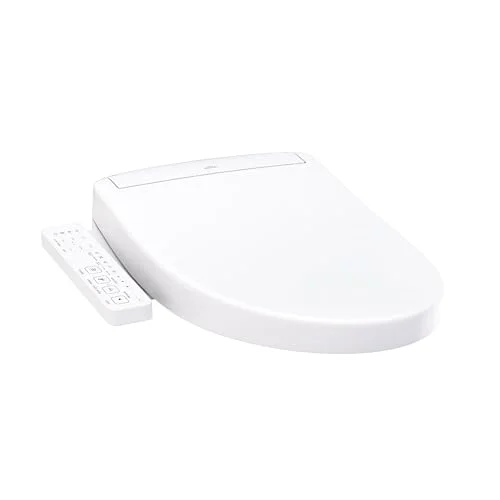
Instantaneous water heating means there is no tank to empty and no wait for it to recover — the water is the same temperature on the first use of the day and the fifth in a row. Add PREMIST, which wets the bowl before use, and EWATER+, which cleans the wand with electrolyzed water, and it's the clearest way to remove the reservoir question from your decision entirely.
Best value hybrid — most of the endlessness, less of the price
A hybrid heater pairs a small reserve with on-demand assist, pushing the thirty-second wall back far enough that most single- and two-person households won't feel it. Add a self-cleaning stainless wand and a quiet-close lid, and it's the seat we'd point most shoppers to before the fully instant option above.
Best hybrid with a side control panel and nightlight
The step up from the E580 in the same hybrid family — tank plus on-demand heating, so the reservoir wall is pushed back rather than removed, with a side panel, quiet-close lid, self-cleaning wand and a nightlight added for late-night trips where you don't want to hunt for a switch.
Best budget reservoir seat, if you know the limit going in
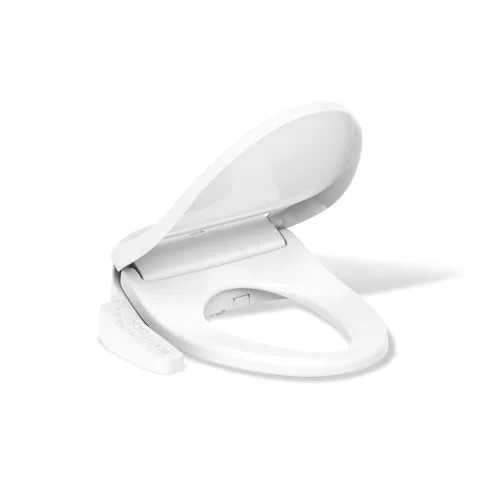
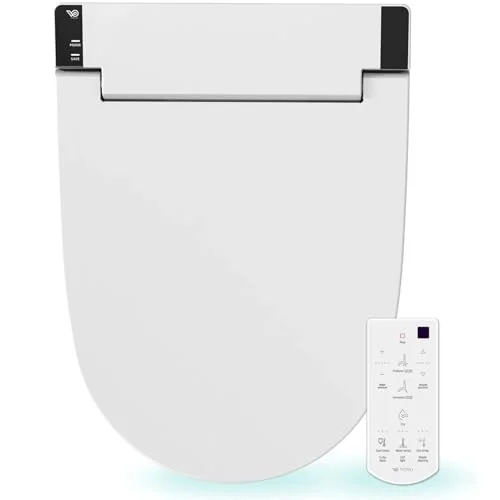
A conventional reservoir heater — meaning the roughly thirty-second warm-water window this whole article is about applies here directly. For a household of one or two with staggered bathroom schedules, that's a real, sensible way to save money over the hybrid and instant models above. It's the wrong choice for a busy household of four sharing one bathroom in the morning rush.
Reservoir seat with a deodorizer, for the same trade-off at a higher price
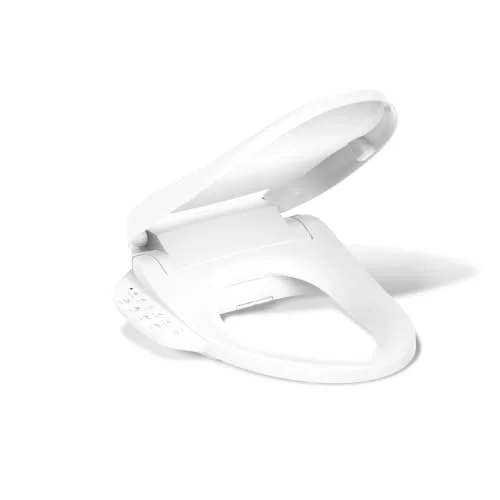
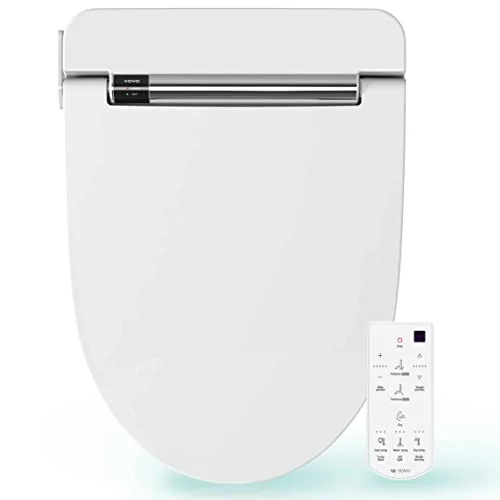
Also a tank-based reservoir heater, so the same roughly thirty-second warm-water figure applies, offset here by a built-in deodorizer and dryer that the VB-6000SE doesn't include. Choose it over the VB-6000SE for the added features, not for a longer warm-water window — the reservoir limit is unchanged.
If you already own, or decide to buy, a reservoir-heated seat, a few habits meaningfully extend the warm-water window without spending another dollar:
Drop the pressure a notch. A gentler, steadier stream draws down the tank slower than a high-pressure oscillating wash — the same reserve simply lasts longer at a lower flow rate.
Use a shorter wash, then dry separately. If your seat has a warm-air dryer, finishing the spray a few seconds sooner and relying on the dryer for the rest keeps you inside the warm window rather than spraying into the cold tail end.
Space out back-to-back uses where you can. A few minutes between the first and second use in a household gives the tank more time to partially recover before the next wash starts — not a full fix, but enough to matter on an average morning.
Leave the seat powered on rather than unplugging it. Reservoir heaters maintain temperature on standby; unplugging between uses (to save the small standby electricity cost) means starting fully cold every single time, which defeats the point.
Check for an eco or sleep mode. Some reservoir seats let the tank cool further overnight to save power and reheat on a schedule or on first use — useful for the electricity bill, but worth knowing it can mean a colder first wash of the day if the seat hasn't finished reheating yet.
None of this turns a reservoir seat into an instant one. If the household-of-four scenario above describes your bathroom most mornings, these habits buy you some margin, but a hybrid or fully instant heater is the more durable fix.
What we left out
The competition
We didn't include non-electric bidet attachments or seats here because they don't heat water at all — they run straight off your cold supply line, so the entire reservoir-versus-instant question this guide answers simply doesn't apply to them. If a cold-water bidet is what you're considering instead, our bidet seats with a remote control guide and our running-cost breakdown cover that trade-off directly. We also left out several reservoir-only models from our broader database that don't disclose enough about tank behavior or heater wattage for us to describe it honestly here — we'd rather leave a seat off this specific list than guess at a spec we don't actually have.
FAQ
Common questions
How long does warm water actually last on a bidet seat?
On a reservoir-heated (tank) seat, roughly 30–45 seconds before the water reverts to your cold supply's temperature — the exact duration depends on your pressure setting, since a stronger spray draws the tank down faster. On a hybrid or fully instant (tankless) seat, warm water doesn't run out at all, because there's no fixed reserve being depleted.
How long does a reservoir take to refill after it runs dry?
Several minutes of standby heating, not seconds — it's a small heating element bringing a tank back up to temperature. Coming back a few minutes later often gets you a partially, not fully, reheated tank, which owners describe as a "lukewarm" second wash more often than a fully cold one.
Do all electric bidet seats have this thirty-second limit?
No — only reservoir (tank) heated seats do. Hybrid seats like the Kohler PureWash E580 and E590 pair a small tank with on-demand heating to push the limit back substantially, and fully instant (tankless) seats like the TOTO WASHLET S2 don't have a tank to deplete in the first place.
Is a reservoir seat a bad choice for a family of four?
It can be, specifically during the compressed morning and bedtime windows when multiple people use the same bathroom in quick succession — the tank doesn't have time to fully reheat between uses. For that specific situation, a hybrid or instant heater is the more reliable choice; for one or two people with staggered schedules, a reservoir seat is usually fine.