By Ilane TallUpdated August 30, 2026Research-based
Best Bidet Seats is reader-supported. When you buy through our links we may earn a commission, at no extra cost to you. Commissions never change which products we recommend.
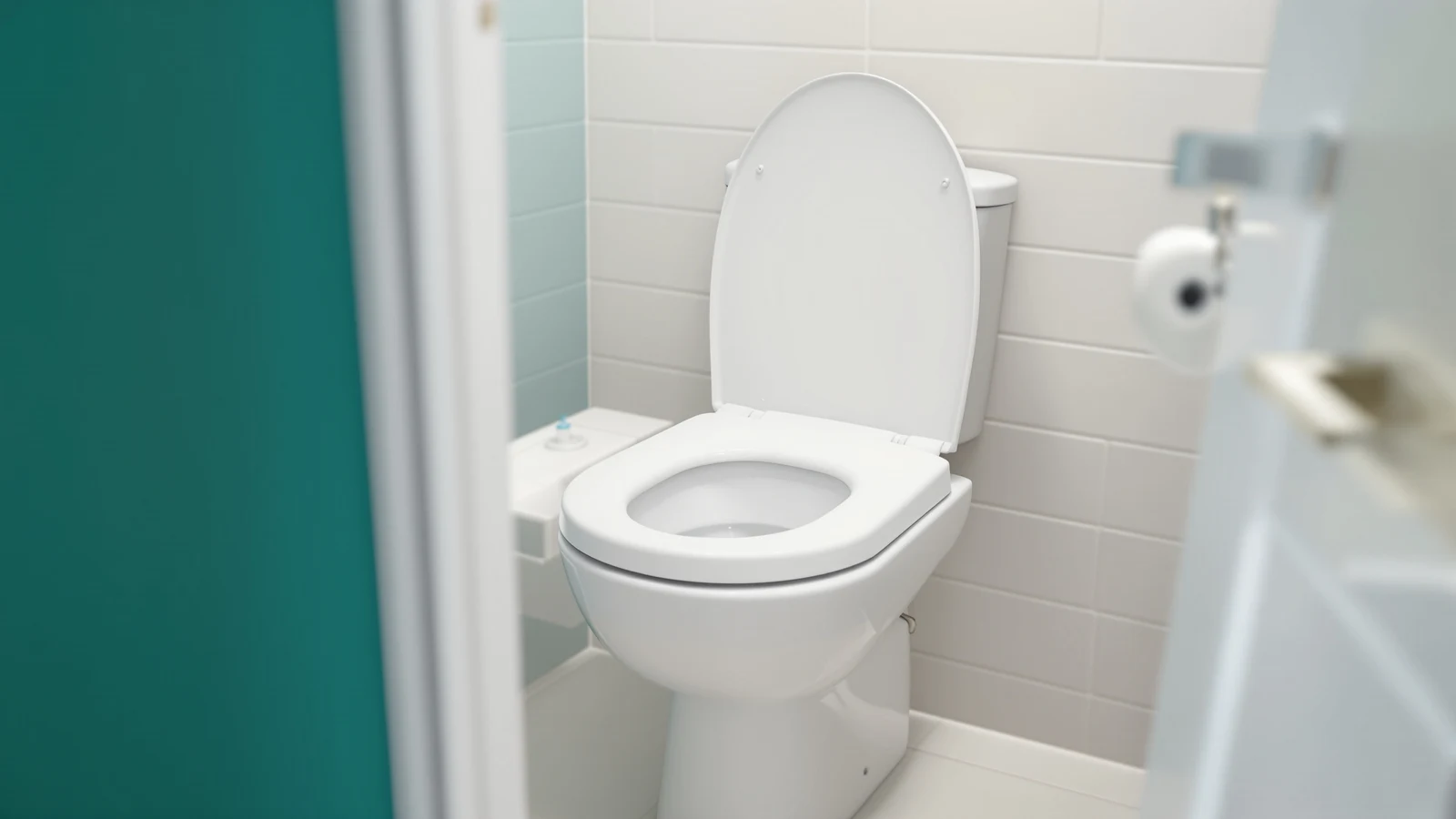
A bidet seat is not a flat accessory. It is a piece of hardware that sits on top of your existing toilet, and in a powder room where the door already brushes your knee and the vanity is close enough to touch without standing up, that extra bulk is the whole decision. Most bidet buying guides are written for a primary bathroom with room to spare. This one isn't. It's for the half-bath under the stairs, the guest toilet with eighteen inches of clearance to the door, and the small en-suite where the previous owner apparently measured the room around the toilet rather than the other way around.
The good news is that the category has a real answer for tight spaces, and it isn't a compromise so much as a different design brief. Manufacturers build slim attachments specifically to minimize the one dimension that matters in cramped rooms, and full seat replacements that add function without adding bulk at all. We compared the published dimensions, mounting specs and verified buyer feedback on five non-electric bidets built around exactly this problem — no outlet required, because in most of the smallest bathrooms in American homes, there isn't one to plug into anyway.
One honest note before we get into it: we don't run a testing lab and never claim to. Everything below comes from manufacturer-published specifications, live Amazon pricing, and the patterns that repeat across verified buyer reviews — including the complaints, which is where you learn what a listing photo doesn't show.
Before you order
The three measurements to take before you order anything
Do this with a tape measure before you open a single product page. It takes five minutes and it's the difference between a bidet that fits and one you're shipping back.
01
Rear clearance to the wall
Measure from the back of the toilet bowl (or the base of the tank) to the wall behind it. Bidet attachments add a control module and a wider hinge assembly at the back; some full seats sit slightly further back than a standard seat. An inch or two of unused space back there is what most small-bathroom fits come down to.
02
Side clearance to the nearest fixture
Measure from the centerline of the bowl to the closest obstruction on either side — a vanity, a wall, a towel bar. A bidet attachment's side-mounted control panel or a full seat's slightly wider shell can close that gap by an inch. If your elbow already grazes the vanity when you sit down, this measurement matters more than the price tag.
03
Front clearance to the door swing
Measure from the front edge of the bowl to wherever the door reaches when fully open, and to any fixture directly ahead. This is the one people skip, and it's the one that bites in a room where the door swings inward — see the section below on why that combination changes which bowl shape you should buy.
04
Bonus: bowl shape and bolt spread
While the tape measure is out, note whether your bowl is round or elongated, and confirm the mounting-hole spread (almost always the standard 5.5 inches center-to-center on US toilets). Every full seat and attachment here is sized to one bowl shape — buying the wrong one means a gap, a wobble, or a return label.
The dimension that actually matters
Where a bidet seat adds height, and why that matters more than depth
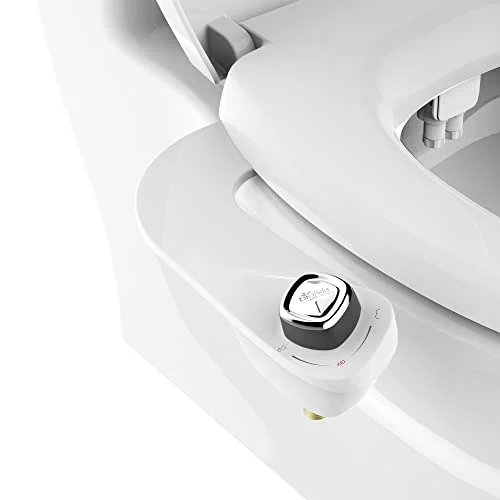
Most people shopping for a small bathroom fixate on how far a bidet sticks out — the depth question. It's a reasonable instinct, but it's usually not where the fit actually fails. A bidet attachment, like the Bio Bidet SlimEdge, clamps between your existing seat and the bowl, and its footprint barely extends past the seat you already own. What it does change is the stack height: the seat now sits on top of a wedge-shaped module instead of directly on the bowl's rim, which raises the sitting height by roughly the thickness of a paperback book and moves the seat hinge a little further back and up.
In a full-size bathroom, nobody notices an extra half-inch of seat height. In a small one, it compounds two problems at once. First, your knees end up slightly higher relative to the door, the vanity, or a wall-mounted towel bar than they were before — the exact clearance you measured in step three above just got a little tighter, even though the bowl itself hasn't moved. Second, a taller seat stack can make the tank lid harder to lift or a low wall-hung cistern harder to clear, which is invisible on a spec sheet and only shows up once the thing is installed.
This is the real argument for a full seat replacement over an attachment in a genuinely small room. A seat like the VOVO Nature 7 or the Kohler PureWash M300 replaces your seat entirely rather than stacking under it, so the nozzle mechanism is built into a hinge that's designed to sit at standard seat height from the start. You don't get the added-height penalty an attachment carries, because there's no separate wedge between the seat and the bowl. The trade-off, as always with non-electric hardware, is that you lose nothing here in terms of the wash itself — these are still simple, valve-based, ambient-temperature systems — but you do commit to a full seat swap rather than a quick clamp-on job.
If you're keeping your seat
Slim-edge attachments: the thinnest thing that still works
Bio Bidet SlimEdge Bidet Attachment
Best slim-edge attachment
Bio Bidet builds this one specifically around a low-profile edge, which is the part of an attachment most likely to catch on a seat lid that doesn't sit flush in a tight installation. It has two nozzles — a front wash and a rear wash — both running cold water off your existing supply line, with a dial to adjust pressure between them. It ships as a single unit (1 Pack) that mounts under your current seat in roughly the same install window as any other attachment.
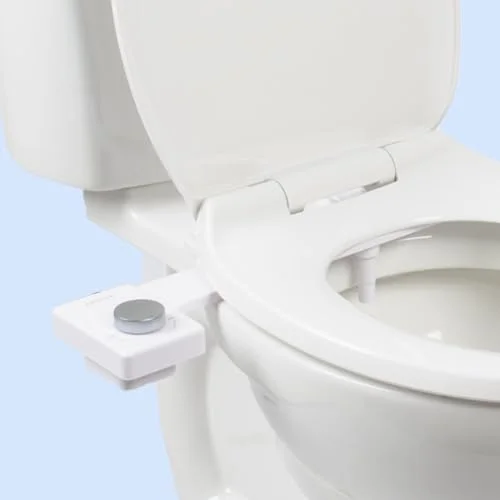
TUSHY's "Ultra Slim" line exists for exactly this scenario — a bidet you can add to a toilet that's already tight for space, without redesigning the bathroom around it. It's the starter tier of TUSHY's lineup: a single cold-water wash, a silver finish that reads more like hardware than a medical appliance, and the same clamp-under-your-seat install as any other attachment. If your priority is the thinnest possible profile over extra wash modes, this is the one built around that single constraint.
Neither of these tells you its exact stack height on the listing, and we won't invent a number that isn't published. What both are designed around, by name and by category, is minimizing the one measurement an attachment can't avoid adding to. If your rear and side clearances from step one and two above are already snug, a slim-edge design is the safer bet of the two attachment styles on the market — check the current listing for the exact profile height before you order. Our installation problems and fixes guide also covers what to do if a lid doesn't sit flush once it's mounted.
Bowl shape and door swing
Round versus elongated in a room where the door swings inward
Round bowls are shorter front-to-back than elongated ones, typically by an inch and a half to two inches. In a full bathroom that difference is mostly cosmetic. In a powder room where the door swings inward — a common layout in older houses and apartments, where there wasn't room to hang the door to swing out into a hallway — that inch and a half is the clearance between the door closing fully and the door bumping your knees on the way to catching the latch.
This is where the measurement from step three above earns its keep. If your front clearance is tight enough that the door drags across your knees even with your current toilet, an elongated bidet seat will make that worse, not better — a full seat replacement built for elongated bowls sits at the same footprint as an elongated toilet already does, but it's still the longer of the two shapes. A round-bowl seat, by contrast, keeps the bowl at the shorter dimension the room was likely designed around in the first place.
The VOVO Nature 8 is the round-bowl option here — a full non-electric seat replacement built specifically to fit round toilets, running ambient (unheated) water temperature with the manufacturer's stated easy-installation hardware. If your existing toilet is already round, this is the one to check first; a round bowl paired with an elongated bidet seat is one of the more common return reasons in this category, and it's avoidable with the tape measure you already have out.
If your bowl is elongated and the door clearance isn't the binding constraint in your room, the VOVO Nature 7 is the direct elongated counterpart to the Nature 8 — same non-electric, ambient-temperature design, same easy-installation approach, sized for the longer bowl shape instead. Neither Nature seat states a rated bowl-shape crossover, so treat the shape on the listing as fixed rather than approximate: an elongated seat on a round bowl leaves a visible gap at the front, and a round seat won't fully seat on an elongated bowl's mounting posts. For a broader field of round-bowl-specific picks beyond just these two, see our best bidet seats for round toilet bowls guide.
At a glance
The five small-bathroom picks, side by side
Prices move on Amazon — confirm the live price before buying.
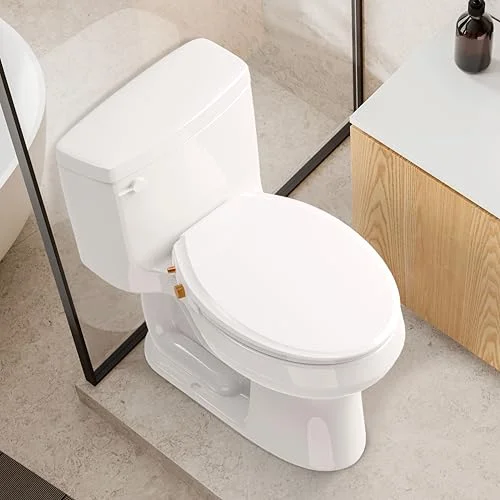
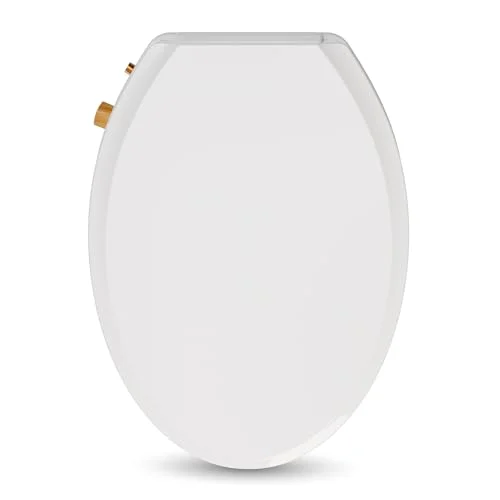
A full elongated seat replacement from a plumbing brand that stocks parts, at 21.06 x 17.3 x 5.1 inches per Kohler's published dimensions — worth checking directly against your own measurements from step one above. It has a quiet-close lid designed to prevent slamming, quick-release hinges that make it easy to lift off for cleaning around the bowl, and a self-cleaning wand, all without a motor, a heater, or a cord to plug in.
No wedge under your existing seat, no added stack height, no electronics — a straightforward elongated replacement seat with ambient (cold) water and the manufacturer's stated easy-installation hardware. The appeal for a small elongated-bowl bathroom is exactly that it behaves, dimensionally, like the seat you're replacing.
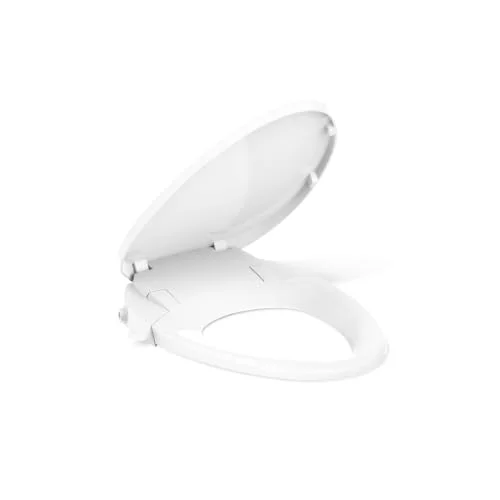
The round-bowl counterpart to the Nature 7, built for the shorter bowl shape that's more common in the smallest, oldest bathrooms. Same ambient water temperature, same no-wedge, no-added-height full-seat design. If your toilet is round, start here rather than adapting an elongated product to fit.
If you'd rather keep your current seat and toilet exactly as they are, this is the attachment built around a low-profile edge, with dual front and rear cold-water nozzles and adjustable pressure. The clamp-on install is the fastest of any option here, which matters if you're not ready to commit to swapping the whole seat.
The lowest-commitment way to find out whether a bidet earns a permanent place in a small bathroom. It's TUSHY's starter tier — one cold-water wash, an ultra-slim design built for exactly the clearance problem this guide is about, and the same reversible, clamp-on install as the SlimEdge above.
Small bathrooms and missing outlets travel together
Powder rooms and half-baths are disproportionately likely to have been added after the house was built — converted from a closet, tucked under a staircase, carved out of a hallway — and electrical work is often the first thing skipped when space and budget are both tight. That's not a coincidence you need to fight against; it's the reason every product in this guide is non-electric. None of the five picks above need a wall outlet, a GFCI circuit, or a cord run across the floor, which is one less clearance problem to solve in a room that already has several.
If you want warm water anyway
The honest trade-off
Every seat and attachment here runs at ambient water temperature — exactly as warm as your cold supply line, no more. That's the deliberate trade-off for skipping a heater, a pump and a cord entirely. If warm water eventually becomes the deciding factor and you have (or are willing to add) a nearby outlet, our do bidet seats need an electrical outlet? guide walks through exactly what electric models require and what it costs to add a GFCI outlet where there isn't one.
Skipping electricity isn't only about convenience — it changes the installation itself. Every product above connects with the same small T-valve that splits your existing cold supply line, and none of them need you to find, add, or route power. That keeps the whole job to a wrench and, on the full-seat replacements, a screwdriver for the old seat's mounting bolts. If pressure feels weak once it's installed, or the spray seems inconsistent, that's almost always a valve or supply-line issue rather than a defect in the unit itself — our water pressure and nozzle guide covers the fixes. And if you later add a second bathroom to the project and that one does have an outlet, our best bidet seats with a remote control picks are worth a look for the room that can support them.
FAQ
Small-bathroom bidets: common questions
Do bidet attachments really add noticeable height to the toilet?
Yes, though modestly — an attachment sits between your existing seat and the bowl, adding roughly the thickness of a paperback book to the sitting height. In a spacious bathroom that's unnoticeable. In a small one, it can be just enough to tighten knee clearance against a door or vanity you'd already measured as snug. A full seat replacement avoids this because it installs at standard seat height with no wedge underneath.
Should I get a round or elongated bidet seat for a small bathroom?
Match whichever shape your current toilet bowl already is — that's a fixed spec, not a preference. Round bowls run an inch and a half to two inches shorter front-to-back than elongated ones, which matters most in a room where the door swings inward and front clearance is already tight. Measure your existing bowl before ordering; a round seat won't mount on an elongated bowl's bolt spread, and vice versa.
Can I install a non-electric bidet without a plumber?
Almost always, yes. Every model in this guide connects with a small T-valve that splits your existing cold water supply line — no electrician, no new wiring, and typically no plumber. The tools involved are usually just an adjustable wrench and, for full seat replacements, a screwdriver for the old seat's mounting bolts. See our installation problems and fixes guide for the handful of things that commonly go wrong.
Is it worth waiting to add an outlet instead of buying non-electric?
That depends on how badly you want warm water and how easy an outlet is to add in your specific room. A non-electric bidet costs a fraction of an electric one and needs zero electrical work, which is why it's the practical default for small bathrooms that were never wired for a fixture like this. If you decide warm water is worth the cost of adding a GFCI outlet, our electrical outlet guide covers what that typically involves.