By Ilane TallUpdated August 19, 2026Research-based
Best Bidet Seats is reader-supported. When you buy through our links we may earn a commission, at no extra cost to you. Commissions never change which products we recommend.
Every bidet seat listing has the same paragraph of jargon somewhere near the bottom: adjustable pressure, oscillating wash, posterior and feminine settings, self-cleaning nozzle. It reads like a checklist of features that all sound roughly the same until you're actually sitting there, turning a dial that either does something useful or doesn't. The spec sheet doesn't tell you which.
This guide translates the pressure and nozzle language on a typical bidet listing into what it actually changes about the wash: where the water pressure comes from in the first place, how many pressure steps you genuinely use versus how many exist to pad a features list, what the different nozzle types are actually for, and what happens when your house's own water pressure isn't cooperating. We'll point to specific real models from our database where a spec is genuinely relevant, and we'll say so plainly when we don't have a number to back a claim.
One honest note before we start: we don't run a fake testing lab, and we never pretend to. Everything below comes from published specifications, listing details and how the plumbing and hardware physically work — we do not physically test these products. Where reviewers consistently describe the same experience across a product category, we say so; where a spec isn't published for a specific model, we tell you to check the listing rather than guess.
The short version
Two very different ways to get water to the nozzle
Line pressure
Your house does the work
Non-electric attachments and seats have no pump — they rely entirely on your home's own supply-line pressure to push water through the nozzle. No pump means no motor to fail, but also means the wash is only ever as strong as your plumbing allows. See our bidet seat vs. bidet attachment breakdown for how that trade-off plays out beyond just pressure.
Pump-assisted
The seat does the work
Electric seats add an internal pump that pressurizes the wash independently of your house supply, which is how they deliver consistent pressure levels and presets regardless of what your plumbing is doing. That pump — like the heater — needs power, so an electric seat also needs an outlet; see do bidet seats need an electrical outlet? if that's still an open question for your bathroom.
Before you buy
Four things that actually change the wash
01
Pressure source
Line pressure (non-electric) depends on your house; a pump (electric) delivers the same pressure every time, house plumbing aside.
02
Adjustment range
Most people settle on one or two pressure levels and never touch the rest. A wide dial range matters less than a comfortable low end.
03
Nozzle count
A single nozzle covers the basics; a second nozzle adds a distinct, gentler feminine-wash setting most single-nozzle models can't offer.
04
Nozzle material
Stainless steel nozzles resist staining and scale better than plastic ones over years of daily use — worth checking on the listing.
The mechanics
Where the pressure comes from
Every bidet, electric or not, starts the same way: a small T-valve splits off your toilet's existing cold supply line. From there, the two categories part ways completely in how that water gets from the valve to the nozzle.
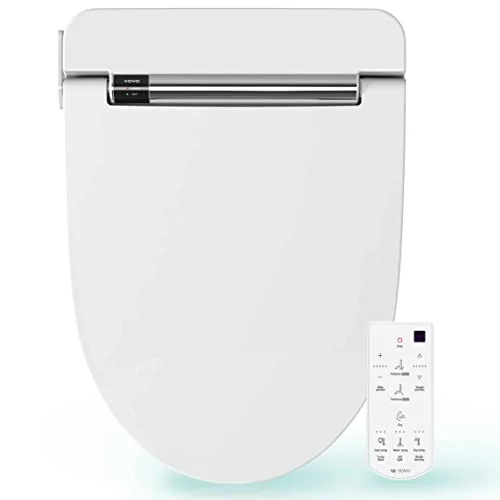
Line pressure is the simpler of the two, and it's exactly what it sounds like — your home's own water pressure, typically somewhere between 40 and 80 psi in a healthy residential system, pushes water straight through the nozzle when you turn the dial. There's no pump, no motor, nothing electrical in the path at all. The budget bidet seats under $100 guide covers more of these line-pressure options if price is the main driver. The VOVO Nature 8 non-electric seat works this way: it replaces your existing seat outright, uses ambient (unheated) water straight from the line, and needs nothing but the water already running to your toilet. That simplicity is also the ceiling — a line-pressure wash can only ever be as strong as the plumbing behind it.
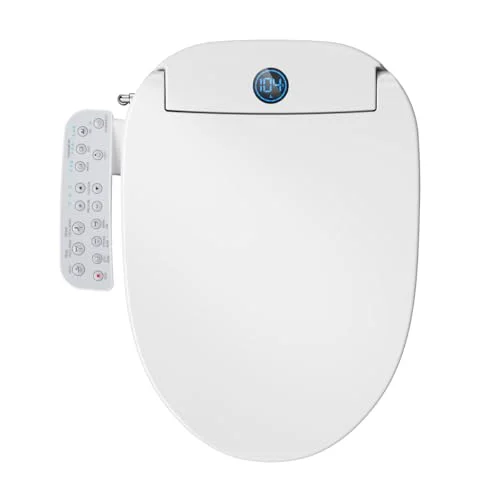
Pump-assisted systems, essentially every electric bidet seat, add a small internal pump between the valve and the nozzle. The pump pressurizes the water independently, which is what lets an electric seat offer a numbered pressure dial or remote presets that behave the same way every time, regardless of what the rest of the house is doing with its water. It's also what makes the water heater, when the seat has one, physically possible — the pump usually does double duty, pressurizing the wash and pushing water through the heating element fast enough that it comes out warm rather than lukewarm. The SR SUN RISE electric seat, the WLJBIDET O7L-1V and the GAICOM elongated seat are all pump-assisted — a fundamentally different pressure mechanism, not just a fancier version of line pressure. If warm water is what's pulling you toward electric, our heated seats and warm water guide goes deeper on the heating side of that pump.
Turning the dial
Pressure dials and presets — how much you'll actually use
Spec sheets love to advertise a number here — "5 pressure levels," "8-step adjustable pressure" — as if more steps were automatically better. In practice, most owners land on one comfortable setting within their first week and rarely touch the dial again after that. What actually matters is less the total count of steps and more two narrower things: whether the lowest setting is genuinely gentle rather than just "less strong," and whether the control — a side panel dial or a wireless remote — is easy to reach and adjust mid-wash without contorting.
Side-panel controls are the more common and less expensive option; you reach down and turn a dial or press a button built into the seat itself. A wireless remote, mounted on the wall or held in hand, does the same job without the reach, and it's the upgrade owners mention most often when comparing the two. Our bidet seats with a remote control guide covers which remote-equipped models are worth the added cost. Either way, the pressure adjustment itself is doing the same basic thing: increasing or decreasing how hard the pump — or, on a non-electric model, how far you open the valve — pushes water through the nozzle. A wide numbered range is a marketing detail more than a functional one; a comfortable low end that doesn't feel like being hosed down is the detail that actually decides whether you enjoy using the thing daily.
What's actually spraying you
Nozzle types: single, dual, oscillating, adjustable position
Underneath the pressure dial is the part that actually decides how the wash feels: the nozzle itself, and how it's built to move.
Single nozzle. The simplest, least expensive design. One nozzle handles the primary rear wash; some single-nozzle models let you nudge it forward for a lighter front pass, but that's a compromise, not a dedicated setting.
Dual nozzle. Two physically separate nozzles, one dedicated to a stronger rear wash and a second, usually shorter and softer, dedicated to a gentler front wash — the setup that makes a genuinely distinct feminine-wash mode possible, covered below.
Oscillating. Instead of spraying from one fixed point, the nozzle sweeps back and forth (and on some seats, pulses) while spraying, covering more surface area than a static stream at the same pressure. If it isn't mentioned on the listing, assume the nozzle is fixed.
Adjustable position. A dial or button that moves the nozzle forward or back a small amount so the spray lands correctly for different body types and seating positions, independent of pressure — one of the features that matters most for anyone with limited reach or flexibility; see our bidet seats for seniors and limited mobility guide.
These categories aren't mutually exclusive — a seat can be dual, oscillating and position-adjustable all at once, or just a single fixed nozzle. A general "adjustable" claim without one of these specific words attached usually just means the pressure dial, not the nozzle's physical position.
The second nozzle
Posterior vs feminine wash: what actually changes
On a dual-nozzle seat, the two settings aren't just the same spray aimed at two spots — they're built differently on purpose. The posterior wash nozzle sits further back, sprays at a steeper angle, and is typically tuned to run at higher pressure by default, because that's the setting doing the actual cleaning work after using the toilet. The feminine wash nozzle sits forward, sprays at a shallower, gentler angle, and is tuned for lower default pressure and a softer stream, because it's designed for more sensitive use.
This is the practical reason a single-nozzle seat can't fully replicate what a dual-nozzle model does: repositioning one nozzle changes where the water lands, but it doesn't change the angle, default pressure or stream softness the way a second, purpose-built nozzle does. If both settings matter to your household, a dual-nozzle model is worth prioritizing over a single-nozzle one even if the single-nozzle option has other appealing features. When checking a listing, look for both wash types called out by name rather than assuming — a single-nozzle seat that also advertises "adjustable position" is still a single-nozzle seat, just a repositionable one.
Between uses
Self-cleaning and retracting nozzles, and stainless vs plastic
Two things happen to a nozzle when you're not using it, and both are worth understanding before you buy. First, most electric seats and better attachments retract the nozzle behind a small guard gate between uses, so it isn't sitting exposed in the bowl collecting whatever passes through. Second, on models that advertise it explicitly, a self-cleaning cycle rinses the nozzle with a short burst of water before and after each use — not a deep clean, but enough to rinse the exterior of the wand rather than leaving it to sit. Neither retraction nor self-cleaning replaces manual maintenance; our how to clean and maintain a bidet seat guide covers the periodic deeper clean every model still needs regardless of what it does automatically.
The other detail worth checking is what the nozzle is actually made of. Stainless steel nozzles resist staining, scale buildup and bacterial growth better than plastic over years of daily use, and they tend to hold up better in hard-water households where mineral deposits are the main long-term wear factor. The VOVO VB-4000SE is a good example of a model that specifies a stainless steel nozzle on the listing, alongside warm water, an LED light, a heated seat, deodorizer and a warm-air dryer — it's a higher-tier build where the manufacturer calls out the nozzle material specifically, which is exactly the kind of detail to look for rather than assume. Plastic nozzles aren't a dealbreaker — they're standard on the large majority of seats in this category and work fine — but if a listing goes out of its way to mention stainless steel, that's a genuine, checkable upgrade rather than marketing filler.
When the plumbing fights back
Low household water pressure: what to expect, and how to fix it
If your home already runs low water pressure at the sink or shower, it's worth knowing how that plays out on a bidet before you buy one, because the two pressure sources handle it very differently.
On a line-pressure, non-electric model, low house pressure translates directly into a weak wash — there's no pump to compensate, so if your shower feels underwhelming, expect the bidet to feel the same way at its highest setting. This is the main practical downside of the category's simplicity: what you get is exactly what your plumbing provides, nothing more.
On a pump-assisted electric seat, the internal pump largely insulates the wash from your house's baseline pressure, which is one of the more underrated reasons to go electric in an older home or an apartment with historically weak water pressure — the pump does the pressurizing regardless of what's happening upstream, within the limits of the incoming supply.
If you'd rather fix the underlying issue than work around it, the usual causes and remedies, in roughly the order worth checking:
A partially closed shutoff valve. The valve behind the toilet is sometimes not fully open from a previous repair — check that it's turned all the way counterclockwise.
A clogged or kinked supply line. Sediment can build up in an older flexible supply line over years; a new braided steel line is inexpensive and a common fix.
A whole-house pressure regulator set too low. If every fixture in the house runs weak, not just the toilet, the home's pressure-reducing valve (often near the main water line entry) may be the actual culprit, and adjusting or replacing it is a job for a plumber.
Municipal supply pressure. In some areas, especially at the top of a hill or the end of a municipal line, incoming pressure is simply lower than average. A booster pump for the whole house is the fix here, but it's a bigger project than most people take on just for a bidet.
If fixing house-wide pressure isn't realistic right now, the pragmatic answer is to lean pump-assisted — an electric seat sidesteps a weak supply line in a way a line-pressure attachment structurally can't.
At a glance
How the pressure source breaks down across five real models
Prices move on Amazon — confirm the live price before buying.
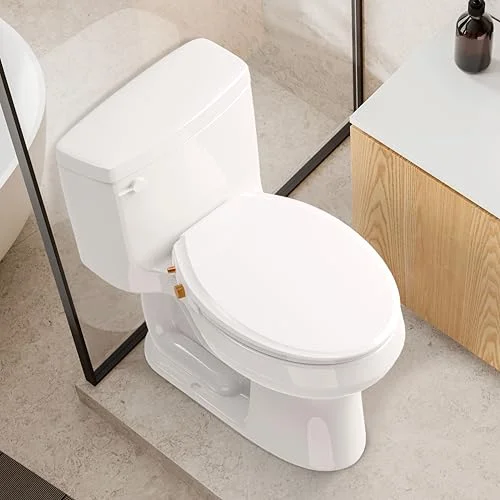
A full seat replacement rather than a clamp-on attachment, built for round toilets, running entirely on ambient water straight from your supply line at whatever pressure your house delivers. Easy stated installation and nothing electrical in the path at all — the trade-off for that simplicity is a wash that's exactly as strong as your home's own plumbing.
The straightforward entry point into pump-assisted pressure
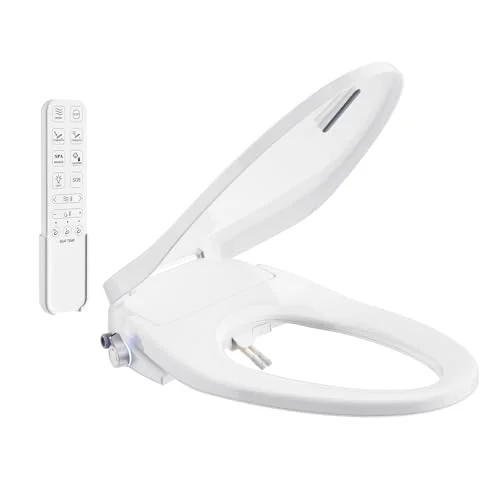
An electric, elongated-fit seat that gets you a consistent, pump-driven wash instead of relying on your house's line pressure, at a price close to a premium non-electric attachment. A reasonable place to start if pump-assisted pressure is the priority and you're not chasing every extra feature.
Pump-assisted pressure with warm water and drying added
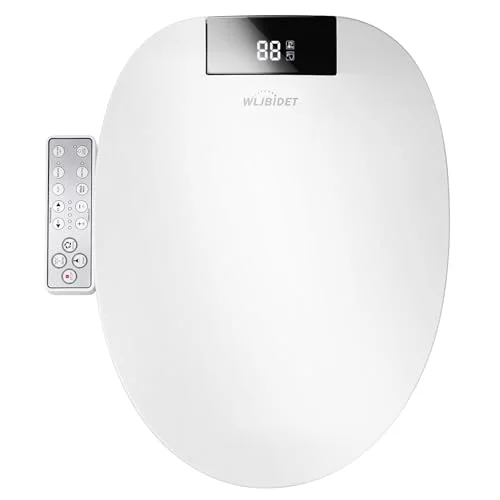
Builds on a basic pump-assisted wash with warm water and a drying function, in an elongated fit. If a plain pump-driven pressure system feels too bare but a $400 flagship feels like overkill, this sits in between on both price and feature count.
Adds a heated seat and dryer around the same pump-assisted core
Similar pump-assisted foundation to the WLJBIDET, with a heated seat and warm-air dryer as the headline extras, in an elongated fit. Worth comparing directly against the O7L-1V above since they sit close together in price with slightly different feature emphasis.
The nozzle-material upgrade, plus most of the feature list
Warm water, an LED light, a heated seat, deodorizer, dryer and — the detail most relevant here — a stainless steel nozzle, in an elongated fit. If the self-cleaning and materials section above convinced you that nozzle construction is worth paying for, this is the model on our list that specifies it outright rather than leaving you to guess.
Does a bidet seat need strong water pressure to work well?
It depends on the type. A non-electric, line-pressure model relies entirely on your home's own supply pressure, so a weak house supply produces a weak wash with no way to compensate. An electric, pump-assisted seat pressurizes the water internally, so it delivers a consistent wash largely independent of your home's baseline pressure — one of the practical reasons to choose electric in an older home with weak plumbing.
What's the difference between posterior and feminine wash?
On a dual-nozzle seat, the posterior nozzle sits further back, sprays at a steeper angle and higher default pressure for the primary cleaning wash. The feminine nozzle sits forward and is tuned for a gentler angle and softer, lower-pressure stream. They're built differently on purpose, which is why a single repositionable nozzle can't fully replace a dedicated second nozzle.
Do self-cleaning nozzles actually keep themselves clean?
A self-cleaning cycle rinses the exterior of the nozzle with a short burst of water before and after each use, which meaningfully cuts down on buildup between uses — but it's not a substitute for periodic manual cleaning. Retractable nozzles that tuck behind a guard gate between uses add a separate layer of protection by keeping the nozzle out of the bowl entirely when it's not in use.
My house has low water pressure — will a bidet still work?
A line-pressure, non-electric bidet will feel exactly as weak as the rest of your plumbing, since there's no pump to compensate. A pump-assisted electric seat sidesteps the problem because its internal pump pressurizes the wash on its own. If you'd rather fix the house's pressure directly, start by checking that the toilet's shutoff valve is fully open and that the supply line isn't old or kinked before assuming it's a bigger plumbing issue.