Affiliate disclosure: Best Bidet Seats is reader-supported. If you buy through links on this page, we may earn a commission from Amazon at no extra cost to you. We publish rating figures only where we hold verified per-product data — never invented numbers.
There's a version of the bidet conversation that starts at $450 and works its way up through stainless nozzles, air dryers, and remotes with more buttons than your TV's. This is not that conversation. This one starts at $39.99, because that's genuinely all it costs to answer the only question that matters for a first-timer: will you actually use this thing?
The under-$100 tier of the bidet market is dominated by non-electric attachments and seats — no plug, no heater, no motor. They run entirely on your home's water pressure, which means they work during a power outage, install in about twenty minutes with hand tools, and have essentially nothing inside them that can burn out. It also means the water is whatever temperature your cold line happens to be, and in January that fact will introduce itself with some enthusiasm.
We researched this tier the way we research everything on this site: published specs, live Amazon pricing, and thousands of verified buyer reviews — with extra attention on the one-star reviews, because that's where the plastic T-valves crack and the pressure dials get sticky. We don't run a testing lab and we won't pretend otherwise. What follows is what the published record actually supports: three budget picks worth your money, one step-up worth knowing about, and a clear-eyed accounting of the trade-offs. If you're weighing this tier against powered seats generally, our electric vs non-electric breakdown goes deeper on that fork in the road.
The honest ledger
What $100 gets you — and what it doesn't
The budget tier isn't a lesser version of the same product. It's a different product that happens to solve the same core problem.
✓
You get the hygiene
A pressurized water wash — the entire reason bidets exist. Owners of $30 attachments describe the same "why didn't I do this sooner" moment as owners of $500 seats.
✓
You get simplicity
No outlet needed, no electronics to fail, no error codes. A twenty-minute DIY install with the included T-valve, and it keeps working when the power doesn't.
✗
You give up warm water
Non-electric units spray cold-line water. "Dual temperature" models need a hot line tapped from your sink — a longer install most owners skip.
✗
You give up comfort extras
No heated seat, no adjustable nozzle position beyond a dial, no oscillation, no remote, no night light, no dryer. The wash is the whole feature list.
How non-electric works
The physics: your house is the machine
Understanding two facts about non-electric bidets will predict most of your experience with one.
Fact one: the pressure is your home's water pressure. A non-electric attachment has no pump. It's a valve, a nozzle, and a dial that throttles the flow of whatever your supply line delivers — typically 40 to 80 PSI in an American home. That's plenty; in fact, the most common surprise in owner reviews isn't weak spray, it's the opposite. Review after review warns new users to open the dial slowly on the first try, because a municipal line at full flow is a firehose compared to what an electric seat's pump meters out. If your home runs on well water with a weak pressure tank, or you're in an upper-floor apartment with tired plumbing, the experience will be gentler — occasionally too gentle. There's no boost mode to compensate. Everyone else has the opposite problem, which the dial solves in half a turn.
Fact two: the water is cold-line water. Not "room temperature." Cold-line. In a Texas summer that means vaguely cool and unremarkable. In a Minnesota February, the water sitting in your supply line can be under 45°F, and the first second of spray is a legitimately bracing event. Owners split into two camps on this: the majority acclimate within a week and report the cold becomes a non-issue — some come to prefer it — while a persistent minority never make peace with it and either upgrade to electric or quit using the attachment entirely. There's no way to know which camp you're in without trying, which is exactly the argument for spending $30 to find out rather than $300. If cold water is a dealbreaker sight unseen, skip this tier and read our warm-water guide instead — no budget attachment will convert you.
One nuance on "dual temperature" attachments: a handful of models — the TUSHY Spa 3.0 is the best-known — offer a hot-water inlet that mixes warm water without any electricity. It genuinely works, and it's the only way to get warm water in this product class. The catch is the install: the unit has to sit next to a sink, because you're running a second braided hose to that sink's hot supply, and each use starts with a wait while warm water travels the line. It also lands at $149, well past this guide's ceiling. Budget accordingly: at under $100, assume cold water, and treat the sink-connected warm option as a separate decision covered in our warm-water guide.
The picks
The three worth buying under $100
Ordered by our recommendation. Prices move on Amazon — confirm the live price before buying.
01Best budget
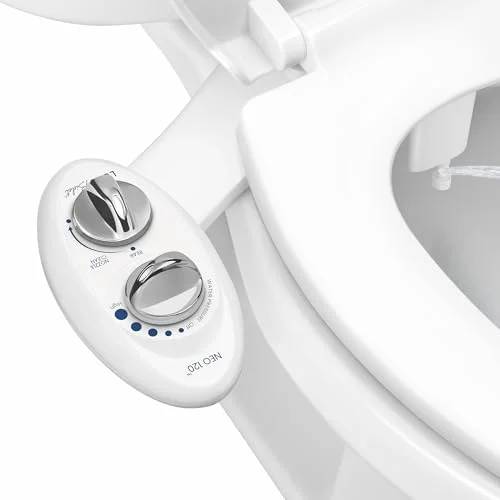
LUXE Bidet NEO 120
The $40 way to find out — metal-core valves in a plastic-fitting category
It clamps under your existing seat, splices into the supply line with the included T-valve, and delivers the core rear wash for less than a family pizza night. What separates it from the bare-nozzle units a few dollars cheaper is what LUXE puts inside it: high-pressure valves with metal-ceramic cores and braided steel hoses instead of plastic, plus a guard gate the nozzle retracts behind between uses.
The long version. The NEO 120 is the product we point to when someone asks whether the cheap end of this category is real or landfill. It's a slim non-electric attachment that sits between your bowl and your existing seat, with a single control dial on a small side panel and a single rear-wash nozzle. The nozzle retracts behind a guard gate when not in use — the detail that separates a decent budget attachment from the bare-nozzle versions, because the nozzle isn't sitting exposed in the splash zone between uses.
The spec sheet matters more than usual at this price, and it's where LUXE differentiates. The category's defining failure is fittings: cheap kits ship all-plastic valves and hoses. LUXE specifies metal-ceramic valve cores and braided steel hoses, which removes the most consequential weak point before you've touched a wrench. Everything needed for the install is in the box — T-valve, hose, mounting hardware.
The install is the other half of the pitch: turn off the supply valve, flush, unscrew the seat, slot the attachment, re-mount the seat, splice the T-valve into the supply line, hand-tighten, turn the water back on, check for drips. It's a hand-tool job on a standard two-piece toilet, typically inside half an hour. If your seat bolts are corroded or hidden under a skirted bowl, add time and mild swearing — our installation walkthrough covers the annoying cases.
The honest limits, which are the limits of the class rather than of this unit specifically: one nozzle, so there's no dedicated front wash; the pressure dial's usable range on a high-pressure home is a small arc, so open it slowly the first time; and the attachment adds a few millimeters of height under the seat, which on some bowls leaves the seat sitting slightly proud until you re-seat the bumpers. If a front wash matters to your household, skip to pick 03. Otherwise, at $39.99 this is the cheapest legitimate answer to the bidet question.
02Best budget seat
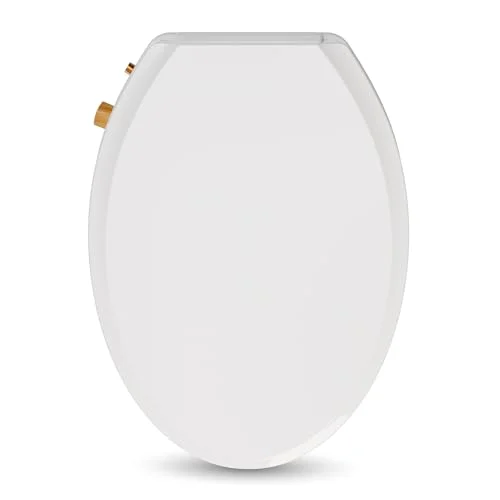
VOVO Nature 7
A full seat replacement — no attachment wobble, no added height, soft-close lid
Instead of clamping under your seat, the Nature 7 replaces it entirely: a one-piece non-electric bidet seat with a quiet soft-close lid and a bamboo control knob on the side. You get a finished-fixture look with no gap and no added seat height, from a Korean manufacturer whose whole product line is bidet seats — and it lands $20 under the budget ceiling.
The long version. The Nature 7 answers the two complaints people have about attachments: the aesthetics and the wobble. Because it's a complete seat rather than a shim under your existing one, there's no gap, no added height, and no side panel bolted awkwardly to the rim — the control knob integrates into the seat's edge. It reads as a finished fixture, which matters more than it sounds like it should if you're staring at this thing every day.
Functionally you're paying roughly two NEO 120s for three upgrades: the integrated build, a soft-close lid that won't slam, and a seat designed as a seat rather than a spacer. The wash mechanics are otherwise the same non-electric physics — house pressure, ambient cold-line water, a manual dial. VOVO is worth a note here: it's a Korean bidet specialist rather than a generalist housewares brand, and bidet seats are essentially all it makes, which is a different proposition from the unbranded units that dominate this price band.
The honest limits. It's elongated-only — round-bowl owners want the Nature 8, the same seat built for round bowls at the same $74, and bowl shape is the single most common cause of budget-bidet returns across every brand we track. Our fit guide explains the two measurements to take before ordering. As with any non-electric, winter supply-line temperature is the trade-off you're accepting, and the bamboo knob is a styling choice you'll either like or not. If those read as acceptable, the Nature 7 is the most polished way to go bidet under $100.
03Best build
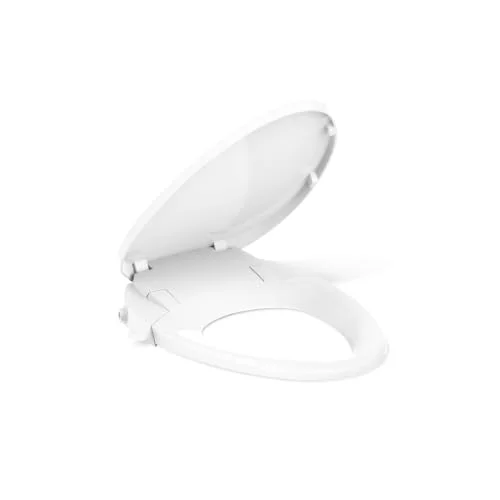
Kohler PureWash M300
Front and rear wash from a plumbing brand — the dual-nozzle pick, still under $100
The M300 is the one to buy if you want a dedicated front wash without leaving the budget tier. It's a manual, non-electric seat with dual-spray front and rear modes, adjustable pressure, a wand that self-rinses after each use, and Quick-Release hinges for cleaning — carrying the name of a plumbing-fixture company that has to support it.
The long version. Seven dollars under the ceiling, the M300 buys the one feature the cheaper picks genuinely lack: a separate front wash. For households where that matters, it isn't a luxury and there's no point pretending the single-nozzle attachment substitutes for it. You also get a self-rinsing wand — the wand cleans itself after every use rather than waiting for you to do it — plus Grip-Tight bumpers to stop the seat shifting, a quiet-close lid, and Quick-Release hinges that let you lift the whole seat off to clean under it.
The Kohler part is not just branding. This is a fixture company with a spare-parts operation and a support line, which at the budget end of a plumbing product is worth real money — the failure modes in this category are fittings and wands, exactly the things a brand with a parts channel can replace. Note one Kohler-specific term before you order: Kohler does not accept returns on toilet seats once opened or out of the original packaging, so the fit measurement genuinely has to happen first.
The limits are the class limits again, plus one. It's manual and non-electric, so the water is ambient cold-line temperature and the control is a side handle, not a remote. It fits elongated bowls; the round equivalent is the PureWash M250 at $117.24, which pushes past this guide's ceiling. And at $93.75 it's more than twice the NEO 120, which is the right trade only if the front wash or the integrated-seat build is something you actually want.
Just over budget
The $270 question: when saving up is the smarter move
Past the budget line sits the thing no non-electric can give you: warm water that doesn't run out. For some readers, it's the better math.
04The step-up
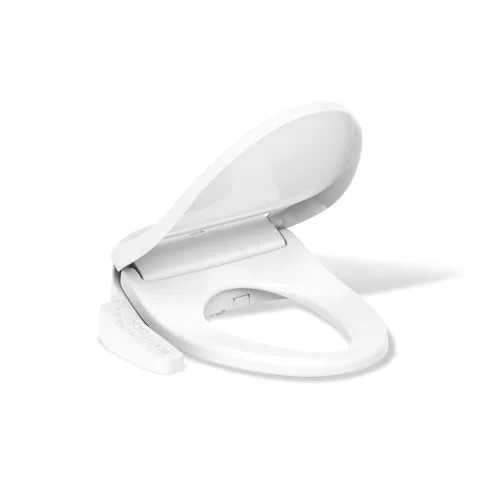
Kohler PureWash E580
Continuously heated water, not a reservoir that runs cold mid-wash
The step-up worth making. A hybrid heater delivers continuously warm water rather than the tank-fed 30 seconds cheap electric seats give you, the stainless wand self-cleans before and after every use, and an oscillating wash with a turbo setting covers a wider area. It needs a GFCI outlet within cord's reach.
Here's the honest decision rule we'd apply. Buy under $100 if you're bidet-curious and unconvinced, you have no outlet near the toilet, you're outfitting a rental or a guest bathroom, or you live somewhere the cold line never gets truly cold. The $39.99 NEO 120 resolves your curiosity at the lowest possible stake, and if you fall in love, it hasn't cost you much to learn what you actually want in the upgrade.
Save up for the electric seat if you already know cold water will end the experiment before it starts — you're in a northern state, you run cold, you've tried a friend's non-electric in winter and noped out. For you, a budget attachment isn't a savings; it's $40 spent confirming a thing you already knew, followed by buying the electric seat anyway. The specific reason we point at the E580 rather than the cheapest electric seat on the listing page is the heater type: budget electric seats use a small reservoir, which means warm water for roughly one wash cycle before it runs cool — fine for one person, a genuine annoyance in a busy household. A hybrid heater doesn't have that limit.
One honest note for the truly budget-bound: electric seats with instant warm water now exist at around the $100 line — the SR SUN RISE elongated seat sits at $99.98 with a seat sensor and multiple wash modes. We're not making it a pick, because it comes from a brand with no track record we can point to, and at the budget end an unsupported product is a real risk. But it exists, and if warm water is non-negotiable while $270 isn't available, it's the honest cheapest route. Whether any of this spending is justified at all is a fair question too; we make the full case, costs and counterarguments included, in Are bidet seats worth it?
Read before you buy
How cheap units fail: what the one-star reviews actually say
We read the critical reviews so you don't have to. Across budget bidets as a class, the same four failure modes repeat.
01
Plastic T-valves
The most serious one. Budget kits ship plastic T-adapters that can crack if over-tightened or stressed — and a cracked T-valve is a water leak running unattended. Hand-tighten only, check for drips at 24 hours and again at a week.
02
Sticky pressure dials
The dial is the only moving part you touch, and on cheap units it's the first to degrade — stiff, gritty, or drifting off its setting after months of mineral buildup. Hard-water homes see it sooner.
03
Nozzle retraction wear
Spring-loaded retracting nozzles can start sticking half-extended after a year or two, especially with hard water. A vinegar soak revives some; others are simply done. At $30, owners shrug and rebuy.
04
Seat-mount wobble
Attachments add millimeters under the seat, and on some bowls that means a seat that shifts or a slow loosening of the bolts. Re-tightening helps; a full seat like the Nature 7 or the PureWash M300 avoids it entirely.
Two practical mitigations are worth the small effort. First, if your kit ships with a plastic T-valve, a brass 7/8" T-valve costs a few dollars at any hardware store and removes the single most consequential failure point — a meaningful minority of experienced owners in the review threads report doing exactly this swap on day one. Second, whatever you install, look at the connections a day later and a week later. Nearly every leak horror story in the review record follows the same script: it held at install, weeped slowly afterward, and nobody looked. Thirty seconds with a dry paper towel against each fitting is the whole inspection.
It's also worth calibrating expectations about lifespan. A $40 attachment is not a ten-year fixture and doesn't pretend to be; the realistic expectation is years of service with soft water and gentle installation, less with hard water and a heavy hand. The economics still favor the experiment — even two NEO 120s over four years costs less than one winter of upgraded toilet paper — but go in knowing you bought a consumable, not an heirloom. The $93.75 M300 sits in a different category here: a fixture-brand seat with a parts channel behind it is a longer-horizon purchase than any clamp-on attachment.
Before you click buy
The five-minute buying checklist
Check your bathroom
Four things to verify
1. Bowl shape. Round or elongated — measure from the seat bolts to the front rim (roughly 16.5" round, 18.5" elongated). Attachments fit both; seats don't.
2. Supply valve access. Find the shutoff valve behind the toilet and confirm it turns. A seized valve turns a 20-minute install into a plumber visit.
3. Skirted bowls. Concealed-trapway toilets can hide the seat bolts and pinch hose routing — check the listing's fit notes before ordering.
4. If electric-curious: an outlet. The step-up seat needs a GFCI outlet within reach. No outlet, no electric — that decision makes itself.
Check the product
Four things to demand
1. A guarded, retracting nozzle. The hygiene feature that separates the decent budget units from the bare-nozzle cheapies.
2. A brand that can still be reached. At this price the failure modes are fittings and wands — replaceable parts. A company with a support line and a parts channel is worth more than a longer spec list.
3. Included T-valve and hose — and ideally metal fittings, or budget $5 for the brass T-valve swap.
4. A front-wash nozzle if it matters for your household. That's the PureWash M300's edge over single-nozzle attachments.
How we picked
The budget tier, filtered hard
We started from every non-electric seat and attachment in our database under $100, then weighted hard for the things budget buyers actually get burned on: fitting materials (metal cores and braided hoses over all-plastic), a guarded retracting nozzle, published fit documentation, and a brand with a parts channel and a support line. Three products survived. The rest are variations on the same hardware from sellers you would have no recourse against.
How we compared
Research, not a lab
We're honest about this: we don't physically test these products and we don't run a testing lab. We compare published specifications, live pricing, and the documented failure patterns of this product class — which at the budget end is where the truth lives. You'll notice no star ratings on this page: we only publish rating figures when we hold verified per-product data, and we don't for these picks. We would rather show you nothing than a number we invented.
FAQ
Budget bidet questions
Is the cold water actually bearable?
For most people, yes — after an adjustment week. The spray lasts seconds and targets a small area, and the majority of owners in warm and temperate states report it quickly becoming a non-issue. In cold-winter states the calculus is tougher: supply-line water can drop below 45°F, and a minority of owners never acclimate. If you already know you're cold-averse, skip straight to an electric seat with a water heater — that's the honest answer.
Will a $40 attachment damage my toilet or plumbing?
Not if it's installed with a light touch. The genuine risk isn't the toilet — it's the T-valve, which can crack if over-tightened and cause a leak. Hand-tighten only, re-check the fittings after a day and after a week, and consider a $5 brass T-valve for peace of mind if your kit ships a plastic one. The attachment itself just sits between the bowl and seat; removal takes ten minutes and leaves no trace, which is why renters love them.
Attachment or non-electric seat — which should I get?
Get the $39.99 LUXE NEO 120 attachment if you're testing the idea, renting, or outfitting a spare bathroom — lowest cost, fastest install, fully reversible. Get the $74 VOVO Nature 7 if you're sold on going non-electric and want it to look and feel permanent: integrated build, no added seat height, soft-close lid. Step up to the $93.75 Kohler PureWash M300 if you want a dedicated front wash, which neither of the other two provides. If you have an outlet by the toilet and $270, an electric seat with continuously heated water beats all three on comfort.
Keep reading
If this helped, go deeper
The fork in the road
The full comparison of what a plug buys you — heaters, pumps, remotes — and who genuinely doesn't need one.
Twenty minutes, one wrench
The step-by-step walkthrough, including the corroded-bolt and skirted-bowl cases the quick-start guides skip.
Measure first
The two measurements that prevent the most common budget-bidet return, in five minutes with a tape measure.