By Ilane TallUpdated September 16, 2026Research-based
Best Bidet Seats is reader-supported. When you buy through our links we may earn a commission, at no extra cost to you. Commissions never change which products we recommend.
Your own bathroom gets used twice a day, every day, by someone who's going to live with whatever you buy for years. A guest bathroom is a different animal entirely: it might get used four or five times a month, by people who have never touched your fixtures before and never will again after the weekend is over. That single fact — infrequent use by unfamiliar people — should change almost every decision you make about what goes on that toilet, and for most shoppers it doesn't, because the marketing for bidet seats is written for the primary bathroom, not the guest one.
We built this guide specifically for that second bathroom: the one down the hall from where your in-laws sleep, the one your neighbors use during a dinner party, the powder room off the entryway that a delivery driver might end up in. The products that win in that context are not the ones with the most features. They're the ones nobody has to think about, ask about, or troubleshoot at 11pm during a holiday visit.
One honest note before we get into it: we don't run a fake testing lab, and we don't pretend to. Everything below comes from published product specifications, current Amazon pricing, and how each of these categories of bidet hardware is documented to work. We compare, we research, we don't invent.
The short answer
If you just want the pick
Get an attachment if…
You want the cheapest, fastest fix
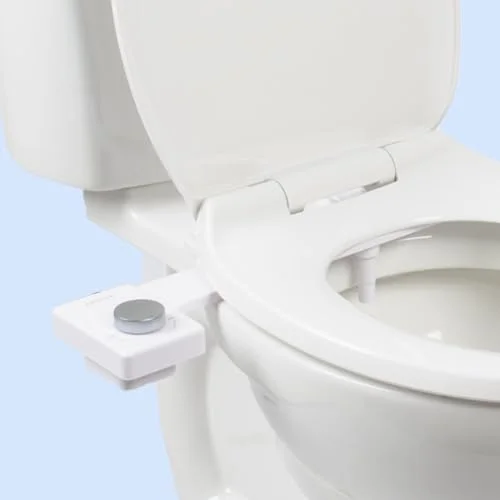
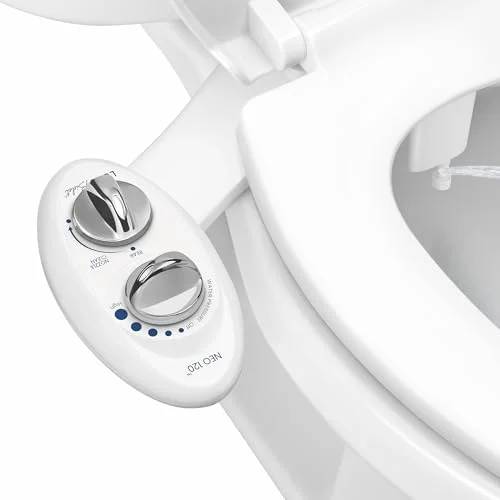
An attachment clamps under the seat your guest bathroom already has, so bowl shape stops being a variable. The LUXE Bidet NEO 120 ($39.99) is the lowest-friction way to add one to a bathroom nobody spends much time in.
Get a full seat if…
Your guest bowl is a known shape and you want it to look built-in
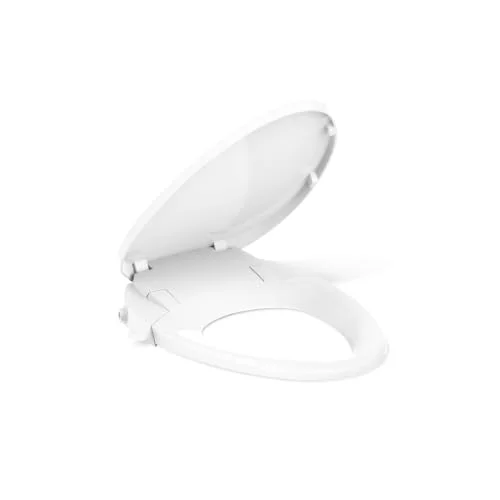
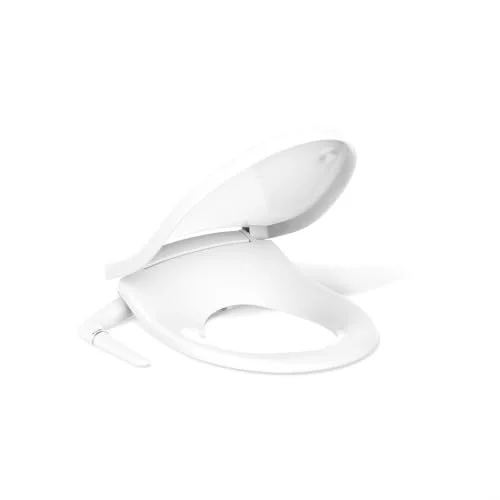
A manual bidet seat replaces the whole thing and reads as original equipment. Measure the bowl first, then pick the Kohler PureWash M300 (elongated, $93.75) or the Kohler PureWash M250 (round, $116.26).
The real question
Why a guest bathroom is a different buying problem
In your own bathroom, the cost of a confusing control panel or a fussy install is a few days of you personally figuring it out, once, and then never thinking about it again. In a guest bathroom, that same confusing control panel is a cost you pay over and over, for years, every single time someone new stands in front of your toilet trying to figure out which lever does what. The bidet seat with the most settings is, by definition, the one most likely to confuse a first-time user — and a confused guest either gives up, gets sprayed somewhere unexpected, or asks you an awkward question through the door.
There's also a usage-rate math problem that most buying guides ignore. A bidet seat used twice a day amortizes its price over roughly 730 uses a year. A guest bathroom fixture used four times a month sees about 48 uses a year — fifteen times less. Every dollar of premium you spend on warm water, a heated seat, or a remote control gets divided across a fraction of the uses, which means the payback math that justifies a $270 electric seat in your primary bathroom simply doesn't compute in a room that sits empty most of the month. The products that make sense here are cheap, obvious, and durable while sitting unused — not feature-rich.
Finally, a guest bathroom fixture has to survive being ignored. It might go three weeks without a single use, then get four uses in one holiday weekend. Anything with a water reservoir, a battery-backed remote, or standby electronics is designed around regular use; irregular use is exactly the pattern that exposes their weak points — a remote whose batteries die from disuse, a reservoir that sits with stagnant water between uses. A simple manual valve fed directly by your home's water line has no such failure mode. It works identically whether it was used yesterday or three weeks ago.
The learning curve
No learning curve: a control a first-time guest understands in seconds
The single biggest usability difference in this category is the control type — side panel, wireless remote, or a plain mechanical dial or lever — and it matters more in a guest bathroom than anywhere else in the house. A remote with a dozen buttons for pressure, position, oscillation, and temperature is genuinely nice for someone who lives with it every day and learns the layout once. It's the opposite of nice for a guest who has never seen it before, is already slightly uncomfortable being in someone else's bathroom, and now has to read tiny icons under unfamiliar lighting to figure out which button sprays water and which one might do something else entirely.
Every product in this guide sidesteps that problem the same way: a single mechanical control — a knob, a lever, or a dial — that a person can operate purely by intuition. Turn it toward you, water comes on; turn it back, it stops. There's no menu, no mode to select first, no remote to locate. That's not a compromise made to hit a lower price point, although it does hit a lower price point — it's the actual design goal for a fixture that strangers need to use correctly on the first try, with nobody there to explain it.
If you're furnishing a primary bathroom where the household will live with the controls daily, the calculus flips, and a remote or side-panel model with more settings is worth the learning curve. For that comparison, see our breakdown of side panel vs. remote control. For a guest bathroom, simpler wins every time.
Measure first
Round or elongated — check the guest bowl before you order
This is the mistake that turns a cheap, simple purchase into a return-and-reorder headache: buying a full replacement seat before confirming which bowl shape you actually have. Elongated bowls are oval and slightly longer at the front; round bowls are, unsurprisingly, closer to a circle. Most toilets installed since the 1990s are elongated, but plenty of older homes, and the powder room that came with the house rather than a later renovation, still have a round bowl — and a seat built for one shape will not sit flush on the other. It'll either overhang the front or leave a visible gap at the back.
The two full-seat picks in this guide solve that by existing in matched pairs: the Kohler PureWash M300 is built specifically for elongated bowls, and the Kohler PureWash M250 is built specifically for round bowls. There's no universal version — you have to know which one you have before you order. If you're not sure, measure from the bolts at the back of the bowl to the front rim: under about 18.5 inches is typically round, over that is typically elongated. Our full guide to bidet seats for elongated toilets walks through the measurement in more detail if you want to be certain before you buy.
Attachments dodge this question almost entirely. Because the LUXE Bidet NEO 120 and the TUSHY Fresh Ultra-Slim Starter both clamp between your existing seat and the bowl rather than replacing the seat outright, they conform to whatever seat is already installed — round or elongated — instead of needing to be matched to the bowl shape themselves. That's a meaningful advantage in a guest bathroom you may not have measured recently, or one you're outfitting sight-unseen for a rental property or a relative's house.
The feature trap
Why electric features rarely pay off on a fixture used a few times a month
Electric bidet seats earn their premium price in a primary bathroom through sheer repetition: warm water and a heated seat stop being novelties and start being habits after a few dozen uses, and a household using one twice a day recoups that comfort many times over across a year. None of that math holds up in a guest bathroom used a handful of times a month. Warm water is genuinely nicer than cold, but "nicer" spread across 48 annual uses instead of 730 is a rounding error in the value it delivers, while the downside risk stays exactly the same size.
That downside risk is real and specific to low-use fixtures. Electric seats need a GFCI outlet within reach, which not every guest bathroom or powder room has without an electrician visit. They also introduce standby electronics — a heater keeping a water reservoir warm, a control board, sometimes a remote with its own batteries — that are built to be used regularly and checked on occasionally. A fixture that sits idle for three weeks and then gets used four times over a weekend is precisely the usage pattern that exposes whatever can go quietly wrong with standby hardware, and what a bidet seat does when the power goes out is a question you'd rather not have to answer for a bathroom you don't check daily. A simple mechanical valve, by contrast, doesn't degrade from disuse and has nothing to fail while nobody's using it.
There's also a straightforward cost argument. Every product recommended in this guide is a bidet seat or attachment that needs no electricity at all — no outlet, no standby power draw, and a purchase price a fraction of what an electric model with auto-open lids or voice control would run. If you want to see exactly what that premium buys in a primary bathroom, our look at auto-open and voice-controlled bidet seats and our guide to luxury bidet seats lay out the electric feature set in full — features that are genuinely worth paying for where they get used daily, and largely wasted where they don't.
At a glance
The four picks, side by side
All four are manual — no outlet, no standby power, nothing to fail while the room sits empty. Prices move on Amazon — confirm the live price before buying.
Best overall — the fastest, cheapest way to add one
It clamps under the seat your guest bathroom already has, so there's no bowl shape to check and no seat to replace. A single control operates the spray, which is exactly the interface a first-time guest can figure out without a second thought. At $39.99, it's the least you can spend and still give a guest bathroom a real bidet.
Like the LUXE, it's an attachment rather than a seat replacement, which means the same fit-anything advantage in a guest bathroom you haven't measured. Its ultra-slim build sits lower under the seat than a bulkier attachment would, which matters in a small powder room where every added inch of seat height is visible. A sensible step up at $49.00 if you want the thinnest possible profile.
A full seat replacement built for elongated bowls, with a quiet-close lid that prevents the late-night slam every guest bathroom eventually suffers, quick-release hinges that make cleaning underneath simple, and a self-cleaning wand. Because it replaces the seat outright rather than clamping under it, it reads as original equipment — nobody has to know it was added later. Confirm your guest bowl is elongated before ordering.
Best for round guest bowls — the only match for older toilets
The round-bowl counterpart to the M300, for the older or smaller guest bathroom that never got upgraded to an elongated fixture. It shares the quiet-close lid and quick-release hinges, and adds an adjustable spray position and pressure dial, still operated with a single manual control rather than anything electric. If your guest toilet predates the elongated-bowl era, this is the one that will actually fit it.
Cost per use, and why cheaper is often the right answer here
Cost per use is the number that actually separates a good guest-bathroom purchase from a wasteful one, and it looks nothing like the cost-per-use math for a primary bathroom fixture. Assume a guest bathroom gets used about four times a week when it's actually in use — realistic for a household with regular weekend visitors — which works out to roughly 200 uses a year, or about 1,000 uses over a five-year span before most people reconsider their bathroom fixtures anyway.
Run the numbers on that basis. The LUXE Bidet NEO 120 at $39.99 works out to about four cents a use over five years. The TUSHY Fresh Ultra-Slim Starter at $49.00 comes to roughly five cents a use. Even the pricier Kohler PureWash M250 at $116.26 — the most expensive pick here — lands at about twelve cents a use, and that's before accounting for the fact that a full seat replacement typically outlasts an attachment because there's less to wear at the connection points. None of these numbers are large enough to move a household budget in any direction. The entire spread between the cheapest and priciest pick in this guide, over five years, is less than the cost of one dinner out.
That's precisely why cheaper is so often the right answer for a guest bathroom specifically: the financial upside of spending more is almost nonexistent at this usage rate, while the risk of spending more — a feature nobody in the room knows how to operate, an outlet that isn't there, standby electronics sitting idle for weeks at a time — is concrete and recurring. In a primary bathroom, the calculus can genuinely favor an electric seat with a real payback in daily comfort. In a guest bathroom, the honest math says spend the smallest amount that reliably does the job, and let the savings go toward literally anything your guests will actually notice.
If you're weighing this decision across your whole house rather than just the guest room, our broader are bidet seats worth it? guide runs the full cost-benefit comparison for primary-bathroom use, where the math tilts differently because the usage rate is so much higher.
FAQ
Guest bathroom bidets: common questions
Should a guest bathroom bidet be electric or non-electric?
Non-electric, in almost every case. A guest bathroom's low usage rate means warm water and a heated seat deliver very little of the value they provide in a primary bathroom, while an electric seat still requires a nearby GFCI outlet and introduces standby electronics that are built for regular use rather than sitting idle for weeks between visits. A simple manual attachment or seat does the core job with nothing to fail while the room is empty.
How do I know if my guest bathroom has a round or elongated bowl?
Measure from the two bolts at the back of the bowl to the front rim. Under about 18.5 inches is typically a round bowl; over that is typically elongated. Most homes built or renovated since the 1990s have elongated bowls, but older or smaller guest bathrooms and powder rooms often kept the original round bowl. If you'd rather not measure, a clamp-on attachment fits either shape without you needing to know which one you have.
Will a first-time guest know how to use it without instructions?
That's the design goal of every product in this guide — a single mechanical knob, lever, or dial rather than a remote or multi-button side panel. Turning it toward you starts the spray and turning it back stops it, with no mode to select and no icons to interpret. It's the same intuitive control whether it's someone's first time or their fiftieth.
Is a $40 attachment really worth it for a bathroom used a few times a month?
Yes, more so than a pricier option. At a guest bathroom's typical usage rate, a $39.99 attachment works out to a few cents per use over several years, and it delivers the same core hygiene benefit as a $300 electric seat would, minus features that a fixture used this infrequently rarely justifies. The lower the usage rate, the less sense it makes to spend more.