Bidet Seats That Open by Themselves (and Answer You)
By Ilane TallUpdated September 14, 2026Research-based
Best Bidet Seats is reader-supported. When you buy through our links we may earn a commission, at no extra cost to you. Commissions never change which products we recommend.
A bidet seat that lifts its own lid when you walk in and takes a spoken command instead of a button press used to be a $500-plus novelty reserved for the TOTO Neorest catalog. That's no longer true. Sensor-driven auto-open and basic voice control have both worked their way down into seats that sell for under $300, which means the real question isn't whether you can afford these features anymore — it's whether you actually want them in your bathroom, on a $150–$280 seat, for the rest of the time you own it.
That's a different question than the marketing copy answers. A proximity sensor and a microphone are two more things that can go wrong on an appliance that's already juggling a water heater, a pump and a seat warmer, and both add a small but real electricity draw that runs around the clock, not just when you're in the room. We compared the published specs, prices, and owner reviews for the seats currently offering these features to work out what they actually sense, how reliable the voice commands are in practice, and what a year of ownership looks like once the novelty wears off.
One honest note before we start: we don't run a fake testing lab, and we never pretend to. Everything here comes from published specifications, live pricing, and verified Amazon buyer reviews — including the critical ones, which is where the real trade-offs hide.
The short answer
If you just want the verdict
Get one if…
Hands-free actually matters in your bathroom
If you're shopping with mobility, dexterity or reach limitations in mind, or you simply like the idea of never touching a side panel, auto-open and voice control solve a real problem rather than a manufactured one. The ZingPOP Voice Control seat ($169.99) is the least expensive way to try both features together.
Skip it if…
You just want warm water that works every day
Every motor and microphone you add is one more thing that can eventually need a repair or a reset. If your priority is dependable warm water with the fewest possible failure points, a remote-controlled seat without auto-open does the core job with less to go wrong. See our electric vs non-electric comparison for the simpler end of the category.
What's actually under the hood
What auto-open really senses, and how often it gets it wrong
"Auto-open" sounds like the seat knows you're coming, but what's inside is almost always a passive infrared (PIR) motion sensor — the same low-cost technology in a porch light or a paper-towel dispenser — mounted somewhere near the base or the side panel. It detects a change in infrared heat within a cone in front of the bowl, and when it fires, a small motor lifts the lid and, on some models, the seat as well. There's no camera, no facial recognition, no way for the seat to know it's actually you and not the family dog wandering past the doorway.
That distinction matters because PIR sensors are a blunt instrument. They react to motion and heat, not intent, which produces two predictable failure modes that show up repeatedly in owner reviews: false triggers, where the lid lifts because someone walked past the bathroom door or a pet crossed the sensor's field, and missed triggers, where a person standing still in the room — reading, or simply not moving toward the bowl fast enough — doesn't register at all and has to reach for the panel anyway. Sensitivity and detection range are usually adjustable in the settings menu, and most owners who complain about false triggers report the issue mostly resolves once they narrow the range down from the factory default.
The other thing worth knowing: auto-open only lifts the lid, and often the seat. It does not flush, and on most models it does not auto-close on a timer either — some close automatically after a set interval of no motion, others require the same panel or app press to close as any other electric seat. Read the specific product's settings menu before assuming it behaves like a fully hands-free toilet from start to finish; the feature set varies enough between models that a blanket assumption will disappoint you.
Party trick or actually useful
Voice control: convenience or party trick?
Voice control on a bidet seat is a much smaller feature than the name implies. It is not a general-purpose assistant — it does not connect to Alexa or Google Home, it doesn't answer questions, and it doesn't understand natural sentences. What it actually does is listen for a small set of fixed command words — typically things like "wash," "stop," "dry," and a seat or lid open/close pair — and trigger the matching button press. Think of it as a voice-activated remote with a five-to-ten-word vocabulary, not a smart speaker bolted to a toilet.
Within that narrow scope, it works reasonably well according to owner reports, with the usual caveats of any voice-recognition feature in a small room: it can mishear a command over a running exhaust fan or shower, it may need a specific wake phrase before the following command, and accents or a quiet speaking voice can reduce reliability. The genuinely useful case for it — and the one that shows up again and again in reviews from buyers who kept using it past the first week — is hands-free operation for anyone with limited grip strength, arthritis, or a temporary injury that makes reaching or pressing a side panel difficult. For everyone else, it tends to become a feature people demo for guests once and then quietly go back to the remote or panel for, simply because pressing a button is faster and more certain than speaking a command and waiting to see if it registered.
If reliable hands-free control is the actual goal rather than the novelty, it's worth comparing this to a standard wireless remote first — our side panel vs remote guide breaks down why a remote alone solves most of the same reach and dexterity problems with one motor fewer and nothing to mishear.
The picks
The three worth a closer look
ZingPOP Bidet Toilet Seat
Best value — voice control and auto-open together, under $160
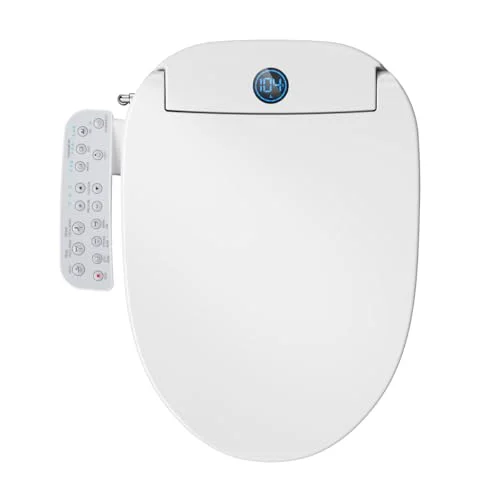
The least expensive way to get both features on the same seat: voice-activated wash and dry commands alongside a motion-sensing auto-open lid, plus heated water and an elongated fit. At this price point it's the one to buy if you want to find out whether you'll actually use these features before spending twice as much on a premium model.
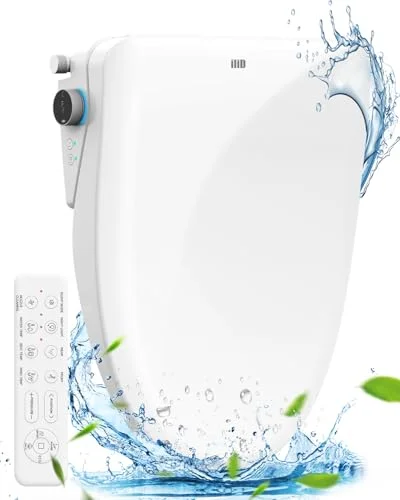
No auto-open, no microphone — a wireless remote instead, with electric warm water and a heated elongated seat. It's here as the direct comparison point: the same core comfort features as the sensor-and-voice models, at a similar price, with two fewer subsystems that can eventually need a repair. If the answer to "would I really use voice control" is genuinely uncertain, this is the lower-risk seat.
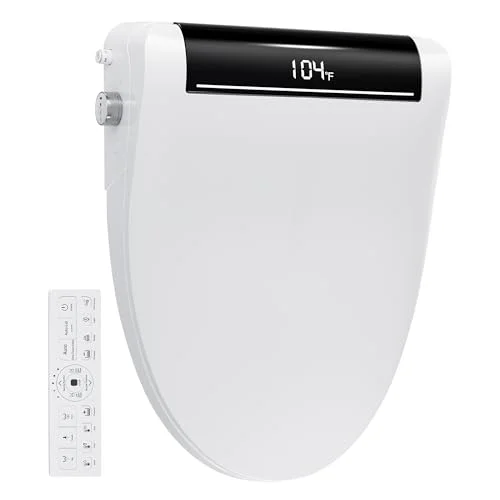
A heated seat and a warm-air dryer on top of the electric wash, for buyers who've decided the drying step matters more than a voice command does. It's the highest priced of the three here, which buys a more complete comfort feature set rather than more sensing hardware — worth comparing against the ZingPOP if you're deciding which extras are worth paying for. If you're not sure the dryer earns its keep, our warm-air dryer breakdown weighs it against just keeping a towel nearby.
Power draw and standby cost of an always-listening seat
Every electric bidet seat already draws standby power around the clock to keep its water — and on most models, its own seat — warm, typically landing somewhere in the range of $15–$40 a year in electricity depending on climate, settings and local rates, as we've covered in our electric vs non-electric guide. A motion sensor and a microphone add to that baseline, but not dramatically — PIR sensors and always-listening microphones for a fixed command set are both low-power components by design, drawing a small fraction of a watt continuously rather than anything comparable to the heater's brief high-wattage bursts. Manufacturers of these seats don't publish a separate standby wattage for the sensing hardware, so we won't invent one; the honest statement is that it's a real addition to the always-on draw, layered on top of an already-present standby cost, and not something published specs let us quantify precisely.
What that means practically: don't expect auto-open and voice control to move your electric bill in any way you'd notice next to the water heater and seat warmer, which are doing the real work. But "negligible" isn't "zero," and if minimizing standby draw is a priority for you at all, a remote-controlled seat without either feature — like the iliD above — has strictly less always-on electronics running than a sensor-and-microphone model does.
There's also a practical wrinkle worth knowing before you shop: a seat that's always listening for a command word and always watching for motion needs to stay powered on to do either job. Unlike the wash function, which only draws real current for the seconds it's actually spraying, the sensor and the microphone are on continuously, which is exactly why their draw is described in fractions of a watt rather than the double-digit wattage a heater pulls in bursts. If you ever unplug the seat — during a move, a renovation, or simply to reset it — both features come back online the moment power is restored, with no separate battery backup to worry about on the models covered here.
The long haul
More motors, more to fail: what owners report after a year
Every additional motor, sensor or microphone on an electric bidet seat is a component that eventually needs to work correctly at the same moment as everything else on the seat. That's not a reason to avoid these features — it's a reason to have realistic expectations about what a year or two of ownership looks like. Across owner reviews of sensor- and voice-equipped seats, the recurring themes are consistent with what shows up on simpler electric seats, just with two more items on the list:
Sensor drift. A PIR sensor that worked reliably at installation can become more prone to false or missed triggers over months, often traced to dust accumulation over the sensor window or a settings reset after a power interruption. Reviewers who stuck with the feature past the first month generally report re-checking the sensitivity setting occasionally rather than living with a fixed factory setting forever.
Voice recognition fatigue. Some owners report the voice feature working well initially and becoming less reliable over time, though it's not always clear from reviews whether this reflects hardware wear, software drift, or simply the owner's patience for repeating a command wearing thin faster than the hardware does.
The core electric-seat failure modes still apply. Remote or button pairing quirks, occupancy-sensor finickiness on models that also gate the wash behind a "seated" detection, and eventual heating-element wear are the same issues that show up on any electric seat, sensor-equipped or not — see our electric vs non-electric comparison for the full breakdown of typical electric-seat failure points.
None of this is a reason to write off the category — it's a reason to buy from a brand that answers support requests and stocks parts, and to treat auto-open and voice control as comfort features you're paying a small reliability premium for, not as a guaranteed set-and-forget upgrade. If either feature stops responding correctly, the fallback is almost always the same physical remote or side panel every electric seat ships with — you lose the convenience, not the core function. It's also worth knowing what these seats do when the fallback isn't available at all: a power outage takes the sensor and the microphone down along with everything else, which our power-outage guide covers for electric bidet seats generally.
Not for everyone
Who should skip these features
Auto-open and voice control earn their keep for a specific buyer: someone who genuinely struggles to reach or press a side panel, someone furnishing a bathroom for a family member with limited mobility, or simply a household that has decided the convenience is worth a small premium and a small added reliability risk. For everyone else, a few honest reasons to pass:
You share the bathroom with pets or young children. A motion-sensing lid that lifts itself for a curious toddler or a cat jumping onto the tank lid is an annoyance at best and, with a lid heavy enough, a minor safety concern at worst. A standard manual or remote-controlled lid removes that risk entirely.
You want the fewest possible things that can break. Every sensor and microphone is one more component in the failure chain described above. If dependable warm water is the entire goal, a simpler remote-controlled electric seat — or a non-electric bidet with nothing to fail at all — is the lower-maintenance choice.
You live in a household with a lot of foot traffic near the bathroom door. False triggers are more common the closer the sensor's detection cone comes to a hallway or a doorway that people pass through without entering. A small bathroom with the toilet close to the door is the worst-case layout for this feature.
You already own — or are shopping for — a remote-controlled seat you're happy with. Retrofitting voice control or auto-open onto an existing seat isn't realistically possible; these are factory features on specific models, not add-ons. If your current seat's remote or panel already does the job, there's no upgrade path here worth chasing for its own sake.
The honest summary: these are genuinely useful accessibility and convenience features on the right seat for the right household, not a must-have upgrade that every buyer is missing out on. Decide based on whether hands-free operation solves an actual problem for you, not because the feature exists and the price has dropped enough to make it tempting.
FAQ
Common questions
Does auto-open also flush or close the lid automatically?
No — auto-open only lifts the lid (and sometimes the seat) when its motion sensor detects you approaching. It doesn't flush, and closing behavior varies by model: some close after a timed interval of no motion, others require the same button press or voice command as any other electric seat. Check the specific model's settings before assuming it's fully hands-free start to finish.
Can voice control on a bidet seat connect to Alexa or Google Home?
No. The voice control on these seats is a self-contained feature that listens for a small fixed set of command words — typically wash, stop, dry, and open/close — and triggers the matching function directly. It does not integrate with smart-home assistants or understand open-ended speech.
Will pets or kids set off the auto-open sensor?
Often, yes. The motion sensor detects heat and movement in its detection cone, not a specific person, so a pet walking past or a child near the toilet can trigger it. Most models let you narrow the detection range and sensitivity in settings, which reduces but doesn't eliminate false triggers — worth factoring in if pets or young kids share the bathroom.
Do auto-open and voice control use much extra electricity?
Very little on their own. Both are low-power components — a motion sensor and a fixed-vocabulary microphone — layered on top of the seat's existing standby draw for keeping the water and seat warm, which typically runs $15–$40 a year already. Manufacturers don't publish a separate wattage for the sensing hardware, but it's not comparable to the heater's power draw.