The Honest Guide · 2026
Bidet Seats and Septic Systems: What You Need to Know
By Ilane Tall · Updated September 17, 2026 · Research-based.
Best Bidet Seats is reader-supported. When you buy through our links we may earn a commission, at no extra cost to you. Commissions never change which products we recommend.
If you're on a septic tank, one question tends to stop the bidet decision cold: does adding more water down the toilet wreck the system I can't see and really don't want to think about? It's a fair worry — septic systems are unforgiving of the wrong inputs, and "more water" sounds like exactly the wrong input.
The honest answer is more reassuring than the question implies, but it isn't a blanket "don't worry about it" either. A bidet changes what leaves your toilet bowl by a small, specific, and calculable amount, and for the overwhelming majority of septic systems that amount is a non-event. There are a handful of situations — an aging or undersized tank, a system already near its limit, a household about to add several daily bidet users at once — where it's worth doing the arithmetic before you buy, not after. This guide walks through exactly what a bidet adds to your septic tank, how that compares to the water your toilet already sends down there every time you flush, why the flow rate on an instant-heating electric seat is the one spec that actually matters for septic math, and which of the products in this category represent the lowest-impact way to try one. We also cover exactly when the right move is to call a septic professional, and — just as importantly — the far more common cases where you don't need to.
One honest note up front: we don't run a testing lab and we haven't hooked instrumentation up to a septic tank to measure this ourselves. What follows is drawn from published manufacturer flow-rate specs, standard plumbing-fixture water-use figures, and the practical experience septic professionals and inspectors have documented about what actually stresses a drain field. It's research, not a lab result — and where a number depends on your specific tank, we say so.
The inputs
What actually goes into a septic tank when you add a bidet
A septic tank doesn't care what fixture the water came from — it only cares about total volume in, total solids in, and how quickly bacteria can break the solids down before the liquid moves on to the drain field. A bidet changes exactly one of those three things: it adds a small, additional volume of water to the wastewater stream at the moment you flush. It does not add soap, detergent, bleach, or any other chemical — a bidet wash is plain water, typically drawn straight from your existing cold (and, on non-electric attachments, sometimes warmed) supply line, with no additives at all.
What a bidet actually reduces is arguably more relevant to a septic system than what it adds: toilet paper. Households that switch to a bidet consistently report cutting their toilet paper use sharply, in many cases by half or more. That matters because toilet paper is one of the few solids a septic system has to physically break down before it can be treated as liquid effluent — it's bulk that has to decompose in the tank rather than water that simply passes through. A bidet trades a small amount of extra water, which a healthy septic system handles effortlessly, for less paper bulk, which is exactly the kind of trade a septic system prefers.
The one genuine caution here has nothing to do with bidets specifically: never flush anything through a bidet-equipped toilet that you wouldn't flush through any other one. Bidet seats don't introduce new solids into the line, but a household that adds one sometimes also starts using "flushable" wet wipes for touch-ups, and those are a documented cause of septic clogs regardless of whether a bidet is involved. Keep the wipes in the trash, and the water-only nature of a bidet wash stays exactly as harmless as it sounds.
Doing the math
Water volume per wash, and how it compares to a flush
Here's the comparison that actually settles the question. A single bidet wash — front or rear, cold or warm — runs the nozzle for roughly 30 to 90 seconds at typical household water pressure, which manufacturers and plumbing references commonly put at somewhere between a quart and half a gallon of water per use. Compare that to your toilet, which is already the largest water user in your septic system's daily routine by a wide margin: a modern low-flow toilet uses about 1.28 gallons per flush, and toilets installed before the mid-1990s can use anywhere from 3.5 to 7 gallons every single time. Every bidet wash happens immediately before or after a flush that's already moving several times more water through the same pipe.
Put concretely: a household of four using a bidet twice a day each adds roughly 2 to 4 gallons of bidet water to the septic system daily. The same household's toilets, on a conservative 5 flushes per person per day at 1.28 gallons each, are already sending upwards of 25 gallons a day down the same line. The bidet water is an increase of roughly 10–15% on top of flushing that was happening anyway — and residential septic systems are engineered with meaningfully more daily-flow capacity than that, since normal household water use already swings by more than 15% from one day to the next. A properly sized, properly maintained system absorbs that without noticing it.
The number that would actually matter is total daily household water use versus your tank and drain field's rated capacity — and a bidet's contribution to that total is small enough that it rarely tips a system that wasn't already close to its limit. If you want the full water-use comparison across every stage of ownership, not just installation, our bidet seat running-cost guide breaks down water and electricity together.
The one spec that matters
Instant-heating units and why their flow rate is the one spec worth checking
Electric bidet seats with instant, on-demand water heating are worth a specific mention, because they're the one bidet category where the plumbing spec sheet — not general assumptions about bidets — is the thing to actually read. An instant heater warms water as it flows rather than drawing from a pre-heated tank, which means it has to move water through its heating element at a controlled rate to heat it properly. That flow rate is a published spec, and it's the number that tells you what an instant-heating seat will actually add to your water use per wash, rather than a rough category estimate.
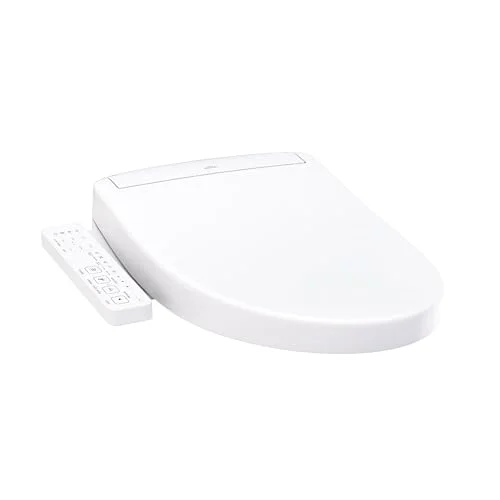
The TOTO WASHLET S2 ($420.00) is the clearest example in this category: its listing leads with "Instantaneous Water Heating" as a named feature, precisely because it never runs out of warm water the way a small reservoir tank does — but that also means every second of spray time is moving water through an active heater rather than drawing down a fixed reserve. A longer wash, or oscillating and pulsing modes that extend spray time, moves proportionally more water. None of this is a septic-system problem on its own — it's still well inside the volumes discussed above — but it's the reason a household with an instant-heating seat and several daily users is exactly the scenario where checking your specific system's rated daily capacity, rather than relying on a rule of thumb, is worth the ten minutes.
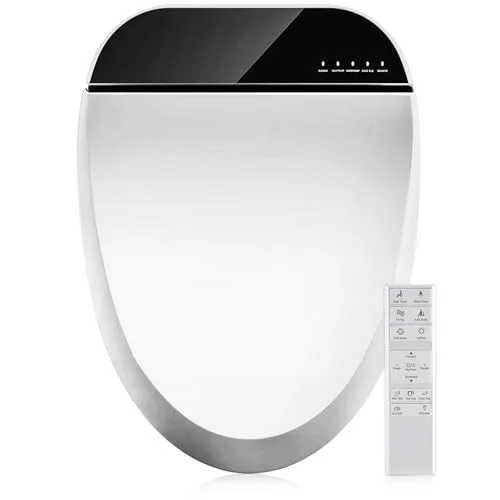
Not every electric seat publishes a heater type up front. The Combier Electric Bidet Toilet Seat ($113.04) is a straightforward wash-and-dry seat with a soft-close lid and remote control, but its listing doesn't specify whether it heats from a reservoir or on demand — so we won't claim one or the other here. If that matters to your decision, check the current Amazon listing or the manufacturer directly. For a deeper look at how reservoir and instant heating differ, see our heated seats and warm water guide.
The lowest-risk entry point
Attachments and non-electric seats: the lowest-impact starting point
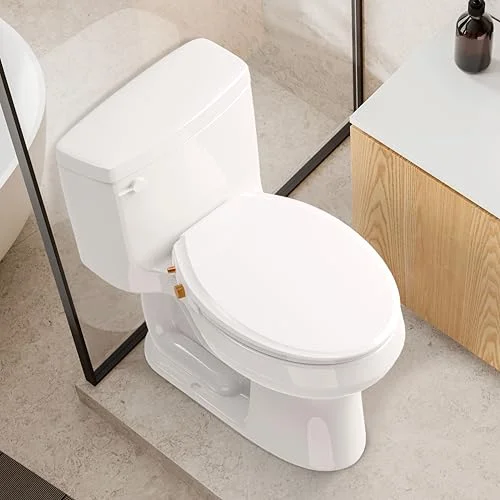
If a septic system is your main hesitation, non-electric bidets — attachments that clamp under your existing seat, or full replacement seats with the sprayer built in — are the lowest-impact way to find out whether the whole idea is for you. They run on nothing but your home's existing cold water pressure: no heater, no reservoir, no pump, no electricity, and no moving parts beyond a valve and a nozzle. Water use per wash sits at the low end of the range discussed above, because there's no tank to fill and no motor cycling water for oscillation — it's exactly as much water as it takes to press the lever, and no more.
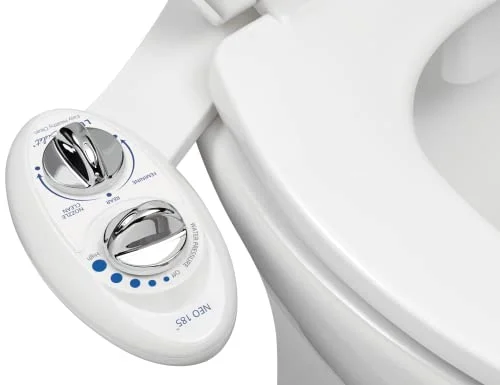
The LUXE Bidet NEO 185 ($49.99) is the simplest version of this: an attachment that clamps under your existing seat and installs in about twenty minutes, with two nozzles — a stronger rear wash and a softer front wash — behind a self-retracting guard gate. Drawing directly off the supply line with no tank or pump, it doesn't change the volume-per-wash math from what a manual valve allows. The VOVO Nature 8 ($79.00) takes the same no-electricity approach as a full replacement seat rather than an attachment — it fits round toilets specifically, uses ambient (unheated) water, and installs with no outlet and nothing electronic to fail. For more options in this vein, see our best bidet attachments with no electricity needed roundup.
Practically, this makes non-electric the natural first step for anyone weighing a bidet against septic concerns: it costs the least, adds the least water per wash of any bidet type, and if you later decide you want warm water from an instant-heating electric seat, you'll be making that upgrade with real household data about your own habits — not a guess.
Know when it matters
When to actually call a septic professional, and when you do not need to
For the majority of homes, none of this requires a phone call. If your septic system is reasonably modern, has been pumped on a normal schedule (typically every 3 to 5 years for an average household), shows no current signs of trouble, and your household isn't dramatically larger than the system was designed for, adding a bidet — electric or non-electric — is not something that warrants a professional visit first. The volume involved is too small relative to normal flushing, and a bidet adds no solids or chemicals for the tank's bacteria to contend with. This is, genuinely, the outcome for most readers of this guide.
A short call or inspection is worth the twenty minutes in a few specific situations. If your system is original to a home built before the 1990s and hasn't been evaluated recently, an inspector can tell you your tank's actual rated capacity rather than leaving you to estimate it. If you've had slow drains, gurgling, or standing water near the drain field in the last year or two, that's a sign the system may already be near its limit, independent of any bidet — worth resolving before adding any new fixture. And if you're outfitting several bathrooms at once for a household of five or more who will all use bidets daily, a professional's read on your specific tank and drain field is more useful than a general guide's averages.
What you're calling about, in every one of those cases, isn't really "can I have a bidet" — it's "what is my system's actual capacity," which is useful information regardless of whether a bidet is part of the plan. A septic professional evaluating your tank size, age, and soil conditions will give you a real number to compare against, rather than the reasonable-but-general figures in this guide. And the reassuring context to hold onto either way: the water volume from a bidet is consistently smaller than what your household's showers, laundry, and dishwasher already send through the same system every week without a second thought.