Are Off-Brand Bidet Seats Safe to Buy? An Honest Look
By Ilane TallUpdated September 24, 2026Research-based
Best Bidet Seats is reader-supported. When you buy through our links we may earn a commission, at no extra cost to you. Commissions never change which products we recommend.
Search "bidet toilet seat" on Amazon and somewhere in the first two pages of results, wedged between the Kohlers and the TOTOs, you'll find a listing from a name you have never heard of and cannot find anywhere else: no homepage, no press mentions, no other product line — just this one seat, a handful of stock photos, and a price that's often forty or fifty percent below the brand-name competition. QMU, HIXUNBIDET, WONDERSKY, Edencho — these are real examples of the genre, sellers with exactly one listing and no discoverable website behind the name.
The instinct is to treat that as an automatic red flag, and sometimes it should be. But "off-brand" is a much narrower claim than it sounds, and conflating it with "unsafe" or "low quality" skips past the actual question worth asking, which is what specifically you lose when the name on the box doesn't ring a bell. This guide walks through what off-brand really means on a marketplace like Amazon, the concrete signals worth checking on any listing before you buy, where these seats genuinely cut corners compared to an established brand, and where — honestly — they don't cut anything at all.
One note before we start: we don't run a fake testing lab, and we're not going to pretend we bought and disassembled these four seats. What follows comes from comparing the published specifications, prices, and listing details for real products against what established manufacturers publish for comparable models. Where we don't have a spec — a rating, a bowl-shape fit, a warranty term — we say so rather than guess.
The short answer
If you just want the verdict
Off-brand is usually fine if…
You check the listing, not the logo
"Off-brand" describes the seller's marketing budget, not automatically the hardware inside the seat. A no-name electric bidet seat with a clear warranty term, a real return window, and a support contact that answers is a reasonably safe bet for the core job: warm water, a heated seat, a remote. The name on the box matters far less than what the listing actually promises in writing.
Pay the brand-name premium if…
You want parts, longevity, or a plan for year five
What you're paying VOVO, Kohler or TOTO for isn't a better nozzle on day one — it's a company that will still exist, and still stock a replacement wand or control board, five to eight years from now. If that matters more to you than the upfront price, the premium is the honest cost of that insurance.
Terminology
What "off-brand" actually means on Amazon
It helps to be precise about what's actually happening when you buy from a name like QMU or HIXUNBIDET, because "off-brand" gets used to mean several different things and they carry very different risk levels.
On Amazon, the entity you're buying from is a seller, and the name printed on the seat is often a brand registered for that seller alone — frequently a fabricated word chosen specifically so it can be trademarked and listed, not a company with any history, factory ownership, or reputation outside that one product page. This is different from a generic, unbranded product (which Amazon also has plenty of) and different again from a counterfeit of an existing brand (which is a separate, more serious problem this guide isn't about). What we're discussing here is the middle case: a real, legitimately sold product, manufactured by one of a relatively small number of contract factories in Guangdong province that produce bidet seats for dozens of storefronts, sold under a name invented for the listing.
That's worth sitting with for a second, because it reframes the actual question. You are very rarely choosing between "an established company" and "a fly-by-night operation" in some dramatic sense. More often you're choosing between a company that spent money building a brand, a support team, and a parts pipeline on top of broadly similar underlying hardware, and a seller that skipped all of that spending and passed the savings to the price tag. Sometimes the hardware genuinely differs too — thinner plastic, a cheaper heating element, looser tolerances — and sometimes it barely does. The listing itself, more than the name, is usually where you can tell which case you're in.
It's also worth saying plainly: a single listing with no other products and no external website is not, by itself, evidence of anything sinister. Plenty of small importers run exactly one SKU through Amazon's fulfillment network because that's the entire business model — buy a container of a decent product, list it, sell it, repeat. The absence of a marketing budget doesn't tell you the seat is bad. It tells you that you have to do the verification work a recognizable name would otherwise do by reputation.
Do this before you buy
Reading a listing for real signals
A brand name tells you almost nothing on its own. These specific details, all visible on the listing itself, tell you a great deal.
01
Warranty terms, in writing
Look for an actual duration (12 months, 24 months) stated in the listing or a linked warranty page — not just the word "warranty" with no number attached. A listing that won't commit to a term in writing usually won't honor one in practice.
02
Return window
Amazon's standard 30-day return applies to most listings by default, but check whether the seller has shortened it, added restocking fees, or requires the buyer to cover return shipping on a bulky item like a toilet seat — that detail is often buried in the seller's own policy tab.
03
Who answers support email
Check the "Ask a question" thread and the Q&A section for evidence anyone actually responds, and how fast. A pattern of unanswered buyer questions from months ago is a stronger signal than anything in the marketing copy.
04
Fulfilled by Amazon or the seller
"Ships from and sold by Amazon.com" or Fulfilled-by-Amazon listings route returns and replacements through Amazon's own process regardless of whether the seller responds, which meaningfully de-risks a no-name purchase.
Two more habits worth building. First, read the one- and two-star reviews before the five-star ones — they're where you find out whether a warranty claim survived contact with an actual failed unit. Second, check how long the listing has existed relative to its total rating count; a handful of reviews spread across two years reads very differently from the same count that appeared last month, even if the star average looks identical.
Being specific
Where these seats cut corners compared to VOVO, Kohler or TOTO
The honest gaps
Parts, support and longevity
Established manufacturers like VOVO, Kohler and TOTO stock replacement wands, control boards and remotes for years after a model launches, and run a support line a buyer can actually reach when something fails. A single-listing seller with no other products has none of that pipeline — if a part fails outside the return window, "repair" usually isn't an option in the way it is for a branded seat. That's the real, structural difference, not the water pressure on day one.
What we can't verify
No rating, no review count, no verified sentiment
None of the four products in this guide carry a published rating or review count we can point to, which is itself the point: a brand-name model from TOTO or Kohler typically arrives with thousands of verified buyer reviews to read before you commit. A one-listing seller often hasn't accumulated that public record yet, so you're buying on the strength of the spec sheet and the policies above — not on a verified track record. That's a real trade-off, and it's the honest reason to weigh the brand-name premium seriously if reading buyer sentiment matters to your decision.
It's also worth naming what we are not claiming. We have no teardown data, no measured wattage, no lab comparison of nozzle materials between any of the four seats below and a Kohler or TOTO equivalent — and we won't invent one. The gap we can responsibly point to is structural: company longevity, published support terms, and the volume of independent buyer feedback available to check before you buy. Where a listing doesn't state a spec — bowl shape, warranty length, wattage — the right move is to treat it as unknown and check the live listing yourself, not to assume the better or worse case.
To be fair
The features they still get right, honestly
01
The core wash function
Warm water, front and rear modes, and an adjustable spray are table stakes even on inexpensive listings — the basic hydraulics of a bidet seat are a solved, decades-old problem, and getting them wrong would sink a listing's reviews immediately.
02
Heated seats and warm-air drying
All four seats in this guide list a heated seat and a warm-air dryer as standard features, the same headline comforts that brand-name seats charge a premium for. The hardware to do this — a resistive heating element and a small fan — is inexpensive and widely available to any manufacturer.
03
Remote control and LED features
A wireless remote, an LED display, and a nightlight are all listed on these seats without needing a legacy brand behind them — this is commodity electronics, not a proprietary advantage any single company owns.
04
Self-cleaning nozzle claims
Several listings, including ones below, advertise a self-cleaning nozzle cycle. It's a genuinely useful feature when it works as described, and it's not exclusive to premium brands — check the listing for how the self-clean cycle is triggered before assuming it matches a name-brand implementation.
At a glance
Four off-brand-style listings, side by side
No ratings are shown because none of these four listings carry a published rating or review count we can verify. Prices move on Amazon — confirm the live price before buying.
The picks, and what we'd want confirmed before buying each
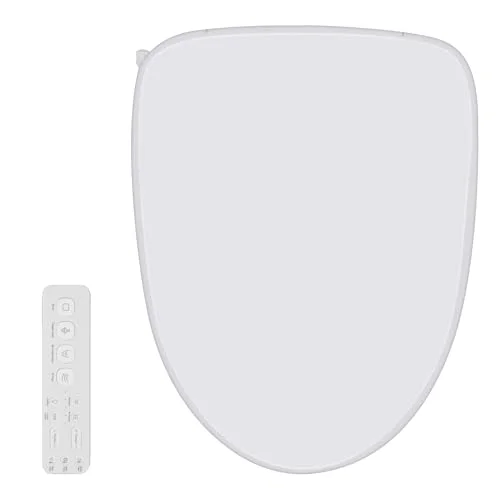
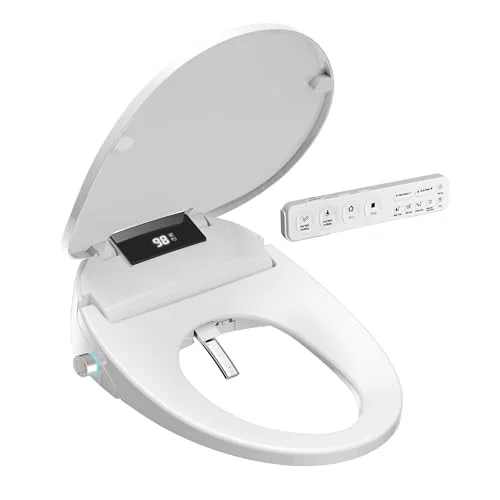
Electric Heated Bidet Toilet Seat, Elongated — $99.99
The most fully-featured of the four for the price
This listing packs adjustable warm water with separate rear and front wash, a warm-air dryer, a self-cleaning nozzle, soft-close, a nightlight and remote control into an elongated seat at under $100 — a feature list that would cost noticeably more from a recognized brand. No rating or review count is published for this listing, so before buying we'd want to confirm in writing: the warranty term, whether returns route through Amazon or the seller directly, and — since no Size/variant beyond "Elongated" is specified — that your toilet bowl is in fact elongated rather than round before you order.
Smart Electric Heated Bidet Toilet Seat, Round — $169.99
For a round-bowl toilet specifically
Listed with warm water and a warm-air dryer on a round-bowl seat, which fills a real gap — most electric bidet seats, brand-name or otherwise, are built for elongated bowls, so a confirmed round-fit option matters if that's what your bathroom needs. We don't have a published spec here beyond warm water and drying, so before buying we'd confirm the heater type (reservoir versus continuous), the warranty term, and the seller's return policy directly on the live listing rather than assume parity with the pricier elongated models above.
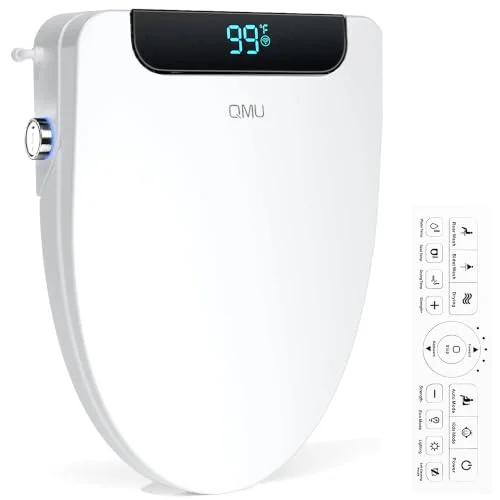
QMU Electric Bidet Toilet Seat, Elongated — $189.99
The one with an actual name attached
QMU is the one brand name among these four listings rather than a generic product title, which is itself a small, useful signal — a seller willing to put a consistent name on a listing has slightly more incentive to protect that name's standing across future sales. It lists a heated seat, warm water and a dryer for an elongated bowl. No rating is published, so before buying we'd search "QMU" for any other listings under the same name (a second product is a mild positive sign of an ongoing operation, not a one-off), and confirm the warranty term and return window on the live page.
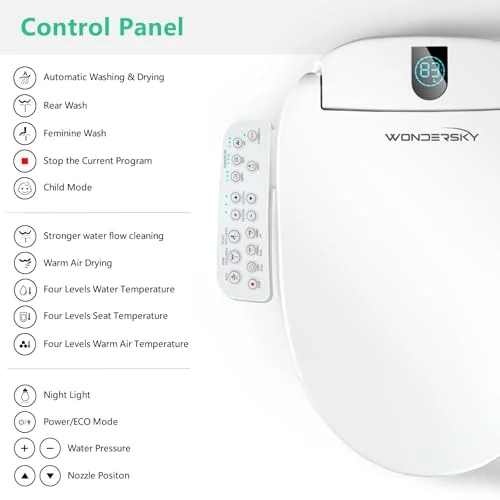
The most feature-dense of the four, if you have a round bowl
Warm water wash, an air dryer, a heated seat, remote control, an LED display, a self-cleaning nozzle, a night light and multiple cleaning modes, all on a round-bowl seat — the longest feature list of the four at the highest price point. It's the clearest example in this guide of a no-name listing matching a brand-name feature sheet almost line for line. With no published rating, before buying we'd confirm the warranty term in writing, check the Q&A section for evidence support actually responds, and re-verify the round-bowl fit against your own toilet's measurements rather than the listing photo alone.
When the brand-name premium is worth paying instead
There are specific, concrete situations where paying two or three times as much for a recognized brand with a real warranty is the more rational purchase, not just the more cautious one.
You want a documented repair path, not just a replacement. If a wand or heating element fails in year three, a manufacturer with a parts channel can sell you the part or send a technician. A one-listing seller generally cannot — your only real recourse once the return window has closed is buying a new unit.
You're outfitting a bathroom you won't personally maintain. A guest bathroom, a rental unit, or a property you don't live in benefits from the lower support burden of a brand people can search for and troubleshoot without you being the only point of contact — see our guide on the best bidet seats for guest bathrooms for picks built around exactly that.
You want verified review volume before committing. If reading a few thousand real buyer reviews before purchase is part of how you shop, brand-name models simply have more of that public record accumulated than a listing that's been live for a shorter time under a single seller.
The installation is unusual. If you're working around a spare valve limitation, an odd bowl shape, or a cold-climate install where freeze risk is a real concern, a manufacturer's documented compatibility list and support line reduces the guesswork — see installing a bidet seat without a spare valve and bidet seats in cold weather for the specifics.
You've had a bad experience with an unresponsive seller before. If a past no-name purchase left you without a working return process, the brand-name premium is effectively an insurance payment against repeating that experience — a completely rational thing to pay for.
None of that means every off-brand seat is a bad buy, and none of it means every brand-name seat is worth its price premium in every situation. It means the decision comes down to what you personally value: lowest upfront cost with more homework on your end, or a higher price that buys you a company's ongoing existence as a form of insurance. Both are defensible. What isn't defensible is skipping the listing checks in the section above and assuming the brand name alone answers the question either way.
FAQ
Off-brand bidet seats: common questions
Is it dangerous to install an off-brand electric bidet seat?
Electrical safety on a bidet seat mostly comes down to using a proper GFCI outlet, not overtightening the water connections, and never using an extension cord — none of which depends on the brand name. That said, an off-brand listing is less likely to carry independent safety certification you can verify (UL or similar marks) than an established brand, so check the listing photos and description for certification marks before buying, and treat their absence as a data point rather than an assumption of danger.
Why don't these listings have star ratings?
A published rating and review count require enough verified purchases to accumulate on Amazon, and a newer listing from a single-product seller simply hasn't built that record yet — it isn't necessarily evidence of a problem, just of a shorter track record. We only print ratings we can verify, so where a listing has none, we say none rather than estimate one.
Are off-brand and generic bidet seats made in the same factories as name brands?
Often, yes, at least at the contract-manufacturing level — a relatively small number of factories produce bidet seat hardware for a wide range of storefronts, brand-name and off-brand alike. That doesn't mean every unit off every line is identical; the same factory can build to a stricter or looser spec depending on what a given brand pays for. It's a reason not to assume the worst about hardware quality by default, not a guarantee that quality is equivalent.
What's the single most useful thing to check before buying a no-name bidet seat?
The written warranty term and the Q&A section, in that order. A specific stated warranty length tells you what the seller is actually committing to, and a Q&A section with recent, answered questions tells you whether that commitment is likely to be honored if you ever need it.