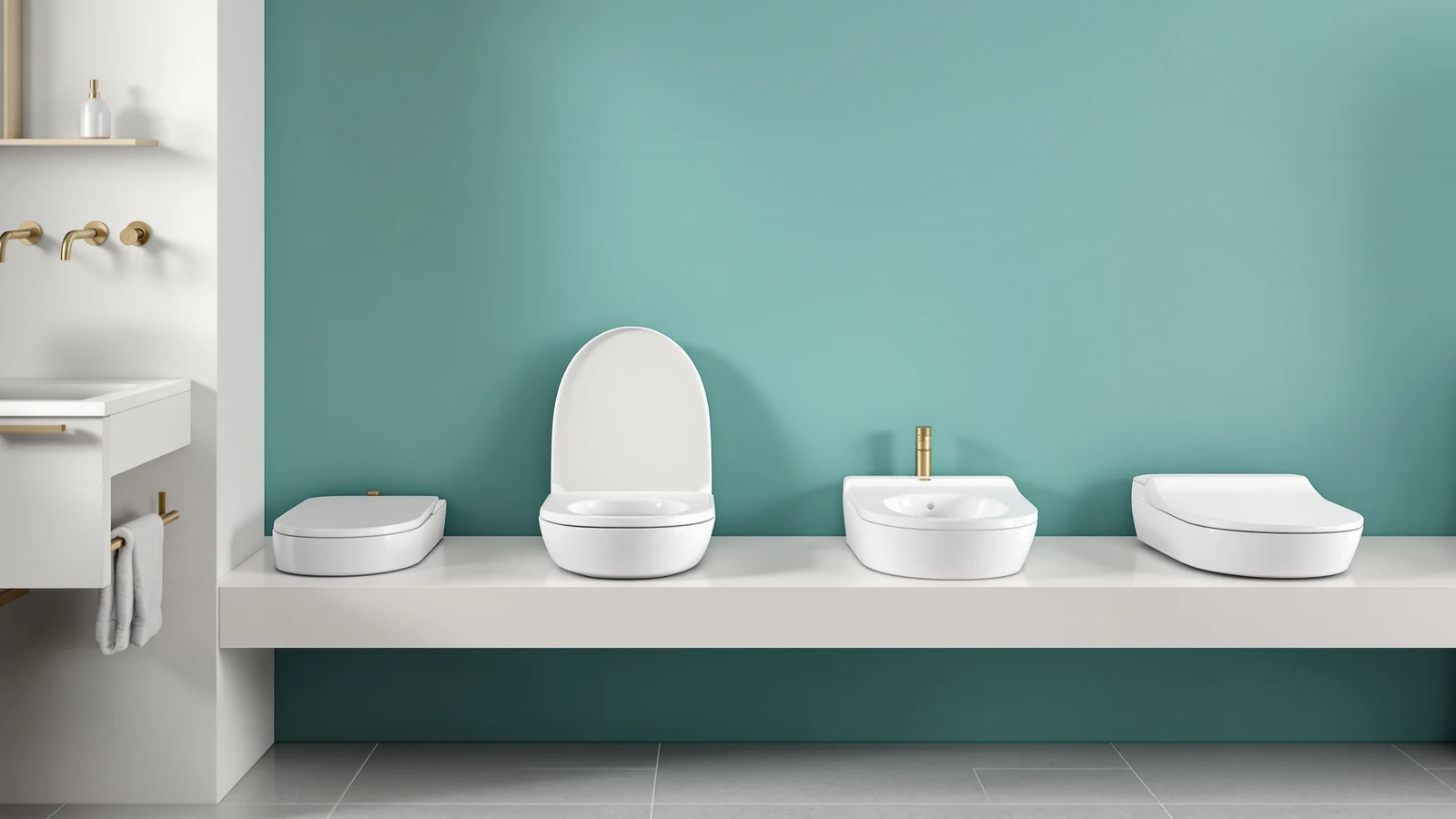
Brand Lineup · 2026
The Kohler PureWash Lineup, Reviewed
By Ilane TallUpdated November 2, 2026Research-based.
Best Bidet Seats is reader-supported. When you buy through our links we may earn a commission, at no extra cost to you. Commissions never change which products we recommend.
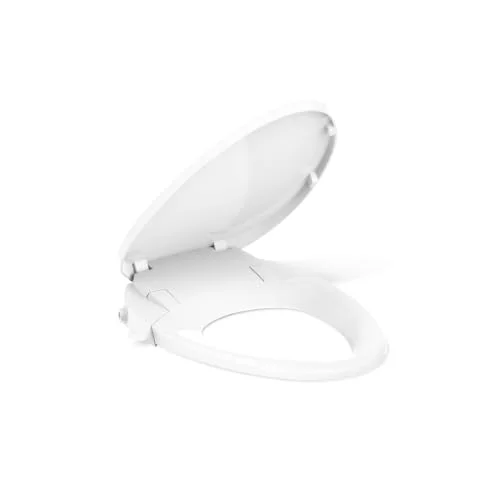
Kohler puts four bidet toilet seats under one name — PureWash — and the four of them span a wider range than almost any other single-brand lineup we track. At the bottom, an $88 manual seat you turn by hand. At the top, a $379.04 electric seat with a remote. In between, a $116.26 manual seat that costs more than the $88 one despite doing less with electricity, and a $239.99 electric seat that's $139 cheaper than the flagship. That's a 4.3-to-1 spread from cheapest to priciest, wider than the narrower gaps we found across LUXE's three-attachment lineup but short of the 12-to-1 range in our Bio Bidet lineup review.
What makes PureWash worth a closer look isn't just the price spread — it's that the name itself doesn't tell you which side of the manual/electric line a given model sits on. "PureWash" appears on the box whether you're buying a $94.99 hand-operated seat or a $379.04 seat with a remote and an electric heater. The model number is the only reliable signal, the same way our MIJIC vs KioGro comparison found that price alone doesn't predict feature count across brands. Here, we walk through what the M300, M250, E580 and E835 each actually are, and where the real jumps in price land.
One honest note before we start: we don't run a fake testing lab, and we never pretend to. Everything below comes from Kohler's own published listing details for these four specific products — names, prices, and the documented specs we have for each — not from owning or installing them ourselves. Where a listing doesn't name a spec, we say so rather than guess.
The real split
Manual versus electric: the line that splits the whole catalogue
Set aside model numbers for a moment and the PureWash lineup splits cleanly into two families. The M300 and the M250 are manual seats: you operate the wash by hand, there's no electrical component anywhere in either listing, and neither needs an outlet near the toilet. The E580 and the E835 are electric: both list adjustable water pressure with multiple cleansing options, and the E835 specifically calls out a remote in its own title. That's the fundamental fork, and it's a bigger decision than which specific model you pick on either side of it — the kind of outlet-or-no-outlet question our electric vs non-electric bidet seats guide covers in more depth across the whole category.
Inside the manual pair, the M300 is $94.99 and the M250 is $116.26 — a $16.27 gap that doesn't track with electrical features, because neither model has any. Inside the electric pair, the E580 is $239.99 and the E835 is $379.04 — a much larger $139.05 gap. Whatever decides price within each pair, it isn't current draw or heater wattage. It's something else, and that something else is different for each pair, which is exactly what the next two sections dig into.
The manual pair
M300 at $94.99 versus M250 at $116.26: a gap by model number, not bowl shape
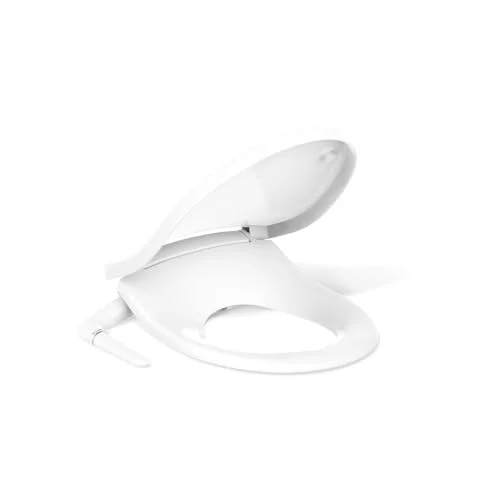
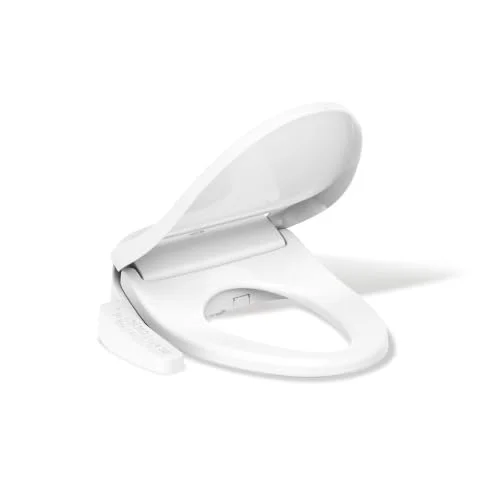
It would be easy to assume the M250 costs more because it's shaped for a different, pricier-to-manufacture bowl. The documented specs don't support that story. The M300 is listed as elongated, with named dimensions of 21.06 x 17.3 x 5.1 inches. The M250 is listed as round — a different bowl shape, not a scaled-up or scaled-down version of the same one. Round bowls are generally the smaller of the two standard shapes, and in the rest of the catalogue round models often undercut their elongated counterparts, the pattern our round vs elongated price-difference review documents across four separate listings from other brands. Kohler's own M-series runs the opposite direction: the round M250 costs $16.27 more than the elongated M300.
Both titles name the same quiet-close lid and the same quick-release hinges for installation, so those two features aren't what separates them. Where the listings do diverge is water control: the M250's title specifically calls out adjustable spray position and pressure, a phrase that doesn't appear in the M300's title. The M300's title instead names a self-cleaning wand. On the documented titles alone, the M250 appears to carry one extra piece of manual control — position and pressure adjustment — that the M300's listing doesn't claim, which is a more plausible explanation for the $16.27 premium than bowl shape is. We're reading this from the product titles Kohler itself publishes, not from a side-by-side teardown, so treat it as the best available evidence rather than a certainty — if the exact mechanism matters to your decision, Kohler's full listing for each model is the place to confirm it.
The practical takeaway: if your toilet takes an elongated seat, the M300 is both the cheaper and the more straightforward self-cleaning option. If your bowl is round, the M250 is the one that fits — and you're paying slightly more for a round bowl shape that, elsewhere in the market, usually costs less, with adjustable spray control as the likely reason.
The electric pair
E580 to E835: what the extra $139.05 and a remote actually add
The jump from electric entry to electric flagship inside PureWash is the widest single gap in the whole lineup. The E580 is $239.99. The E835 is $379.04 — $139.05 more, or roughly 58% above the E580's price. That's a considerably bigger jump in dollar terms than the $139.05 figure might suggest relative to percentage gaps elsewhere: our Delta Refresh Standard vs Premium review covers a $25 step between two seats from a different brand, and even that comparison called a quarter-hundred-dollar gap worth scrutinizing. Kohler's own E-series gap is more than five times that in raw dollars.
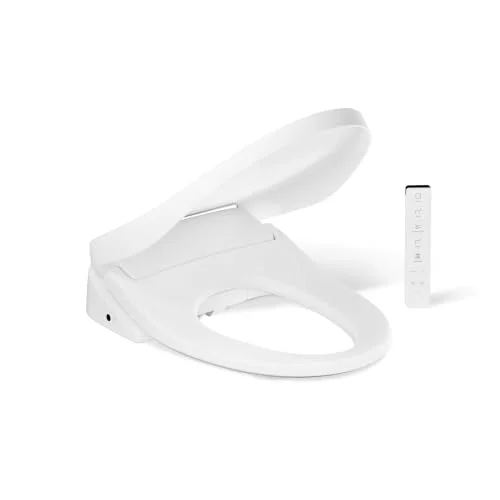
Both titles name the quiet-close lid, the self-cleaning wand, and adjustable water pressure with multiple cleansing options — on paper, the core wash mechanism reads the same across both electric models. The one feature the E835's title adds, in plain language, is a remote. The E580's title doesn't mention one. That single documented difference — a remote control versus none — is what Kohler's own naming tells us the extra $139.05 buys, alongside the E835's full name specifying "Electric Bidet Toilet Seat," making the electrical nature of the seat explicit in its title in a way the E580's title doesn't.
Whether a remote alone is worth $139.05 depends entirely on how you weigh convenience: not fumbling for a side panel every time, versus reaching over to a fixed control. It's a smaller, more contained question than the gap in dollars first suggests — you're not paying for a second heater or a different wash mechanism, on the evidence these two titles give us. If a remote isn't a priority for you, the E580 carries the same core electric features for well under the E835's price.
The one constant
Quiet-close hinges across all four: Kohler's one consistent detail
Here's the detail that doesn't change no matter which PureWash model you're looking at: every one of the four — M300, M250, E580 and E835 — names a quiet-close lid that prevents slamming in its own product title. That's unusual consistency. Price swings by nearly $280 across the lineup, bowl shape changes, electrical features appear and disappear, and the quiet-close lid is present in all four titles regardless.
A slamming toilet seat is a small, specific annoyance — the kind of thing that doesn't show up on a spec sheet most shoppers read closely, but shows up constantly in owner reviews of bidet seats generally, which repeatedly single out loud, hard-closing lids as a complaint about cheaper models elsewhere in the category. Kohler building a soft-close hinge into its cheapest manual model and its most expensive electric one alike suggests the company treats it as a baseline expectation rather than a premium feature to upsell. If you're coming to this lineup from a standard hardware-store seat with a hard-closing lid, that one detail alone will be noticeable on day one, regardless of which PureWash model ends up under your toilet seat.
Getting it in
Installation: the same quick-release hinges, two different requirements
Both the M300 and the M250 name quick-release hinges directly in their titles, which is Kohler's way of telling you the install is meant to be straightforward: lift the old seat off its existing hinges, set the quick-release hinge hardware in its place, and bolt the new seat down. Neither manual model's listing mentions a power cord or any electrical component, so there's no outlet to locate and no GFCI circuit to plan around — the kind of install that belongs squarely on the "no outlet" side of the fork our electric vs non-electric comparison walks through in more detail.
The E580 and E835 add a requirement the manual pair doesn't have: both are electric seats, which means both need a nearby GFCI outlet to power their wash pressure and cleansing options. Neither listing specifies exact cord length or current draw, so we won't invent a number here — if the distance from your toilet to the nearest outlet is tight, that's a detail worth confirming on Kohler's own product listing before you order either electric model. What we can say from the titles alone is that fit is elongated-only for both E-series seats, so a round bowl rules out the electric side of this lineup entirely, not just the M250 end of the manual side.
The decision
Does staying inside Kohler simplify the manual-to-electric upgrade?
In one specific way, yes: you already know what you're buying into. All four PureWash models share the same quiet-close hinge detail, the same self-cleaning-wand language in most of the titles, and the same Kohler parts-and-support channel behind them — a consideration our bidet-seat-and-warranty review flags as worth caring about, since a manufacturer that stocks parts for its own electric seats is the difference between a repair and a full replacement down the line. If you buy the M300 today for an elongated bowl and later decide you want warm water and a remote, moving to the E835 keeps you inside a single brand's fit conventions and support line rather than starting over with an unfamiliar manufacturer.
What staying inside Kohler doesn't simplify is the bowl-shape decision, because that doesn't change based on brand loyalty. The M300 and both electric models are elongated; the M250 is round. If you own a round-bowl toilet today and upgrade later to an electric PureWash seat, you'd be moving from the round M250 to an elongated E-series model — Kohler's electric lineup, on the specs we have, doesn't currently offer a round electric option the way it does on the manual side. That's worth knowing before you assume the whole lineup lines up bowl-for-bowl.
The honest summary: staying inside one brand buys you consistency in hinge quality and support, not a guaranteed upgrade path for every bowl shape. Know your bowl shape first, then decide whether the manual or electric side of PureWash fits your outlet situation and budget — the brand name alone won't make that decision for you.