Brand Lineup · 2026
The Bio Bidet Lineup, Reviewed
By Ilane TallUpdated October 27, 2026Research-based
Best Bidet Seats is reader-supported. When you buy through our links we may earn a commission, at no extra cost to you. Commissions never change which products we recommend.
Bio Bidet is one of the oldest names in the US bidet market, and its catalogue reflects that history in a way most single-brand lineups don't: it spans from a $44.00 non-electric attachment to a $489.00 flagship electric seat, a roughly 12-to-1 spread between the cheapest and most expensive thing it sells. Most brands pick a lane — budget attachments, or mid-tier electric, or premium flagships — and stay in it. Bio Bidet sells into all three at once, under one name, with one warranty structure and one design language carried across every tier.
That's unusual enough to be worth examining on its own terms. We've already looked at how other brands handle a narrower version of this question: our Delta Refresh Standard vs Premium piece covers a $25 gap between two electric seats, our KERDE lineup review covers a $20 gap, and our TUSHY attachment lineup review covers several attachments at adjacent prices. None of those comparisons has to explain a non-electric $46 product and a $549 flagship in the same breath. Bio Bidet does, and the four-tier structure — SlimEdge, USPA PRO, Bliss BB1000, BB2000 — is the clearest way we've found to make sense of it.
One honest note before we start: we don't run a fake testing lab, and we never pretend to. Everything below comes from the published specifications and listing copy for these four specific products, plus the patterns that repeat across their verified owner reviews — including the critical ones, which is usually where the real trade-offs live.
Tier one
The $44 question: what the non-electric SlimEdge gives up
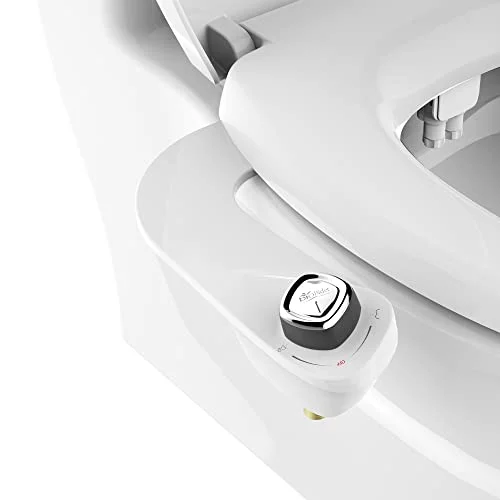
Start at the bottom, because it's the cleanest dividing line in the entire lineup. The Bio Bidet SlimEdge is a non-electric attachment: it clamps under your existing toilet seat, taps your cold water supply line through a T-valve, and gives you dual nozzles — one for a rear wash, one for a front wash — with adjustable water pressure. There is no heater, no pump, no remote and no circuit board anywhere in it. It's priced at $44.00, which is in line with what a well-built non-electric attachment should cost: you're paying for a valve assembly and two nozzles, not an appliance.
That single fact — no electricity — is what separates the SlimEdge from every other product in this lineup, and it's worth being precise about what it means in practice rather than treating "non-electric" as a vague downgrade. It means the water is exactly as cold as your home's cold supply, with no option to warm it. It means there's no seat heater, no air dryer, and no remote to misplace. It also means there's nothing to plug in, nothing that needs a GFCI outlet near the toilet, and functionally nothing inside it that can fail the way a heating element or a control board can. If you've read our broader electric vs non-electric comparison, this is that same trade-off playing out inside one brand's own catalogue: the SlimEdge is Bio Bidet's answer for anyone without an outlet nearby, anyone renting, or anyone who wants to try the core idea of a bidet before spending real money on the electric tiers above it.
The SlimEdge's size/variant is listed simply as "1 Pack" — it isn't sold in separate round and elongated versions the way a full seat replacement would be, since an under-seat attachment's nozzle assembly works across standard bowl shapes rather than needing to match one. If your own toilet has an unusual bowl profile, Bio Bidet's listing is the place to confirm fit before you buy, the same advice we'd give for any attachment.
Tier two
Crossing into electric: what every tier above SlimEdge adds
The moment you move past the SlimEdge, you're buying a different kind of product. Bio Bidet's three electric tiers — USPA PRO, Bliss BB1000, and BB2000 — are all full electric seat replacements: they take the place of your existing toilet seat entirely, plug into a wall outlet, and add warm water, a heated seat, and an air dryer as the baseline feature set shared across all three. Beyond that baseline, the gaps between them are specific and worth walking through one at a time, because the lineup isn't evenly spaced — the jump from USPA PRO to Bliss BB1000 is large, and the jump from Bliss BB1000 to BB2000 is comparatively narrow given how much more the flagship costs.
Tier two vs tier three
Bliss BB1000 versus USPA PRO: about $30 apart, far more than $30 of difference
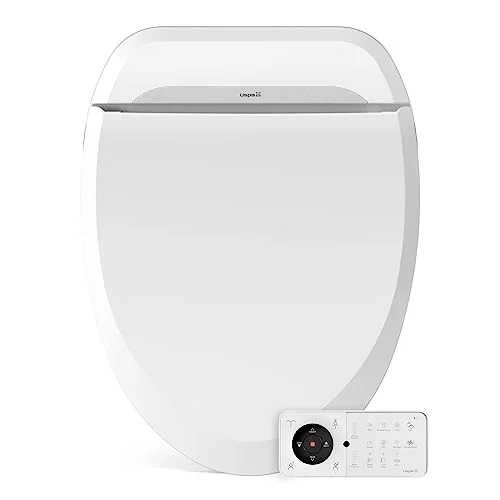
On paper, the Bio Bidet USPA PRO ($249.00) and the Bio Bidet Bliss BB1000 ($336.00) look like they should be close cousins — the gap between their listed prices is about $87, not $30, but both sit in the same "mid-tier electric seat" bracket that shoppers tend to compare head-to-head, which is exactly the shape of question our Delta Refresh Standard vs Premium review and KERDE Original vs 08 review ask about their own brands' adjacent models. Both the USPA PRO and the BB1000 give you warm water, a heated seat, an air dryer, and remote control — on the specs we have, that core feature set is identical.
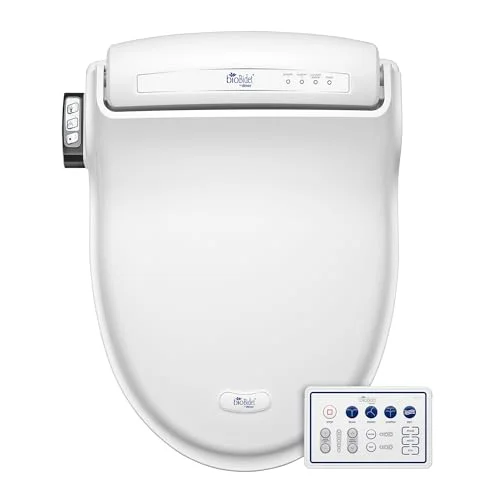
The documented difference is the lid. Bio Bidet's own listing copy calls out a slow-close lid as a named feature of the Bliss BB1000 — the heated seat "with Slow Close Lid" is right there in the product title — and that detail is absent from the USPA PRO's title and spec listing. A slow-close lid sounds like a minor convenience until you've lived with the alternative: a lid that drops on its own, loudly, at inconvenient times, often in the middle of the night. Owners across the bidet category consistently single out slow-close as one of those small mechanical details that stops annoying you the day you stop having to think about it. On the figures we have, that's the one named difference that separates these two models — everything else in their core wash, heat and remote functionality reads the same.
We don't have a rating or review count for either the USPA PRO or the BB1000, so we're not going to guess at owner sentiment beyond what Bio Bidet's own listing copy states. What we can say with confidence is that if a quiet, controlled lid closing matters to you — and for a lot of households it does — the BB1000 is the one that names it as a feature; the USPA PRO's listing does not.
Tier four
The BB2000's occupancy sensor and slow-close lid: what the top tier actually adds
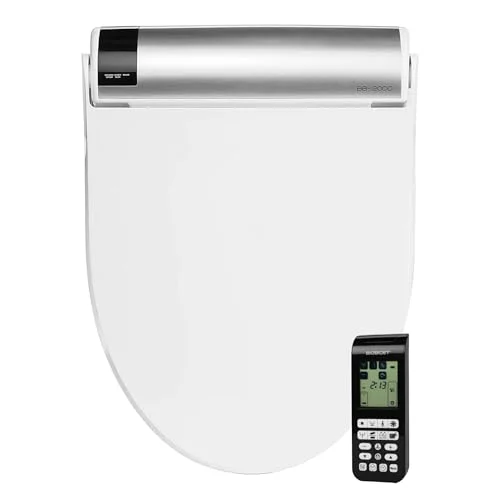
At the top of the lineup sits the Bio Bidet BB2000, priced at $489.00 — among the priciest seats in our entire catalogue, electric or not. Like the BB1000, it carries warm water, an air dryer, a heated seat, and a slow-close lid, plus remote control. What the BB2000 adds on top, named directly in its own product title, is a seat occupancy sensor and a night light, finished in what Bio Bidet calls a "Modern Black Remote Control" rather than the more conventional white remote shipped with the lower tiers.
The occupancy sensor is the functionally interesting addition. On seats that have one, the sensor detects whether someone is actually seated before it allows the wash functions to activate — a safety and cleanliness feature that prevents an accidental spray when the lid is up and nobody's there, and it's the kind of detail that shows up specifically on flagship-tier seats rather than being a given across the category. Paired with the slow-close lid the BB2000 shares with the BB1000, and the night light for visibility at night without a jarring overhead light, the BB2000 reads as the tier where Bio Bidet stops adding core wash functionality — that part was already complete by the BB1000 — and starts adding the refinements that make day-to-day use quieter and safer rather than more capable.
That's a meaningfully different value proposition than the jump from USPA PRO to BB1000. Going from USPA PRO to BB1000 bought you a named comfort feature (slow-close) for roughly $87 more. Going from BB1000 to BB2000 costs about $213 more and buys you a sensor, a night light, and a different remote finish — real additions, but not a change in what the seat fundamentally does for you day to day. Whether that's worth the premium depends entirely on how much you value the occupancy sensor specifically; if the answer is "not much," the BB1000 already covers the features most people actually use.
Across the lineup
Remote control, and where it changes
Remote control is the one feature that spans all three electric tiers, and it's worth tracing how it's described at each level because the differences aren't nothing. The USPA PRO and the Bliss BB1000 both ship with remote control as a named feature, with no documented distinction in finish or function between them on the specs we have — we won't invent one. The BB2000 is the outlier: its listing specifically calls out a "Modern Black Remote Control," a cosmetic and presumably ergonomic update over the standard remote on the two tiers below it.
What doesn't change across any of the three electric tiers, as far as our information goes, is that all of them replace a side-panel control scheme with a separate handheld remote — the detail our remote-and-side-panel comparison covers for seats that keep both. Bio Bidet's electric lineup commits to the remote-only approach at every price point above the SlimEdge, which, if you've already decided you want a remote rather than reaching down to a side panel, means that preference is satisfied whether you spend $249 or $549 — the remote itself is the one piece of the experience that's consistent across almost the entire catalogue above the entry attachment.
The SlimEdge, being non-electric, has no remote and no powered controls of any kind — adjustment happens by hand, directly at the attachment. That's the final piece of the four-tier picture: control sophistication rises in step with price, from manual-only at $44.00, to a standard remote at $249 and $336, to a distinct "Modern Black" remote at $549.
The decision
Four separate buying decisions, or one brand you can trust at any price?
Having walked through all four, the honest answer is: a bit of both. The SlimEdge and the three electric seats aren't really competing for the same buyer — someone choosing the SlimEdge has already decided against an electric seat, for reasons of budget, no outlet, or just wanting to try the idea first, and that decision has little to do with which electric tier might suit them later. In that sense, picking a SlimEdge today doesn't lock you into Bio Bidet's electric lineup tomorrow; it's a standalone choice.
Within the three electric tiers, though, the lineup does behave like one coherent product line rather than three unrelated seats sharing a logo. The baseline — warm water, heated seat, air dryer, remote — holds across all three without exception. Features are added, not swapped out or contradicted, as price climbs: slow-close lid appears at the BB1000 and stays through the BB2000; an occupancy sensor, night light and upgraded remote arrive only at the BB2000. Nothing in the USPA PRO's spec sheet gets quietly removed to justify the BB1000's price, and nothing in the BB1000's gets removed to justify the BB2000's. That additive, non-contradictory pattern is what lets us treat "the Bio Bidet lineup" as a single trustworthy ladder rather than four separate gambles — which is the same structural test our TOTO S2 vs KC2 review and TUSHY Cloud+ review apply to their own brands' tiered lineups.
Practically, that means you can pick your entry point by budget and outlet availability without worrying that a cheaper Bio Bidet seat is a fundamentally different, lesser-engineered product than the expensive one. Start with the SlimEdge if you have no outlet or just want to test the waters. Start with the USPA PRO if you want electric warm water at the lowest price in that category. Default to the Bliss BB1000 if you want the fullest set of comfort features most people actually notice day to day. Reach for the BB2000 only if the occupancy sensor and night light specifically matter to you — because on the features that drive daily satisfaction, the BB1000 already gets you there for roughly $213 less.