Buying Advice · 2026
Does Installing a Bidet Seat Void Your Toilet's Warranty?
By Ilane TallUpdated November 1, 2026Research-based
Best Bidet Seats is reader-supported. When you buy through our links we may earn a commission, at no extra cost to you. Commissions never change which products we recommend.
Somewhere between adding the bidet seat to your cart and actually unbolting your existing one, a specific worry tends to show up: am I about to void the warranty on a toilet that cost $300–$600? It's a reasonable thing to wonder, because a toilet is not a cheap thing to replace, and "warranty void if removed" stickers on other appliances have trained all of us to be nervous about opening anything up.
The short version, which we'll back up with the actual mechanics below: a bidet seat and a toilet are two separate products, sold by two separate manufacturers, each carrying its own separate warranty. Installing a bidet seat — attachment, non-electric full seat, or electric full seat — does not touch the parts of the toilet that the toilet's warranty actually protects. The real risk in this whole process isn't paperwork. It's a cracked bowl from a bolt torqued too far, and that has nothing to do with whether you read the fine print.
One honest note before we get into it: we don't run a testing lab, and we don't pretend to. What follows comes from reading the published warranty terms of major toilet manufacturers, the installation instructions and specs for the products named below, and the patterns that repeat across thousands of verified owner reviews — including the complaints, which is where installation mistakes actually show up.
Read the fine print
What a toilet manufacturer's warranty actually covers
Every toilet sold by a major manufacturer — Kohler, TOTO, American Standard, Delta — comes with a limited warranty on two things: the vitreous china bowl and tank (protection against manufacturing defects like cracking, crazing, or a casting flaw), and the mechanical components inside the tank that make it flush (the fill valve, flush valve, and flapper or canister). Read any of these warranties end to end and you'll notice something: the seat is almost never mentioned, because toilet seats are typically sold as a separate accessory, often from a third-party seat manufacturer, with its own separate warranty card in its own separate box.
That separation is the whole answer to the warranty question. A bidet seat replaces or clamps onto a part of the toilet — the seat — that the toilet manufacturer's warranty was never written to cover in the first place. Even toilet brands that also sell their own bidet seats, like Delta with its Refresh line of bidet seats, warranty the seat and the bowl separately, under separate terms, with separate registration. Swapping the seat for a different one doesn't create a new category of risk; it just means you're now covered by the bidet seat maker's warranty for the seat, and the toilet maker's warranty for the toilet, exactly as if you'd bought a generic replacement seat with no bidet function at all.
What would actually jeopardize a toilet warranty is something that affects the bowl or tank itself: using an abrasive cleaner the manufacturer explicitly warns against, a DIY repair to the tank mechanism that isn't a listed authorized part, or physical damage from dropping something on it or over-torquing a bolt into the porcelain. None of those are things a bidet seat installation requires you to do.
Lowest risk
Attachments: the lowest-risk way to add a bidet
A bidet attachment is the installation option that touches the toilet the least. It clamps in between your existing seat and the bowl, using the same two hinge bolts that are already holding your seat down — you loosen them, slide the attachment's mounting plate underneath, and re-tighten the same bolts through the same holes. The bowl itself is never opened, drilled, or modified. The only new connection is a small T-valve spliced into the water supply line that already runs from the wall to your toilet's fill valve — the same line a plumber would touch to replace that fill valve, something manufacturers fully expect owners to be able to access.
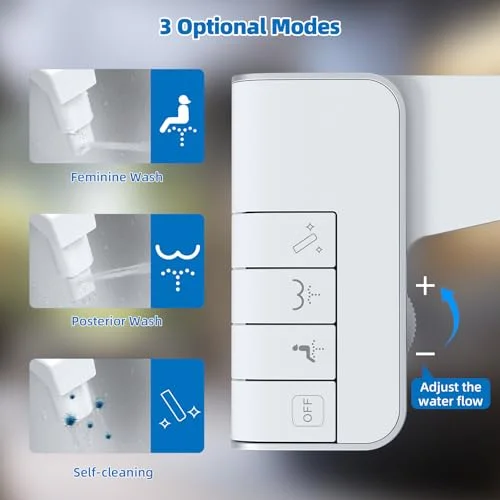
The Hibbent Bidet Attachment ($29.99) is a good example of exactly how little this touches the toilet itself: it's a dual-nozzle unit — separate settings for a rear wash and a frontal wash — with adjustable water pressure and a self-cleaning nozzle, and the whole thing mounts under your current seat using its existing bolts. Nothing about that installation reaches the bowl, the tank, or the flushing mechanism, which is exactly the territory a toilet warranty is written to protect. If you're deciding whether one nozzle is enough or you want the second, our dual-nozzle non-electric guide breaks down what the second nozzle actually buys you.
Full replacement
Non-electric and electric full seats: what the hinge bolts do and don't touch
A full seat — electric or not — goes a step further than an attachment: instead of clamping a device under your old seat, you remove the old seat entirely and bolt the new one down in its place. That still sounds, on paper, like more disruption. In practice it touches the same two things an attachment does, just more directly.
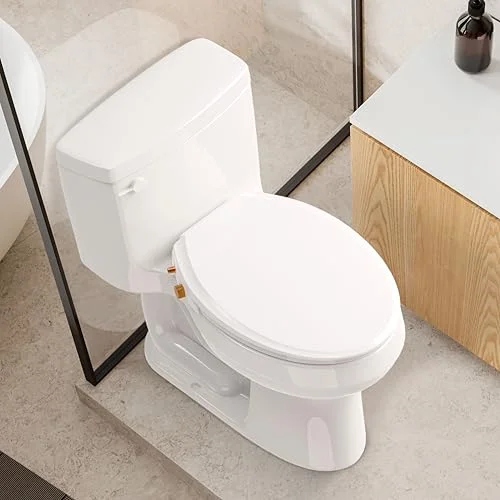
The mounting. Both non-electric and electric full seats bolt down through the exact same two holes at the back of the bowl that your original seat used. There is no new drilling and no new hole in the porcelain — you're using the mounting points the toilet manufacturer built in from the factory, specifically so that seats can be swapped. The VOVO Nature 8 ($89.00), a non-electric full-seat replacement built for round toilet bowls, installs this way: the listing describes it as an easy installation using the standard mounting hardware, with no electrical component and no tank modification involved at all. Check the listing before you order one of these — the Nature 8's "Fits Round Toilets" spec is specific to that model, and a seat sized for the wrong bowl shape will leave a gap no matter how carefully it's bolted down. Our round vs. elongated guide covers how to confirm which shape you have before you order.
The water line. Any bidet seat needs water, so a full seat — like an attachment — splices a small valve into the existing fill line between the wall shutoff and the toilet's tank. This is the same supply-line connection point a plumber uses to swap a fill valve or install a new shutoff; it is not inside the tank, and it doesn't touch the tank's flushing mechanism, which is the part the toilet warranty actually protects.
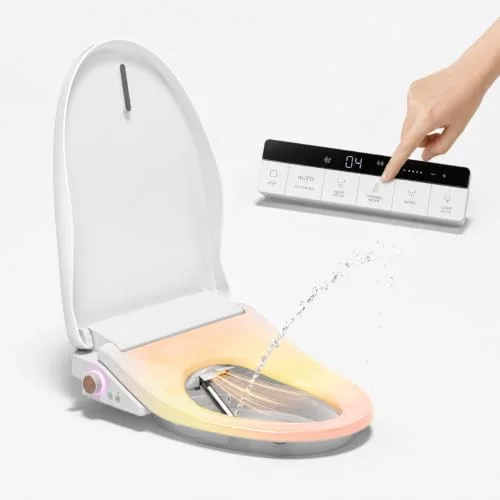
The power. This is where electric full seats add one more step: a cord that needs a nearby GFCI outlet. The Smart Electric Bidet Toilet Seat ($211.00), with a heated seat, an air dryer and a remote, plugs into a standard wall outlet exactly like a space heater or a hair dryer would — it draws power from the room's electrical circuit, not from anything inside the toilet. Running a cord to an outlet changes nothing about the bowl, the tank, or the water line beyond the same supply splice a non-electric seat uses. For a look at how a well-known electric seat compares against the attachment-only line from the same brand, our TUSHY Cloud+ review walks through that exact jump from attachment to full electric seat.
In every one of these three installation types — attachment, non-electric full seat, electric full seat — the toilet's bowl and the tank's internal flushing mechanism are never opened, modified, or even touched. That's not a coincidence; it's because bidet seats were designed from the start to be an add-on that works with any standard toilet, not a modification to one.
Where it actually goes wrong
Where things actually go wrong — and it isn't warranty paperwork
If installing a bidet seat genuinely put a toilet warranty at risk in practice, you'd expect to see that pattern in owner reviews and support forums: people reporting a denied warranty claim after a bidet install. That pattern essentially doesn't exist. What repeats instead, across non-electric attachments, non-electric full seats and electric full seats alike, is a narrower and much more physical problem: a cracked bowl, caused not by the bidet seat itself but by how hard someone tightened the mounting bolts.
The hinge bolts on a toilet seat are meant to be hand-tight, snugged down with a screwdriver or wrench until the seat stops wobbling — not cranked down with real force. Vitreous china is strong under normal use but brittle against concentrated point pressure, and the mounting holes at the back of the bowl are exactly that: a small, thin, concentrated point. Over-torque a hinge bolt, especially a metal wing nut against porcelain with no cushioning washer, and you can crack the bowl right at the hole. That crack is a manufacturing-unrelated, installation-caused failure, and it is excluded from every toilet warranty we've reviewed — not because a bidet seat was involved, but because any installation damage, bidet or otherwise, falls outside what a manufacturer warranties against.
The second most common complaint across owner reviews, for every installation type in this guide, is a slow drip at the new T-valve where it splices into the supply line — nearly always solved by removing the fitting, wrapping the threads with plumber's tape, and reseating it a quarter-turn tighter. That's a plumbing annoyance, not a toilet failure, and it resolves the same way regardless of which bidet seat caused it.
The practical takeaway: the thing to be careful about during installation isn't some clause buried in your toilet's warranty booklet. It's torque. Hand-tighten the hinge bolts, use the plastic or rubber washers included with the seat if your mounting kit has them, and stop as soon as the seat stops wobbling. That single habit prevents the one bidet-adjacent failure that actually costs money to fix.