Bidet Seats With Both a Remote and a Side Panel: Is Having Two Controls Worth It?
By Ilane TallUpdated October 21, 2026Research-based
Best Bidet Seats is reader-supported. When you buy through our links we may earn a commission, at no extra cost to you. Commissions never change which products we recommend.
Most electric bidet seats make you pick one input method and live with it. Spend under $150 and you usually get a side panel bolted to the seat's edge — reliable, but a reach-around every time, and awkward if you're not steady on your feet. Spend $300 or more and the panel often disappears entirely in favor of a single wireless remote, the assumption being that if you're paying flagship prices, you don't want hardware cluttering the seat itself. Somewhere in the middle, a small number of listings refuse to choose. They build in a wireless remote and a full side panel on the same seat, wired to the same settings, and let you use whichever one is closer at the moment.
Three models in our database make that point directly in their own listing copy, and all three land in the same narrow price band: $211.00, $239.98 and $299.99. That's not a coincidence we're asserting without evidence — it's the actual spread of the three products whose titles and feature lists specifically describe dual control, and it's worth asking why that spread exists before you pay for it. This piece covers what "dual control" means mechanically, why it clusters in this particular price range rather than at the bottom or top of the market, what a dead remote battery actually does to a seat that has one, and whether the lit-up side knob some of these seats add is solving a real problem or a marketing one.
One honest note before we get into it: we don't run a testing lab and we didn't install any of these three seats ourselves. Everything below comes from what each Amazon listing's own title and feature list claims, plus current pricing — if a listing doesn't say it, we're not going to assume it anyway.
The short answer
If you just want the verdict
Dual control is worth it if…
You share the bathroom, or you're not always steady
A second control point is cheap insurance against the one failure mode a single-remote seat can't recover from on its own — a flat battery, a remote left in another room, or a user who'd rather not twist around to find a panel behind them. Across all three seats here, that insurance costs nothing extra; it's simply part of the listing.
Skip it if…
One good control surface already covers you
A single person, steady hands, a seat within easy reach of wherever the remote lives — a one-control seat does the identical wash, heat and dry job for less. Dual control is a redundancy feature, not a wash-quality feature, and it's worth being honest with yourself about whether you need the redundancy.
The mechanics
What 'dual control' actually means on these listings
It's tempting to read "remote and side panel" as two different feature sets bolted together — as if the remote handled one job and the panel handled another. None of the three listings here describe it that way, and mechanically it wouldn't make sense if they did. A bidet seat has exactly one set of settings at any moment: wash mode, water temperature, seat temperature, pressure, nozzle position, dryer. Dual control means there are two separate paths that can read and change that one set of settings, not two parallel feature lists.
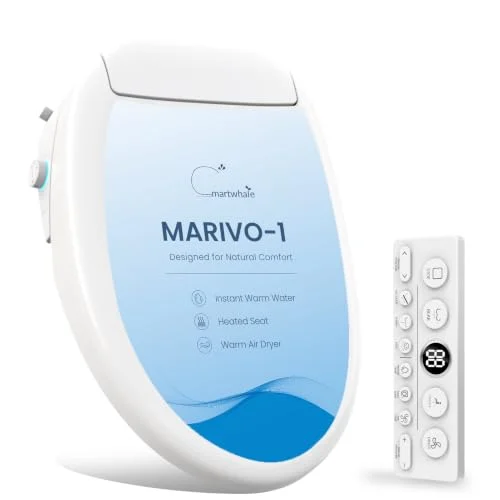
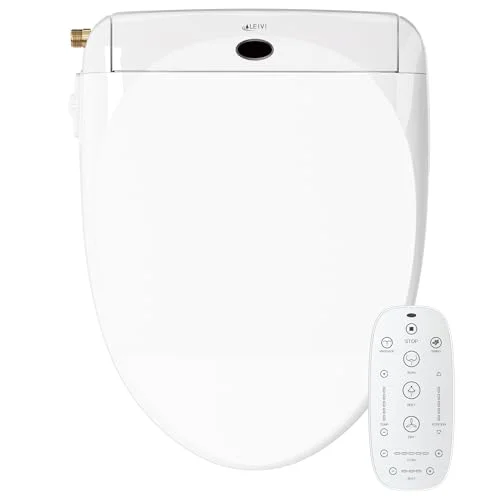
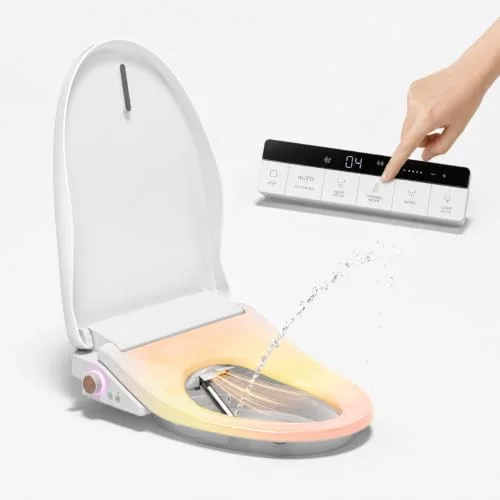
The LEIVI Electric Bidet Toilet Seat with Wireless Remote and Side Panel ($239.98) states this almost exactly: its listing describes a Dual Control System for Easy Access, built around a wireless remote and a side control panel that reach the same wash modes, temperature and pressure settings. The Electric Bidet Toilet Seat Elongated with Digital Display Remote ($299.99) uses the phrase Dual Smart Control for the identical idea — a digital display remote on one side, an illuminated side knob on the other, both adjusting the same water temperature, pressure, nozzle position and comfort settings rather than two different sets of them. Even the Smart Electric Bidet Toilet Seat Elongated ($211.00), whose own title only names a remote, lists an illuminated side knob in its feature copy as a second way to reach wash modes, auto mode, nozzle cleaning, the dryer, the night light and ECO mode — everything the remote also reaches.
Under the hood, that's two different communication paths to one controller board. The remote is a small battery-powered transmitter — usually RF or infrared — that sends a signal to a receiver built into the seat's base. The side panel skips the wireless layer entirely: its buttons or knob are wired directly into the same control board the remote talks to. Press a button on either one, and the seat doesn't know or care which path the instruction came from — it just executes the command. That's the whole trick, and it's also why dual control doesn't cost you a second set of wash modes or a second price tag worth of extra hardware. You're buying a second doorway into a house that already has one, not a second house.
It's also why "dual control" is a meaningfully different claim from a seat that simply ships with a spare remote, or one that lets you pair a phone app alongside a physical remote. A spare remote is a backup for the same transmitter path — if the receiver in the base fails, both remotes stop working identically. A side panel is a structurally separate path. That distinction is exactly what makes the next section worth reading before you decide dual control is a gimmick.
Where it shows up
Why dual control clusters around $200–$300, not the bottom or the top
All three of the listings that spell out dual control in their own copy sit in a tight cluster: $211.00, $239.98, $299.99. That's not where you'd expect a "more is better" feature to land if more expensive seats simply added more of everything — a $420 flagship like the TOTO WASHLET S5 doesn't need to prove it's full-featured by bolting on a second control surface; it has already spent its engineering budget on the wash mechanics themselves, and a single, well-designed remote is enough to reach all of it. The feature that differentiates a flagship seat tends to be what the water does — instantaneous heating, a self-cleaning wand — not how many ways you can ask it to.
At the bottom of the market, the economics run the other way. A basic side-panel-only seat under roughly $150 skips the remote altogether because a wireless receiver, a battery compartment and a second molded housing all add cost to a product built to hit a specific shelf price. Adding a remote to a budget seat usually means the panel disappears rather than the two coexisting — manufacturers pick one control surface and optimize the bill of materials around it.
The middle band is where a manufacturer has enough margin to add the remote's radio hardware as a visible selling point — it reads well in a listing title and photo gallery — without yet having consolidated the design down to one surface the way premium brands eventually do. Put plainly: dual control isn't a comfort upgrade that scales with price. It's most likely to appear on a seat whose maker is using "has a remote" as a differentiator against cheaper seats that don't, while keeping the side panel as the fallback those cheaper seats already rely on. That's a reasonable thing to pay for — it just isn't automatically a sign of a more capable seat, and it's worth reading the rest of a $200–$300 listing's own wash mode count rather than assuming two controls means more washes.
The failure case
What happens when the remote's battery dies
This is the scenario dual control actually exists to solve, and it's worth walking through concretely rather than treating it as an abstract selling point. A remote-only seat is, from the seat's perspective, controlled entirely through one wireless receiver. When that remote's battery runs flat — and coin-cell or AAA remotes on bidet seats typically last many months, which is exactly long enough that most owners have forgotten where the spare batteries are kept — the seat doesn't become uncontrollable in the sense of stopping mid-function. It freezes at whatever settings were last sent. You can usually still sit down and get a wash at the last-used temperature and pressure, but you cannot change a single thing until a working battery goes back in that remote. If the remote itself is lost rather than just dead, the seat is effectively locked to its last configuration indefinitely, or until a replacement remote is sourced from the manufacturer.
A seat with a side panel wired straight into the control board sidesteps that failure mode completely, because the panel was never dependent on the remote's battery in the first place. On the LEIVI seat, the listing is explicit that the wireless remote can be wall-mounted or held in hand — convenient day to day, and it specifically frames the dual system as especially convenient for pregnant or elderly users, who are exactly the users most likely to need a guaranteed, always-on backup rather than a nice-to-have. If that remote goes flat on a Tuesday night, the side panel on the seat's edge still reaches every setting the remote did. Nothing is locked; you just reach down instead of picking the remote up.
The honest caveat here: a dead remote on a dual-control seat is a minor inconvenience, not a crisis, precisely because the panel exists. On a remote-only seat, the identical dead battery is a genuine, if temporary, loss of function. If you've ever owned a device where losing the one remote meant losing control of the whole thing — a window air-conditioner, an older television — this is the same math applied to a seat you use multiple times a day. Whether that's worth paying for depends entirely on how annoyed you'd be hunting for a battery at an inconvenient moment, which is a question only you can answer honestly.
After dark
Illuminated knobs at night versus hunting for a remote in the dark
The clearest, most specific case any of these three listings makes for dual control isn't about redundancy at all — it's about what happens at 2 a.m. The Digital Display Remote seat's own feature copy frames its Dual Smart Control directly around this: Whether you're fine-tuning your perfect wash or simply need a quick adjustment in the middle of the night, our premium bidet puts control exactly where you need it. According to that listing, the digital display remote is for precisely adjusting water temperature, pressure, nozzle position and comfort settings when you can see what you're doing, while the illuminated side knob is built for the opposite situation — instant, intuitive control without searching for the remote, with visual light feedback that the listing says lets you recognize the seat's status at a glance, even in a softly lit bathroom.
That's a genuinely different use case from the dead-battery scenario above. A remote sitting on a shelf or counter across a dark bathroom is a small object you have to locate by feel or by turning on a bright overhead light that defeats the point of a half-asleep bathroom visit in the first place. A side knob built into the seat itself is exactly where your hand already is. Add a backlight to that knob — which is what both the Digital Display Remote seat and the HZOV-made Smart Electric Bidet Toilet Seat ($211.00) describe in their own copy, the latter calling its version an illuminated side knob that keeps essential controls within reach — and you've removed the one step that makes a remote clumsy in the dark: finding it at all.
This is worth separating clearly from the touch-versus-button debate our touch-panel vs. physical controls comparison covers. That piece is about which surface wears better and responds reliably with wet hands. This is narrower: given that a seat already has two controls, does the illuminated one solve a real nighttime problem, or is it solving a problem a single well-placed control wouldn't already have? Our honest read is that it's a real, specific benefit for exactly the use case the listings describe — a late-night adjustment nobody wants to turn a bright light on for — and a non-issue for anyone who only uses the seat in a lit bathroom during the day.
At a glance
The three dual-control seats, side by side
Prices move on Amazon — confirm the live price before buying.
Model
Bowl
Listing claims
Price
Smart Electric Bidet Toilet Seat (HZOV)
Standard
Remote + illuminated side knob, tankless warm water
Electric Bidet Toilet Seat Elongated with Digital Display Remote
Named "Dual Smart Control" directly in its own listing
Its feature copy is the most specific of the three about why it has two controls: a digital display remote for precise daytime adjustments, and an illuminated side knob built for a quick change in the dark without searching for anything. It also lists 4 wash modes, 4 water-temperature levels, 5 pressure levels, 5 nozzle positions, a KID mode, an ECO mode, a full-cycle self-cleaning nozzle, 4-level heated seat and 4-level warm air — a longer spec list than the other two, at the top of this trio's price range.
LEIVI Electric Bidet Toilet Seat with Wireless Remote and Side Panel
Built, by its own description, for pregnant or elderly users
LEIVI's listing calls out its Dual Control System for Easy Access specifically as convenient for pregnant or elderly users, with a wireless remote that can be wall-mounted or held in hand alongside a full side control panel. It also lists adjustable instant warm water, a dual nozzle system, an ergonomic heated seat and an auto LED nightlight. Its size line marks it as a Round-bowl seat — measure your toilet before ordering, since round and elongated shells are not interchangeable.
Smart Electric Bidet Toilet Seat Elongated, Heated Seat, Air Dryer, Remote
The entry point into dual control, at $211.00
Its own title leads with the remote, but the feature copy lists an illuminated side knob alongside it that reaches the same wash modes, auto mode, nozzle cleaning, dryer, night light, ECO mode, temperatures, pressure and nozzle position. It also lists a tankless warm-water system at three settings and three heated-seat temperatures — a genuinely tankless claim worth noting at this price point. Size is listed simply as Standard, so confirm bowl fit on the current listing before ordering.
Would one good control surface have done the same job for less?
Sometimes, yes. If you live alone, you're steady on your feet, and you're disciplined about keeping a remote in the same spot every time, a single well-placed control — remote or panel, it barely matters which — reaches every setting these dual-control seats reach, for a lower price than any of the three above. None of the wash modes, temperatures or pressure levels on these three listings are gated behind having two controls instead of one; the controls are two doorways into the identical house, not a bigger house. A seat like the TOTO WASHLET S5 makes exactly that bet at the premium end — one remote, no second surface, and nobody reasonably calls it under-featured for the omission. If your household genuinely matches that single-user, steady-routine profile, paying extra for a redundant control path is paying for insurance you're unlikely to file a claim on.
Where the math flips is anywhere the single point of failure actually matters: a shared bathroom where the remote migrates between rooms, a household with an elderly or pregnant user for whom LEIVI's listing specifically pitches its dual system, or simply a bathroom visited often enough in the dark that an illuminated side knob removes a real, repeated annoyance rather than a theoretical one. In those households, the $40–$50 gap between a comparable single-control seat and one of these three isn't padding — it's the price of never being stuck at last night's settings because a coin cell finally gave out.
Our honest read: dual control is a legitimate, low-cost insurance feature, not a sign of a more capable wash system underneath it, and not something every buyer needs. Buy it if you can point to a specific, recurring moment — a dead battery at the wrong time, a dark bathroom, a household member who shouldn't have to twist around for a panel — where having two paths to the same settings would actually have helped. If you can't point to one, a single-control seat does the identical job, and the money saved is real money, not a feature you're quietly giving up.
FAQ
Remote plus side panel: common questions
Does "dual control" mean the remote and side panel do different things?
No — on all three seats covered here, the remote and the side panel reach the same underlying settings: wash mode, water temperature, seat temperature, pressure, nozzle position and dryer. They're two separate paths to one set of controls, not two different feature sets bolted together.
What happens if the remote's battery dies on one of these seats?
The seat keeps working at its last-used settings, but you can't change anything from the remote until the battery is replaced or the remote is found. On a dual-control seat, the wired side panel is unaffected by the remote's battery and still reaches every setting. On a remote-only seat, a dead battery means you're stuck with no way to adjust anything until it's fixed.
Why do remote-plus-panel seats mostly cost $200–$300?
Budget seats under roughly $150 typically skip the remote's wireless hardware to hit a lower price, relying on the side panel alone. Flagship seats above roughly $350 often drop the second surface entirely once the wash mechanics themselves — not the number of control points — become the selling point. The $200–$300 band is where a maker has the margin to add a remote as a differentiator while still keeping the panel as the existing fallback.
Is an illuminated side knob actually useful, or just a nice extra?
According to the listings that include it, it's built specifically for a late-night adjustment without hunting for the remote or turning on a bright light — a narrow but real use case. If you only use the seat in a lit bathroom during the day, it's a nice-to-have rather than something you'd notice missing.