Best Bidet Seats
Bidet toilet seat remote control showing multiple wash mode buttons and a pressure dial
The Feature Audit · 2026

Bidet Seats With Multiple Wash Modes: How Many Do You Actually Use?

Best Bidet Seats is reader-supported. When you buy through our links we may earn a commission, at no extra cost to you. Commissions never change which products we recommend.

Open any bidet seat listing today and you'll see the same word doing a lot of work: modes. "Multiple wash modes." "5 wash modes." "Ultra Hygiene System." It reads like a genuinely different feature set from the plain pressure dial that's been on bidet seats since the category existed — more buttons, more capability, more reason to pay more. Sometimes that's true. Often the "modes" are a relabeling of the same two or three underlying controls a basic dial already gives you, packaged as named presets so the spec sheet has more to list.

We pulled apart what a "mode" actually changes mechanically, compared three current listings that market wash settings differently — from a straightforward oscillating-cleanse seat to one branded around a proprietary-sounding "Ultra Hygiene System" — and looked at what owners say they still use once the novelty of pressing every button has worn off. The short version: the extra modes are usually real, but the number a household keeps using after the first month is almost always smaller than the number printed on the box.

One honest note before we go further: we don't run a testing lab and we haven't physically used these three seats ourselves. Everything below comes from comparing published specifications, current pricing, and the patterns that repeat across verified owner reviews for this category — including the complaints, which is usually where a marketing claim and the real experience diverge.

The baseline

What a pressure dial already covers

Strip a bidet seat down to its simplest form — the kind with no electronics, no remote, just a lever or dial under the seat edge — and it already gives you two independent controls: pressure (how forcefully the water sprays, usually on a continuous scale or a few stepped levels) and position (rear wash versus front/feminine wash, selected by rotating the nozzle or flipping a second lever). That's it. Two dimensions, adjusted by hand, every time.

On an electric seat, a remote or side panel digitizes those same two dimensions into buttons — "rear," "feminine," pressure up/down — and nearly every electric seat in this category, including the cheapest ones, offers that much as standard. None of it requires the word "mode." It's the baseline, not the upgrade.

The marketing layer

What a "mode" actually changes versus what the dial already does

A "mode," in most current listings, is one of two things. The first — and more common — is simply a named preset that bundles an existing pressure level with an existing nozzle position: "Gentle wash" might just mean low pressure, rear position. "Feminine care" might be the front position at a fixed moderate pressure. If that's all a mode is, it isn't adding a capability you didn't already have with the dial — it's giving a label to a combination you could set manually in two seconds. The Electric Bidet Toilet Seat with Side Panel, Elongated, Multiple Spray Modes ($239.99) markets its spray settings this way in the listing title itself — "multiple spray modes" as the headline feature, ahead of any single named function.

The second, genuinely distinct kind of mode changes the pattern the water travels in, not just where it points or how hard it sprays. That's where oscillation comes in, and it's the one addition on this list that isn't just a relabeled dial setting — because it requires a part the basic dial seat doesn't have at all.

The real mechanical difference

Oscillating cleanse versus a fixed stream

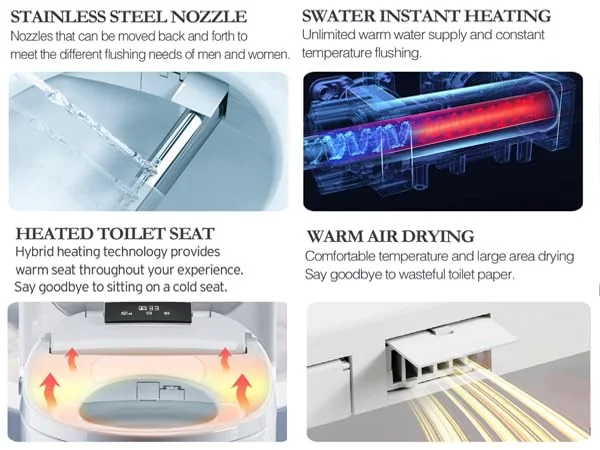
A fixed-stream wash does exactly what the name says: the nozzle holds still and the water hits one point, or a narrow, static spread. You cover the area by shifting your own position slightly, the same way you'd aim a handheld showerhead. An oscillating cleanse instead moves the nozzle itself back and forth in a short sweeping motion during the wash, so the stream travels across a wider area automatically, without you needing to adjust. The XCQQ Electric Bidet Toilet Seat ($169.99) lists this directly in its name — "Rear & Feminine with Oscillating Cleansing" — alongside instant warm water and a warm-air dryer.

Here's the part the "mode" language tends to gloss over: oscillation isn't free. Sweeping the nozzle back and forth requires its own small motor and drive mechanism, separate from the pump that builds water pressure and the motor (if any) that controls nozzle extension and retraction. That's a third moving part added to a seat that, at its simplest, has one. Every additional motor is one more component that can wear, stick, or need a firmware reset years down the line — our guide to bidet seat error codes and blinking lights walks through what a stuck nozzle-motor fault typically looks like on the display, versus a heater fault or a sensor fault. It's also one more moving part that can add a faint mechanical whir to the wash cycle itself, on top of the pump sound — see our pump and dryer noise comparison if a quiet bathroom matters to you, since the oscillation motor is a separate, if usually minor, contributor to the sound a wash makes.

None of that is a reason to avoid oscillating seats. It's a reason to recognize that oscillation is the one upgrade on this list that's mechanically real — not a relabeled dial setting — and to weigh the small added failure point and added sound against the wider, hands-free coverage it provides.

The branding question

DeerValley's "Ultra Hygiene System": the name versus the spec sheet

The DeerValley Elongated Electric Bidet Toilet Seat ($359.00) — the most expensive of the three seats in this comparison — leads with a proprietary-sounding name built directly into the listing title: "Ultra Hygiene System." Names like that are meant to signal a bundled, engineered-together feature set, the way TOTO's PREMIST or EWATER+ branding does on its higher-end seats (our TOTO WASHLET S5 flagship review looks at how that kind of branding does and doesn't translate into a documented spec difference at the top of that lineup).

We looked for a published breakdown of what specifically "Ultra Hygiene System" adds beyond the wash functions already standard on the category — a distinct nozzle-cleaning cycle, a specific UV or electrolyzed-water step, a documented pressure or coverage spec that beats the field. We couldn't find one attached to this listing. That doesn't mean the seat is poorly made or that the name is dishonest; it means the name itself isn't a verifiable spec, and at $359.00 — roughly $120 more than the side-panel multiple-spray-modes seat and $190 more than the XCQQ — the price premium is riding partly on a name we can't independently confirm the engineering behind. If a specific hygiene claim matters to your decision, that's a question worth putting directly to the listing's Q&A section or the seller before paying the premium, rather than assuming the name describes a documented feature.

What actually happens at home

How many modes owners report using after the first month

Week one

Everyone tries everything

The theme that repeats across owner reviews for multi-mode electric seats, as a category: new owners cycle through every preset, every pressure level, and the oscillation setting at least once in the first few days — it's a new remote, and pressing the buttons is part of the appeal.

Month one onward

Settling on two or three

That same pattern of reviews consistently narrows: most households report landing on one pressure level and one or two wash positions — typically rear at a comfortable pressure, feminine occasionally — and leaving the rest of the presets untouched. Oscillation is the one extra setting owners say they keep using past the first month, because it removes a step rather than adding one.

That pattern is worth sitting with before you pay for a longer feature list. A seat advertising five or six named modes isn't lying about having them — it's that most of those modes are combinations of the same pressure-and-position controls a $50 non-electric attachment already gives you by hand, and the household ends up using a small, stable subset once the settings stop feeling new. The number printed on the box describes the ceiling, not the daily habit.

At a glance

The three, side by side

Prices move on Amazon — confirm the live price before buying. Check each listing directly for bowl-fit dimensions.

ModelWash settingPriceWhat decides it
XCQQ Electric Bidet Toilet SeatOscillating cleanse$169.99Real mechanical motion, lowest price of the threePrice
Side Panel, Multiple Spray ModesNamed preset modes$239.99Side-panel control, modes are dial combinationsPrice
DeerValley, Ultra Hygiene SystemBranded system, unverified breakdown$359.00Highest price; name not matched to a documented specPrice
The picks

If you're choosing between these three

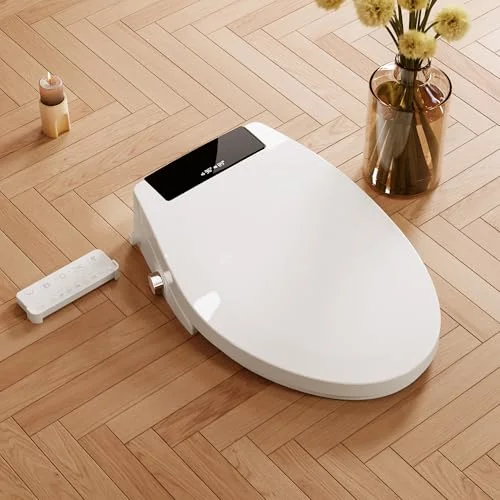
XCQQ electric bidet toilet seat with remote and oscillating cleansing

XCQQ Electric Bidet Toilet Seat with Remote

The one genuinely extra motion, at the lowest price

Instant warm water, a heated seat, a warm-air dryer, rear and feminine wash with oscillating cleansing, a night light, a slow-close lid and an LED display, with remote control — and the one feature on this list that's mechanically distinct from a basic dial. At $169.99 it's also the cheapest of the three, which makes oscillation here look like the better value of the group rather than the "Ultra" branding on the pricier seat. Check the listing directly for bowl-fit dimensions before ordering.

$169.99
Oscillating · remoteCheck price →
Electric bidet toilet seat with side panel and multiple spray modes

Electric Bidet Toilet Seat with Side Panel

If you prefer named presets to remembering a dial setting

Controlled from a side panel rather than a remote, and marketed around "multiple spray modes" as its headline feature. Treat the named modes as a convenience layer over the same pressure-and-position controls every seat in this category has, not as a separate mechanical capability — the side panel itself, not the mode count, is the more useful differentiator if you dislike hunting for a misplaced remote. Check the listing directly for bowl-fit dimensions before ordering.

$239.99
Side panel · modesCheck price →
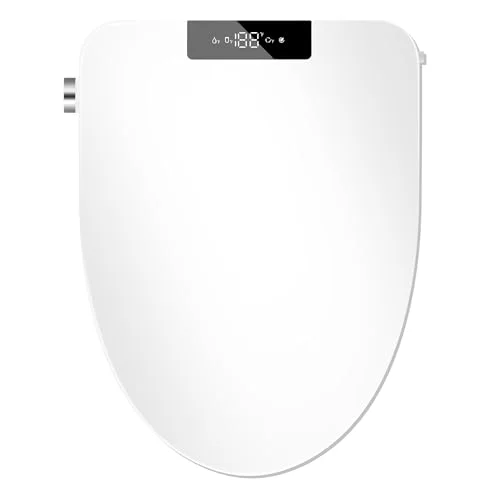
DeerValley elongated electric bidet toilet seat with Ultra Hygiene System branding

DeerValley Elongated Electric Bidet Toilet Seat

If the brand name and price point matter more than a documented spec

The "Ultra Hygiene System" name is the headline of this listing, at $359.00 — the highest price of the three. We could not find a published spec breakdown tying that name to a feature beyond what the other two seats already offer. That's not a defect; it's a reason to read the listing's own Q&A and current reviews closely before paying the premium, rather than assuming the branding describes an engineering difference. Check the listing directly for bowl-fit dimensions before ordering.

$359.00
Branded systemCheck price →
The honest comparison

Does a simple two-setting dial do the same job for less?

For the core hygiene function — a rear wash and a front wash at an adjustable pressure — yes, largely. A basic dial-controlled bidet, electric or not, covers both dimensions that a shopping-cart full of named "modes" is mostly repackaging. If your household's actual daily use turns out to be one pressure level and one position, as it does for most owners within a month according to the review pattern above, the extra modes were a feature you paid for and didn't lean on.

Where the dial genuinely falls short is oscillation, which is a different motion entirely rather than a relabeled setting, and anything an electric seat adds that a manual dial physically can't — heated water, a heated seat, a warm-air dryer, a remote. None of those are "modes" in the marketing sense; they're separate systems, and they're the reasons to go electric at all, dial or no dial. If you're trying to decide how much seat to buy for a household that's genuinely budget-conscious across more than one bathroom, our guide to outfitting a two-bathroom home on a bidet budget runs the same logic against a full house rather than one seat. And if you're weighing whether any extra feature here is worth its added price the way we weighed "Ultra Hygiene System," our look at whether slow-close lids are worth paying for applies nearly the same test to a smaller, cheaper feature.

The honest framing: buy for warm water, a heated seat, and — if hands-free coverage matters to you — oscillation. Don't buy for the mode count on the box. A seat with three honestly useful settings and a documented oscillation motor beats a seat with seven named modes that are three settings wearing different labels.
FAQ

Multiple wash modes: common questions

Is a "wash mode" the same thing as a pressure setting?

Not exactly. A pressure setting adjusts how hard the water sprays. A "mode" is usually a named preset that bundles a pressure level with a nozzle position (rear or feminine) into one button — a labeling convenience over controls a basic dial already provides. The one mode that's mechanically different is oscillation, which moves the nozzle itself during the wash rather than just adjusting pressure or position.

What does oscillating cleanse actually add over a fixed stream?

It sweeps the nozzle back and forth during the wash so the stream covers a wider area automatically, instead of holding one fixed point. That requires its own small motor separate from the water pump, which means one more moving part that can need servicing years down the line, and typically a bit more mechanical sound during the wash cycle.

Is DeerValley's "Ultra Hygiene System" a real documented feature?

It's the name used in the product listing, but we could not find a published spec sheet that ties the name to a specific, verifiable function beyond what's already standard on comparable electric bidet seats. That doesn't make the seat bad — it means the name itself isn't a confirmable spec, and the premium price attached to it is worth weighing against the two lower-priced seats compared here before assuming it buys extra engineering.

How many wash modes do most people actually end up using?

Based on the pattern that repeats across owner reviews in this category, most households settle on one pressure level and one or two wash positions within the first month, plus oscillation if the seat has it — and leave the rest of the named presets unused. The mode count on the box tends to describe the maximum, not the daily habit.

Keep reading

Related guides worth your time