Brand Deep-Dive · 2026
The TUSHY Bidet Attachment Lineup, Reviewed
By Ilane TallUpdated October 19, 2026Research-based
Best Bidet Seats is reader-supported. When you buy through our links we may earn a commission, at no extra cost to you. Commissions never change which products we recommend.
TUSHY built its name on one idea — a bidet attachment that clamps under your existing seat in about twenty minutes, with none of the wiring or GFCI outlet an electric seat demands. What's less obvious from the product pages alone is that TUSHY doesn't sell one version of that idea. It sells three: the Fresh Ultra-Slim Starter at $42.00, the Classic 3.0 at $110.00, and the Spa 3.0 at $127.00. Scroll through the listings quickly and the differences look cosmetic — silver here, brushed nickel there — which is exactly the impression that leads people to either overpay for a finish or underpay and miss the one model that actually does something different.
We compared the published specs and current prices of all three side by side to find where the real differences sit, and where they don't. One honest note before we start: we don't run a testing lab and we didn't install all three ourselves to compare them in person. What follows is a research-based comparison of what TUSHY publishes about each model and what it actually costs to move up the lineup, not a verdict from physically using all three.
Tier one vs tier two
What separates the Starter from the Classic 3.0, beyond the trim
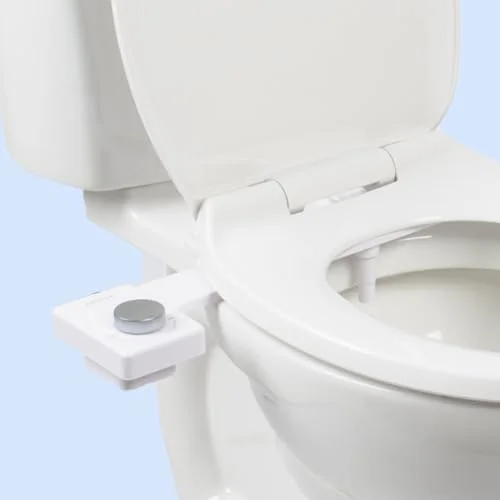
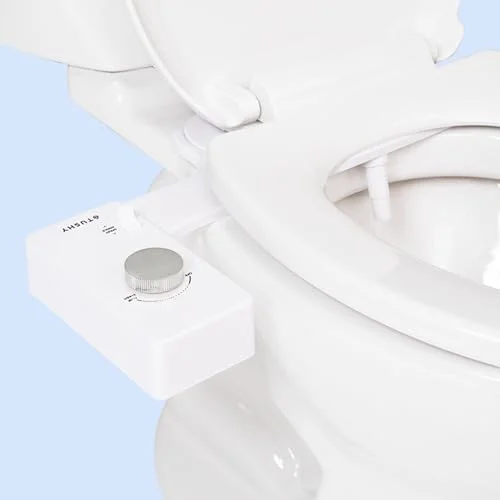
Here's the detail that the listing photos don't make obvious: the Fresh Ultra-Slim Starter and the Classic 3.0 do the same job. Both are non-electric attachments. Both deliver a single cold-water wash controlled by a mechanical dial. Neither has a pump, a heater, or a second nozzle for a separate front wash. If you laid out every published spec for the two side by side, the water they spray and the way you control it would look identical.
What actually separates them is size and material. The Starter earns the "Ultra-Slim" half of its name with the thinnest profile in TUSHY's catalogue — built for exactly the situation where every extra millimeter under the seat matters. The Classic 3.0 is the full-size version of the same dial-and-nozzle mechanism, finished in brushed nickel rather than the Starter's silver. You are paying the $68.00 gap almost entirely for a bigger, nicer-finished housing around an identical cold-water wash — not for an extra feature. That's a real trade-off some buyers will happily make and a lot of buyers would rather skip. If your bathroom is tight on clearance to begin with, the thinner Starter is also the more practical fit, independent of price.
The one real upgrade
Cool-to-warm water is the Spa 3.0's alone — and it needs a sink nearby
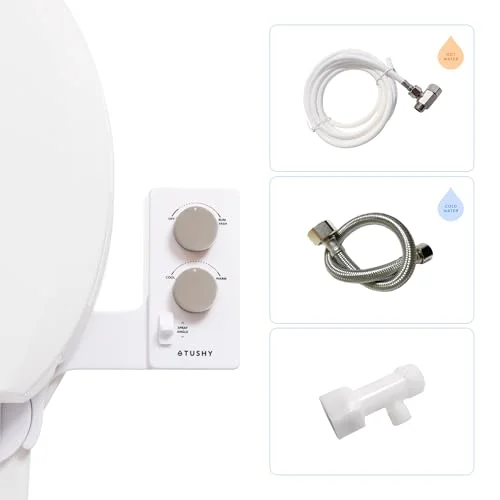
Move up to the Spa 3.0 and the picture changes. This is the only attachment in the three-piece lineup that isn't cold-water-only: it tees a second hose into your bathroom sink's hot-water line and blends it with the cold supply at the dial, letting you turn the wash from cool through to genuinely warm. Nothing about it is electric — no heater, no outlet, no cord — the warmth comes entirely from the hot water already running to your sink.
That mechanism comes with a real installation constraint, not a minor one: the Spa 3.0 has to be installed beside a sink for the second hose to reach the hot line at all. If your toilet and sink aren't close together, or your bathroom's hot-water supply runs somewhere the hose can't practically reach, the warm-water feature simply isn't available to you no matter how much you're willing to pay for it. Measure the distance before you order, not after. On a related note, we've also broken down how other listings phrase their warm-water claims — useful context if you're comparing the Spa 3.0's dial-mixed approach against an electric seat's heater instead.
Not a spec
Brushed nickel versus silver: a finish choice, not a performance one
It's worth saying plainly, because the finish is the first thing you notice in any listing photo: brushed nickel and silver are cosmetic choices in this lineup, not performance tiers. The Starter's silver finish and the Classic 3.0's brushed nickel sit on top of the exact same cold-water-only, single-dial mechanism — paying for nickel buys you hardware that reads less like a bathroom accessory and more like a fixture, and nothing else. The Spa 3.0 also happens to ship in brushed nickel, but don't let that finish do the talking for its price gap — what the Spa 3.0's extra money actually buys is the second hose and the warm-water mixing dial, not the metal it's wrapped in. If you're deciding between the Classic 3.0 and the Spa 3.0, decide on warm water, not on finish; the finish is the same either way.
What installing each one looks like
Installation time across all three — and why none of them need an outlet
Every product in this lineup is a non-electric attachment, which means the installation story starts the same way for all three: there is no GFCI outlet to find, no cord to route, and no electrician to call. You shut off the water at the toilet's existing supply valve, unbolt your current seat, lay the TUSHY attachment plate across the same mounting holes, and bolt the seat back down on top of it before reconnecting the water line. It's hand-tool work — typically a flathead screwdriver is the only tool involved — and it's fully reversible if you ever want your old seat back exactly as it was.
The Starter and the Classic 3.0 follow that single-hose process start to finish, since both are plain cold-water attachments with one supply line to connect. The Spa 3.0 asks for one extra step that the other two don't: routing a second hose from the attachment to your sink's hot-water line, which is also why it has to be installed beside a sink in the first place. That second connection is the only meaningful difference in install complexity across the lineup — everything else about mounting the unit under your seat is identical. If a GFCI outlet near your toilet was ever the thing holding you back from a bidet at all, every model here sidesteps that question entirely; our two-bathroom budget guide gets into what that means once you're outfitting more than one toilet.
The math
Does starting with the Starter and upgrading later actually save money?
It depends entirely on which upgrade you're imagining, and the two paths through this lineup have very different answers.
Starter to Classic 3.0 is not a savings move — it's a finish purchase. Since both deliver the identical cold-water, single-dial wash, "upgrading" from the $42.00 Starter to the $110.00 Classic 3.0 buys you nicer hardware and nothing functional. If you start with the Starter and later decide you want the look of brushed nickel, you'll have spent $42.00 on an attachment you're replacing for appearance alone, then $110.00 on the Classic 3.0 — $152.00 total for the same wash you already had. Buying the Classic 3.0 directly, if you already know you want the finish, is the cheaper route by the full $42.00.
Starter to Spa 3.0 adds a real feature, but it still isn't free. If you start with the $42.00 Starter to confirm you'll actually use a bidet, then later decide you want warm water, you'll pay $42.00 up front and $127.00 for the Spa 3.0 afterward — $169.00 total, which is $42.00 more than buying the Spa 3.0 outright. The only scenario where that math works in your favor is if the Starter doesn't go to waste: move it to a second bathroom, a guest bath, or a rental unit instead of tossing it, and you've effectively paid $42.00 for a second bidet rather than $42.00 for nothing. Our guide to outfitting a two-bathroom home on a bidet budget walks through exactly that kind of multi-toilet math.
So: starting cheap and upgrading later is a reasonable way to test the idea of a bidet at low risk, but it is not a money-saving strategy unless the first attachment keeps earning its place somewhere else in the house. If you already know you want warm water, or you already know you just want the nickel finish, buying that specific model first is the cheaper path every time.