Honest Take · 2026
Which Bidet Seats Actually Have Tankless Instant Heating?
By Ilane TallUpdated October 18, 2026Research-based.
Best Bidet Seats is reader-supported. When you buy through our links we may earn a commission, at no extra cost to you. Commissions never change which products we recommend.
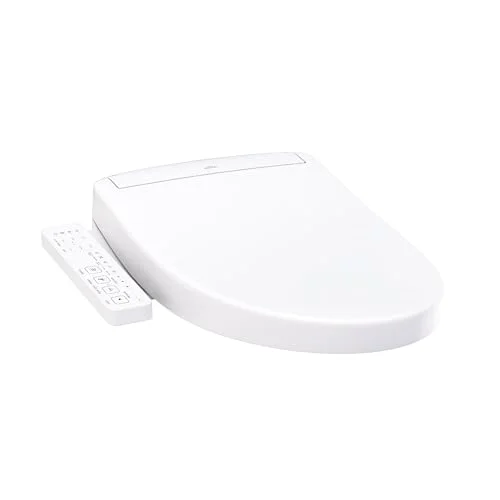
Four listings in our catalogue promise warm water "instantly." Only one of them backs that promise with the word an engineer would actually use. The TOTO WASHLET S2 ($378.00) names its heater "Instantaneous Water Heating" directly in the listing title — a specific, checkable engineering claim about how the mechanism works. The other three — the XCQQ Electric Bidet Toilet Seat ($169.99), the Tadashi Electric Bidet Toilet Seat ($189.99), and an unbranded Bidet Toilet Seat Elongated Heated Electric Seat with Panel ($239.99) — all use the plainer consumer phrase "instant warm water" or "instant water." That phrase describes an experience, not a mechanism, and none of the three titles or spec sheets tells us which mechanism is actually behind it.
That gap — between a word a shopper reads as a promise and a word an engineer would actually stand behind — is the entire subject of this guide. We compared what each of the four listings states, line by line, against the standard engineering distinction between tankless and tank-based water heating that the plumbing and appliance industries have used for decades. We're not going to guess at a mechanism none of the three budget listings names. If a spec isn't given, we say so plainly and move on, the same rule we apply everywhere else on this site.
One honest note before we go further: we don't physically test these seats and we don't run a testing lab. Everything here comes from reading each listing's own stated language closely, against public pricing and the plain engineering meaning of the words involved.
The precise term
What "instantaneous" means in TOTO's own engineering terms
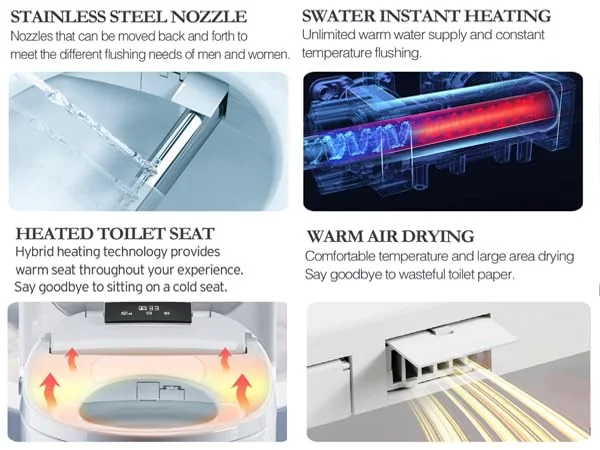
TOTO's listing for the WASHLET S2 doesn't say "instant warm water." It says "Instantaneous Water Heating." That's not a stylistic choice — it's the same term the water-heater industry has used for decades to describe a tankless design: a heating element sits right at the point of use and raises the temperature of water as it flows past, on demand, with nothing held in reserve. There's no tank to run dry, because there's no tank in the first place. The amount of warm water available is limited only by how long the wash runs, not by how much was pre-heated and stored ahead of time.
This is the same mechanical distinction our WASHLET S5 flagship review gets into when weighing TOTO's pricier model against the S2: TOTO is consistent across its own lineup about naming the heater type precisely, rather than leaning on a softer word that could describe either approach. When a listing commits to the specific engineering term, that's a stronger, more checkable claim than a listing that uses a looser synonym — and it's the main reason we can say, with the confidence the title of this guide claims, that the WASHLET S2 is genuinely tankless rather than merely fast.
The honest middle ground
How a fast-recovering tank can still advertise "instant warm water" honestly enough
A tank-based, or reservoir, heater works completely differently, and it isn't automatically a lesser or dishonest design. It keeps a small supply of water warm and ready inside the seat at all times, heated ahead of your arrival rather than on demand. From a cold start — the first wash of the morning, or any wash with enough gap since the last one — the water really is warm the instant the spray starts, because the heater already did its work minutes or hours earlier. For a single person using the seat occasionally through the day, with time between each use for the tank to fully recover, "instant warm water" describes that experience accurately. The phrase isn't the problem; the mechanism behind it just isn't the one some shoppers assume from the word alone.
Where the phrase gets strained isn't a single, well-spaced use — it's repeated or back-to-back use, which is exactly where a reservoir's limits show up and a true instantaneous heater's don't. That's the actual, checkable difference worth caring about, and it's covered in full further down this page.
Reading each listing closely
Where the three budget listings' claims hold up, and where they're really about recovery speed
We read all three budget titles and spec sheets the same way we read TOTO's: looking for the specific mechanism word, not just the marketing adjective. Here's exactly what each one does and doesn't say.
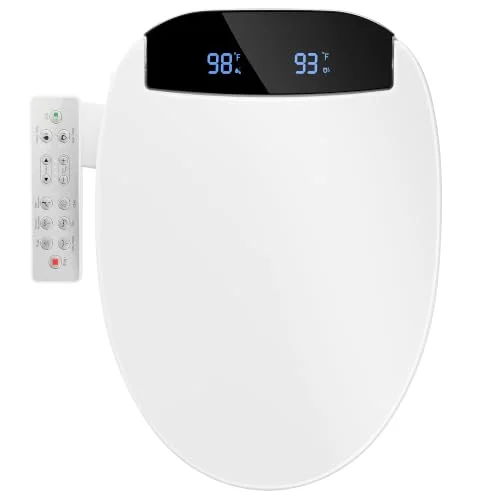
The XCQQ Electric Bidet Toilet Seat ($169.99) states "Instant Warm Water" in its title, alongside a warm air dryer, oscillating rear and feminine wash, a night light, a slow-close lid and an LED display. "Elongated" appears in the product's own title as a fit descriptor, but we have no separate size/variant line on file for this one, so treat that word as the listing's own claim rather than a dimension to measure against — check the listing directly before ordering if exact fit matters. Nothing in the title or the data we have names a heater mechanism, tank or tankless. The claim holds up exactly as far as "the water will feel warm when you use it" and no further.
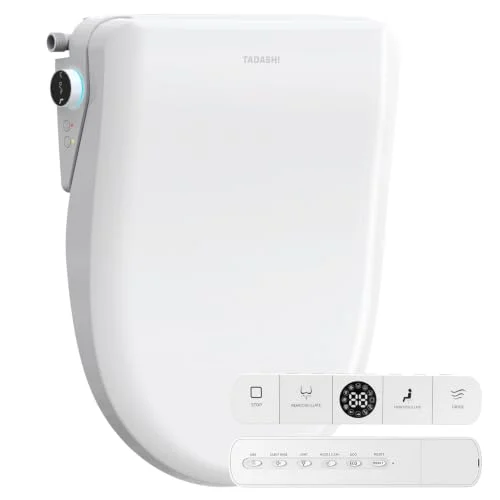
The Tadashi Electric Bidet Toilet Seat ($189.99) also says "Instant Warm Water," alongside a wireless remote and side panel, feminine and rear wash, a self-cleaning nozzle, an adjustable heated seat, an air dryer and a slow-close lid. We do have a size/variant line for this one — 20 inches by 14.7 inches — which is a footprint, not a bowl-shape claim; measure your own toilet against those two numbers rather than assuming round or elongated from the title. As with the XCQQ seat, no heater mechanism is named anywhere in the listing data we have, so the "instant" claim is, on paper, identical in scope: a promise about the result, not the method.
The unbranded Bidet Toilet Seat Elongated Heated Electric Seat with Panel Instant Water ($239.99) is the priciest of the three budget seats and the most literal about fit — "Elongated" is given as its size/variant, so that's the one of the three we can state with confidence rather than inferring from a title alone. Its title names a side panel and "Instant Water," again with no mechanism specified. At nearly $70 more than the XCQQ seat and roughly $60 more than the Tadashi, the higher price doesn't buy a more specific heating claim — just a different control layout and a higher number on the tag.
Across all three, the pattern is consistent: a real, usable feature — warm water that's ready when you want it — described with a word that could honestly mean either a genuine tankless system or a well-designed tank that recovers between uses. We're not willing to guess which, because the listings themselves don't say, and guessing would be exactly the kind of invented spec we don't publish.
The practical check
Back-to-back use: the test that actually separates tankless from tanked
There is one honest, no-lab way to tell which kind of heater is actually inside a seat you already own, or to know what to expect from one you're about to buy: use it twice in quick succession and pay attention to the second wash. A genuinely instantaneous heater, like the one TOTO names on the WASHLET S2, heats water on demand every single time, so the second wash arrives at the same temperature as the first no matter how little time separated them. A tank-based heater draws down its warm reserve on the first use and needs a recovery window — typically a couple of minutes, though the exact figure isn't something any of these three budget listings states — to bring that reservoir back up to temperature. Run it again before that window closes and the second wash will measurably run cooler than the first.
This is the scenario that matters most for a household where more than one person uses the bidet seat within a short span — one person right after another in a shared morning bathroom, or the same person using it twice in a row. A single, well-spaced use per sitting will feel "instant" on either type of heater. Repeated or back-to-back use is where the word stops being a safe synonym for "tankless" and starts actually testing the mechanism underneath it.
If you already own one of the three budget seats here, the test costs nothing: use it, wait roughly sixty to ninety seconds, use it again, and compare how the second wash feels against the first. If you're deciding between the budget seats and the WASHLET S2 before buying, that same back-to-back scenario — not a single morning use — is the one to imagine honestly for your own household before deciding whether the extra cost is worth it. Our guide to "unlimited warm water" claims runs through a closely related version of this same test for a different listing's wording.
The decision
Whether tankless is worth the price gap for a typical household
The honest math here is a roughly $180 to $250 premium for the WASHLET S2's named tankless heater over the three budget seats, which don't name a heater type at all. Whether that premium is worth paying depends entirely on how your household actually uses the seat, not on which word sounds more impressive.
If you're outfitting a single-occupant or lightly used bathroom — a guest bath, a home office half-bath, or a household where the seat sees spaced-out, one-at-a-time use — a reservoir-style heater, whichever of the three budget seats you choose, is very unlikely to ever hit the recovery-window limit that makes "instant" feel inaccurate. In that case, the extra $180 to $250 buys certainty about a scenario you'll rarely or never encounter. Our guide to outfitting a two-bathroom home on a bidet budget walks through exactly this kind of room-by-room allocation.
If your household regularly uses the bidet back-to-back — a family's morning routine, multiple people sharing one bathroom, or simply a household that doesn't want to think about timing a second use — the WASHLET S2's named tankless heater removes the variable entirely, and the premium buys a real, checkable guarantee rather than a hope. It's also worth noting that a tankless heater draws meaningfully more power in short bursts than a small reservoir does, which is part of why it costs more to build in the first place; if dryer and pump noise factor into your decision alongside heating, our pump and dryer noise guide covers what that extra hardware sounds like in daily use.
There's no universal right answer here, and we're not going to pretend there is one. What we can say honestly is that only one of these four listings has told you, in its own words, which mechanism you're paying for. The other three are asking you to trust a word that's accurate often enough — just not guaranteed to mean what you might assume it means.