Comparison · 2026
Hibbent vs LUXE NEO 120: The Two Cheapest Bidet Attachments, $12 Apart
By Ilane TallUpdated November 9, 2026Research-based
Best Bidet Seats is reader-supported. When you buy through our links we may earn a commission, at no extra cost to you. Commissions never change which products we recommend.
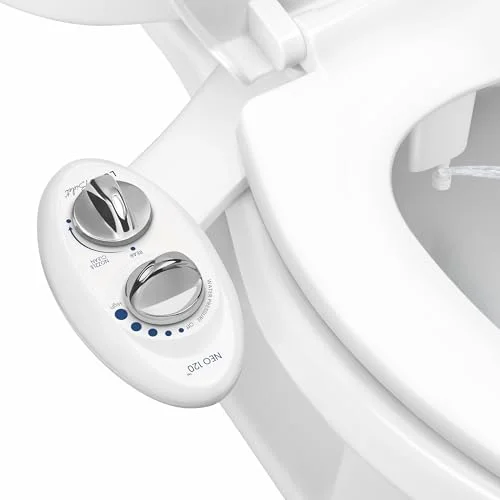
Scroll to the bottom of any "bidet attachments under $50" search and you'll land on the same two names: Hibbent's dual-nozzle attachment and LUXE Bidet's NEO 120. They're the floor of the category — the two cheapest non-electric attachments we track for this site — and on paper they look like they should be nearly identical. They aren't. Hibbent gives you two nozzles for frontal and rear wash; the NEO 120 gives you one, and asks more money for it. That's the kind of gap that's easy to miss if you're skimming product titles and just sorting by price.
We lined the two up spec against spec, then brought in Bio Bidet's SlimEdge — a step above both at $44.00 — to see what a bigger budget actually buys once you're past the entry tier. The short version: the cheaper of these two cheap attachments isn't the one giving anything up. The more expensive one is. We'll walk through exactly where, and whether that makes the priciest option here, the SlimEdge, worth the extra money too.
One honest note before we get into it: we don't own these three attachments, and we don't run a testing lab. What follows is built from the manufacturers' published specifications, current Amazon pricing, and the pattern across public buyer reviews, with no physical unit in front of us. Where a spec isn't published, we say so instead of guessing.
The gap
What ten (or twelve) dollars actually buys here
The headline math moves depending on when you check it, which is itself worth saying plainly: Amazon repricing is constant, and the gap that first caught our eye — Hibbent at $27.69 against the NEO 120's $39.99, a $12.30 spread — had narrowed to $10.00 by the time we rechecked prices for this piece, with Hibbent listed at $29.99. Confirm the live price before you buy either one; the point we're making doesn't depend on the exact figure, just on the direction of it.
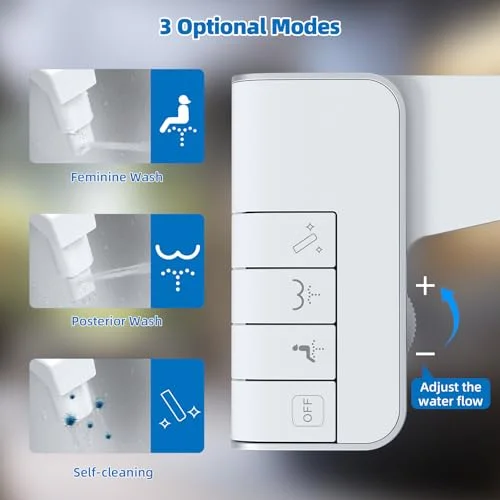
And the direction is the interesting part. Normally, paying more for a bidet attachment buys you something: a second nozzle, a sturdier valve, a longer hose, a bigger brand's support line. Here, the cheaper attachment is the one with the longer feature list. Hibbent's listing specifies dual nozzles for frontal and rear wash, adjustable water pressure control, and a self-cleaning sprayer — all at the lower price. LUXE's NEO 120 listing, at the higher price, specifies a single nozzle. If you're buying on spec sheet alone, the ten-to-twelve-dollar gap runs backward from what you'd expect.
That's not a knock on LUXE as a brand — the company also sells attachments with more nozzles and more features at higher price points, like the dual-nozzle NEO 185 we recommend elsewhere on this site. It's specifically a note on the NEO 120 as the particular model sitting at this price, next to this particular competitor. Price inside one product line, and price across two different brands' cheapest models, aren't answering the same question — and in this match-up, the second one is what matters.
One wand or two
Dual nozzle vs. single adjustable nozzle
A non-electric attachment's nozzle setup is most of what you're actually paying for — there's no heater or pump to speak of, just a valve body, a hose, and whatever is pointed at the water once it arrives (more on that in a moment). Hibbent's attachment runs two separate nozzles: one positioned for a rear wash and one for a frontal wash, each with its own water path, plus a dial for adjustable water pressure so you can tune the spray before it reaches either one. Two nozzles on an attachment this cheap is unusual — most sub-$30 attachments we track in this database settle for one.
LUXE's NEO 120, at the higher price, is built around a single nozzle that you adjust directly rather than switching between two dedicated ones. In practice that means one wash position to work with instead of two, and whatever pressure and placement that one nozzle allows has to cover both uses. It's a simpler mechanism — fewer moving parts behind the panel — but it's also objectively less than what Hibbent includes for less money.
Neither company publishes a water pressure range in PSI for these two specific listings, so we won't invent one; what we can say with confidence, because it's stated directly on the product, is that Hibbent's pressure control is adjustable and dedicated to each of its two nozzles, while the NEO 120 asks one nozzle to do both jobs. If a frontal wash option matters to you — and for a meaningful share of bidet attachment buyers, it's the main reason to own one at all — that single difference should settle the comparison before price even enters the conversation.
What "self-cleaning" means with no motor
Self-cleaning claims, and why neither one needs a pump or a heater to make them
Hibbent markets its attachment specifically as having a "self-cleaning water sprayer," and it's worth being precise about what that phrase can and can't mean on a product with no pump, no reservoir and no electronics anywhere in it. These three attachments all run on nothing but your toilet's existing supply-line pressure — turn the dial, water flows through the nozzle, the dial closes, the nozzle retracts. There's no motor circulating water and no heating element anywhere in the loop. "Self-cleaning" on a non-electric attachment describes the nozzle rinsing itself with a quick burst of the same supply water just before it withdraws behind its guard, not a separate cleaning cycle, UV light, or sanitizing agent. It's a genuinely useful mechanical feature — it means the nozzle isn't sitting exposed between uses — but it's doing a smaller job than the phrase might suggest to someone picturing an appliance with a self-clean button.
LUXE doesn't use the phrase "self-cleaning" on the NEO 120's own listing, and we're not going to assume it behaves identically to a product that does make the claim just because the two are mechanically similar as a category. What we can say generically, because it's true of every attachment of this type regardless of brand, is that a nozzle with no self-retracting mechanism sits exposed to the bowl environment between uses, while one that retracts behind a gate — whether or not the manufacturer calls that "self-cleaning" — stays more protected. If that specific mechanism matters to you, check the current NEO 120 listing's own description and photos rather than assuming either way from this comparison.
The broader point holds across all three products here: none of them need a pump to "clean" a nozzle, because none of them are cleaning anything beyond a rinse with the water that's already flowing. That's a fair trade for the price — a $30–$46 attachment isn't going to out-engineer a $300 electric seat's dedicated cleaning cycle, and it isn't trying to.
The step up
Where Bio Bidet's SlimEdge fits above both
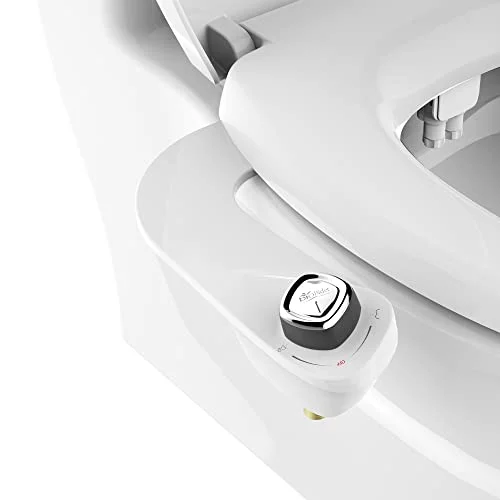
Bio Bidet's SlimEdge lists at $44.00 — a $16 premium over Hibbent and a $6 premium over the NEO 120 — and for that money it brings back the second nozzle the NEO 120 dropped. The SlimEdge's listing specifies dual nozzles for front and rear cold water wash, non-electric, with adjustable water pressure, putting its core feature set closer to Hibbent's than to LUXE's. The size/variant data we have for it lists simply as "1 Pack," with no bowl-shape dimensions published, so we won't claim it fits any particular toilet shape beyond what Bio Bidet states on its own listing — check that before ordering, the same as you should for any attachment.
So what does the extra $16 over Hibbent actually buy, if the nozzle count is the same? Mostly brand. Bio Bidet has sold non-electric and electric bidet products in the US for longer than either of the other two names here, which matters if you weight a more established support line and parts availability over saving the difference — a consideration we've raised for electric seats on this site too, and one that applies with lower stakes, but the same logic, to a $46 attachment. If you're simply comparing feature for feature at the lowest price, Hibbent gets you there for less. If you'd rather have the more recognizable name behind an otherwise similar mechanism, the SlimEdge is the one to pay up for — not the NEO 120, which costs more than Hibbent without matching either Hibbent's or the SlimEdge's nozzle count.
The decision
So is the cheapest option actually the better buy?
In this specific match-up, yes — and it's worth sitting with how unusual that is. Across most of the comparisons on this site, the pricier item earns its premium with something concrete: a hybrid heater, a second valve, a name with a longer warranty. Here, the pricier of the two cheapest attachments is the one with the shorter feature list. Hibbent's dual nozzle and adjustable pressure, at the lower price, aren't a discount version of what the NEO 120 offers — they're simply more than the NEO 120 offers, for less. If price and spec sheet are the only two things you're weighing, there isn't a case for the NEO 120 over Hibbent at these numbers.
Where a reasonable buyer might still choose the more expensive option is brand confidence, and that's a legitimate reason even when the spec sheet says otherwise — it's just a different question than "which is the better buy." If that's the deciding factor for you, the honest answer isn't the NEO 120 either; it's stepping up further to the Bio Bidet SlimEdge at $44.00, which gives you Hibbent's dual-nozzle layout alongside a name that's been selling bidet hardware in the US for longer. Pay the premium for the brand, not for a lesser version of the cheaper attachment's feature set.
And if you're simply trying to spend as little as possible on a working non-electric attachment, the Hibbent is the one to order. It's not a compromise pick at this price point — on the numbers we have, it's simply the better-specified product of the three, and it happens to be the cheapest one too. For context on what you'd be stepping up to if you ever want more than an attachment, our guide to whether a bidet seat voids your toilet's warranty and our roundup of three overlooked bidet seats under $190 are good next stops.