Comparison · 2026
XCQQ's Two Bidet Seats: Wireless Remote vs Side-Mounted Panel, $20 Apart
By Ilane TallUpdated November 3, 2026Research-based
Best Bidet Seats is reader-supported. When you buy through our links we may earn a commission, at no extra cost to you. Commissions never change which products we recommend.
XCQQ sells two electric bidet seats that read, at a glance, like the same product listed twice. Both are elongated, both heat the seat, both heat water on demand, both dry with warm air, both wash front and rear with an oscillating mode, both have a slow-close lid, an LED display and a night light. Scroll past the headline bullets and the difference that actually separates them is how you tell the seat what to do: one ships with a handheld wireless remote, the other builds the controls into a panel bolted to the side of the seat itself. The remote model lists at $169.99. The side-panel model lists at $189.99 — twenty dollars more for what is, on paper, a less complex part.
That's the question worth answering before either model goes in a cart: what does the layout actually change about using the thing every day, and is the $20 premium buying anything beyond a different control surface? We compared the two listings line by line — what each one claims, what it leaves out, and where the control method itself creates a real practical difference rather than a cosmetic one. One honest note first: we don't run a testing lab and didn't install either seat ourselves. Everything below comes from the published listings, the spec sheets each brand provides, and what we can responsibly infer about how a remote versus a fixed panel behaves in daily use. Where a listing doesn't give us a number, we say so instead of guessing.
Day to day
What each control layout actually looks like to use
On the remote model (B0DDC63M1G), the controls live on a small handheld unit, the kind with a row of buttons for wash position, pressure, seat heat, water temperature and the dryer. The listing doesn't specify whether it's wired or wireless beyond calling it a remote, so we're not going to assert a range or a battery type the listing doesn't give us — check the current listing for that detail before you buy if it matters to you. What a remote changes in practice is simple: the controls go wherever you put them. Mount the included holster to the wall beside the toilet and it behaves like a fixed panel with better reach. Leave it loose on the tank lid and it behaves like every other small household remote — sometimes exactly where you left it, sometimes not.
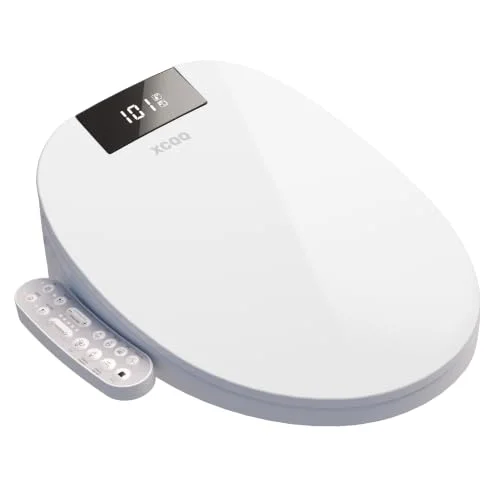
On the side-panel model (B0HFR1VSPW, XCQQ calls it the K7L), the same functions sit on a control panel mounted directly to the right side of the seat, within arm's reach the moment you sit down. There's nothing to pick up, nothing to aim, nothing to find in the dark — though the listing credits the night light for that last part on both models. The tradeoff is physical: the panel is fixed at seat height, which means leaning or reaching down rather than holding a remote at a comfortable height, and anyone who wants to pre-set the wash before sitting down loses that option entirely, since the panel isn't reachable until you're already seated.
Reviewers of side-panel bidet seats in general tend to describe the layout as "intuitive once you learn it" — the panel is in the same spot every time, so muscle memory takes over fast. Reviewers of remote-based seats tend to describe the opposite trade: more flexible placement, but a flatter learning curve only if the remote stays where it's supposed to.
What doesn't change
The feature list that's identical on both
It's worth being precise about how much these two seats share, because the overlap is the whole reason the comparison is interesting. Both listings name the same core set:
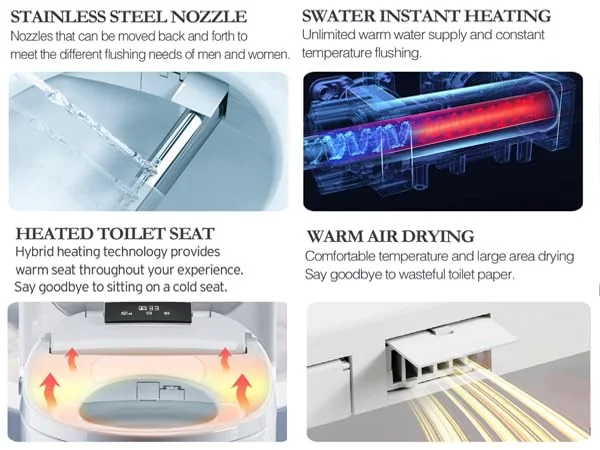
- Heated seat — both listings call out a heated seat as a standard feature, with no separate temperature spec given for either.
- Instant/warm water wash — both are described as warm-water electric bidets with rear and feminine (front) wash; the remote model's listing additionally calls out oscillating cleansing.
- Warm air dryer — both include a warm-air drying function as a standard mode, not an add-on.
- Slow-close lid — both lids are specified as slow-close, so neither one bangs down.
- LED display — both have an LED display for status and settings feedback.
- Night light — both include a built-in night light; the K7L's listing additionally names a PSM (power-save mode) setting that the remote model's listing doesn't call out.
- Elongated fit — both are elongated-bowl seats. Neither listing offers a round-bowl version under this spec sheet, so if your toilet is round, neither of these two is the one to buy — check a different listing instead of assuming either stretches to fit.
In other words, nearly everything a household actually uses a bidet seat for — warm water, a warm seat, a dryer, a lid that doesn't wake the house at 2 a.m. — is identical on both models. The $20 gap is not buying a better wash or a warmer seat. It's buying a different way to reach the controls, plus whatever small manufacturing cost difference comes with building a control panel into the seat shell instead of shipping it as a separate handheld unit.
Where the money goes
What the extra $20 is actually paying for
Neither listing itemizes cost the way a spec sheet might, so we're reasoning from what each product physically is rather than from a stated breakdown XCQQ doesn't provide. A handheld remote is a separate molded unit with its own buttons, its own internal wiring or pairing hardware, and its own holster — it's an extra manufactured part, which is usually what makes remote-equipped appliances cheaper to add to a base seat, not more expensive, since the remote itself tends to be a commodity component shared across product lines. A side-mounted panel, by contrast, has to be integrated into the seat's shell: the buttons, the wiring harness and the LED display all have to be built into the one-piece housing rather than bolted on as an accessory.
That's the most plausible honest explanation for the $20 gap running the direction it does — toward the panel, not the remote: integrating a control panel into a molded seat shell is generally a more involved manufacturing step than packaging a second handheld unit. It's also possible the $20 simply reflects XCQQ's own pricing strategy for the K7L line rather than a precise cost pass-through — neither listing says, and we're not going to pretend either brand published a bill of materials. What we can say with confidence is that the $20 is not buying an extra wash mode, a hotter seat or a stronger dryer — those are identical on the feature lists both brands publish.
The real risk
Battery life and the thing a remote can do that a panel can't: disappear
This is where the two models genuinely diverge in a way that matters for some households and not at all for others. A handheld remote on an electric bidet seat is powered by its own small battery, separate from the seat's main power, and that battery eventually needs replacing — neither listing specifies the remote's battery type or expected life, so budget for an eventual swap rather than treating it as maintenance-free forever. A fixed side panel draws its power straight from the seat's own electrical connection, the same wall outlet that runs the heater and the pump, so there's no second battery to track and nothing with its own independent power cycle to fail.
The bigger practical risk isn't the battery, though — it's the remote itself. A handheld control is, by definition, a loose object in a bathroom: something a toddler can drop in the bowl, something that slides behind the tank, something that ends up in a junk drawer during a cleaning spree and stays lost for a week. A side-mounted panel physically cannot be misplaced, because it's bolted to the seat. If your household already has a drawer full of orphaned TV remotes, garage door openers and the backup key fob nobody can find, that's a legitimate, non-trivial reason to pay the $20 premium for a panel that's permanently attached rather than a remote that joins the pile.
The flip side is real too: a remote lets you pre-arm a setting before you sit down, lets a household member with limited mobility operate the seat from a wall-mounted holster at a comfortable height instead of reaching down to seat level, and can simply be more comfortable to hold than leaning sideways toward a fixed panel. Neither control method is objectively better — they fail differently and they suit different people differently.
The decision
So which should you buy?
Buy the remote model if the $20 matters, if you want the option to operate the seat from a wall-mounted holster at standing height rather than reaching down to the seat, or if someone in the house has limited mobility and would genuinely benefit from a control they can hold rather than lean toward. Just budget mentally for an eventual remote battery swap, and accept that a handheld object in a bathroom is a handheld object that can walk off.
Buy the K7L with the side panel if your household already loses remotes — the TV remote, the garage opener, the thermostat fob — as a matter of established pattern. Twenty dollars to permanently solve that one specific failure mode, on a part you'll use multiple times a day for years, is a reasonable trade for a lot of households. It's a smaller win if you live alone and are simply careful with small objects; in that case the remote model gets you the identical wash, heat and dryer for less.
If you're still deciding between electric and non-electric altogether before you even get to control layout, our guide on whether a bidet seat voids your toilet's warranty and our breakdown of round vs elongated pricing are both worth a read first — this comparison assumes you've already settled on an elongated electric seat and are choosing between these two specifically.